

China’s Space Program Soars-Explore China’s latest space triumphs in 2026, from Shenzhou-20’s empty landing after Tiangong repairs to iSpace’s Hyperbola-3 factory and Galactic Energy’s Ceres launches. Dive into reusable tech breakthroughs driving satellite constellations and cost reductions.

China’s Space Program Soars: Unstoppable Rise in Space Exploration
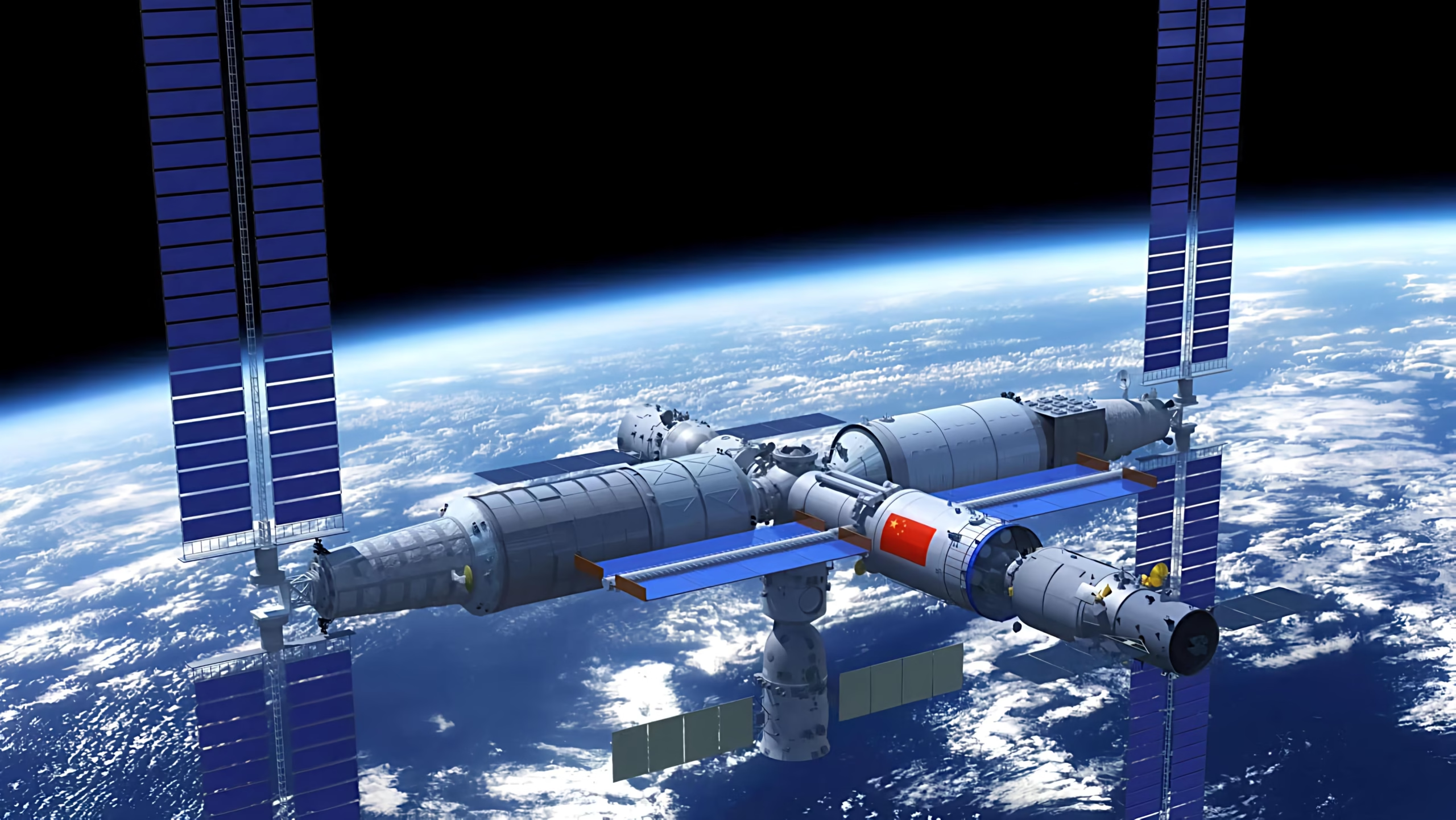
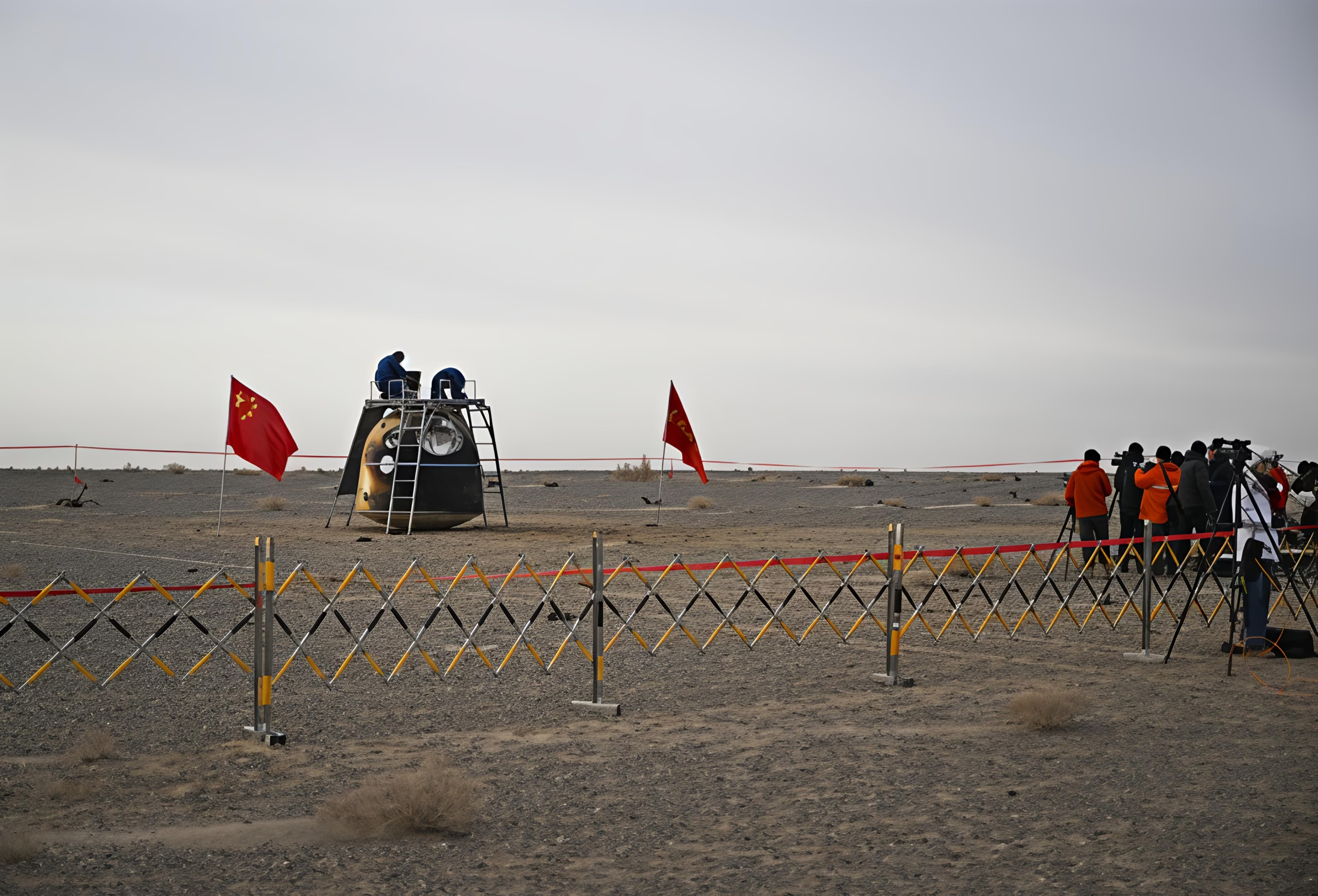
In the ever-evolving landscape of global space exploration, China’s space program soars and continues to make headlines with its ambitious programs and rapid advancements. As we step into 2026, the nation’s space agency and private sector players are pushing boundaries like never before. Just yesterday, on January 19, the Shenzhou-20 spacecraft made a successful but empty landing in Inner Mongolia, marking a significant milestone in reusable technology testing after completing repairs on the Tiangong space station.
This event, coupled with announcements from private companies like iSpace and Galactic Energy, underscores China’s commitment to becoming a dominant force in space. In this article, we’ll delve into these developments, explore their implications, and look at the bigger picture of China’s space strategy. Whether you’re a space enthusiast or just curious about the future of human spaceflight, these updates highlight why China is a key player to watch.
China’s space program, managed primarily by the China National Space Administration (CNSA), has grown exponentially since the early 2000s. From the first manned mission in 2003 with Shenzhou-5 to the operational Tiangong space station, the country has achieved what many thought impossible in such a short time. Now, with private enterprises entering the fray, innovation is accelerating. The Shenzhou-20 mission is a prime example of this progress, focusing not just on crewed flights but on sustainability and reusability—concepts that could revolutionize space travel.
Shenzhou-20: A Successful Empty Landing and Reusable Tech Breakthroughs
The Shenzhou-20 spacecraft’s return has captured international attention for good reason. Launched as part of China’s ongoing efforts to maintain and upgrade the Tiangong space station, this mission was unique in that it returned empty. After docking with Tiangong, the spacecraft facilitated critical repairs, including system upgrades and module maintenance. These operations are essential for extending the station’s lifespan, which has been in orbit since 2021 and serves as a hub for scientific research, international collaboration, and future deep-space missions.
Touching down in the vast deserts of Inner Mongolia on January 19, 2026, the landing was flawless, demonstrating the reliability of China’s reentry technology. But why empty? This was a deliberate test of reusable components. Unlike previous missions where crew members returned, Shenzhou-20 carried cargo and automated systems designed to simulate human presence while prioritizing the recovery of the spacecraft itself. CNSA officials have stated that this approach allows for rigorous testing of heat shields, propulsion systems, and structural integrity without risking lives. The data collected will inform future iterations, potentially reducing costs by up to 50% through reusability.
Reusable technology is the holy grail of spaceflight, popularized by companies like SpaceX. China’s Space Program Soars is catching up fast. The Shenzhou series has evolved from single-use vehicles to ones incorporating partial reusability, such as recoverable capsules and engines. In Shenzhou-20, engineers tested new materials for the ablative heat shield, which withstands the intense friction of atmospheric reentry. Early reports suggest the shield performed beyond expectations, showing minimal wear. This could pave the way for more frequent missions to Tiangong, supporting China’s goal of a permanent human presence in low Earth orbit.

Moreover, the mission highlights Tiangong’s role as a versatile platform. Repairs included fixing solar panels and enhancing life support systems, ensuring the station can host larger crews for longer durations. With plans for expansions like additional modules, Tiangong is set to rival the International Space Station (ISS), which is slated for decommissioning around 2030. China’s independent approach avoids the geopolitical tensions affecting the ISS, allowing for collaborations on its terms—such as with countries in the Belt and Road Initiative.
The success of Shenzhou-20 isn’t just technical; it’s strategic. By mastering reusability, China reduces dependency on expendable rockets, lowering launch costs and enabling more ambitious projects like lunar bases and Mars missions. Analysts predict that by 2030, reusable tech could make China the leader in commercial space services.
iSpace’s Bold Move: New Factory for Hyperbola-3 Rockets
Shifting gears to the private sector, iSpace—officially known as Beijing Interstellar Glory Space Technology Ltd.—has announced a groundbreaking development. The company is building a new factory in Chengdu, Sichuan Province, dedicated to mass-producing its reusable Hyperbola-3 rockets. Set to be operational by the end of 2026, this facility aims to churn out rockets at a scale unprecedented for a private Chinese firm.
iSpace has been a rising star since its founding in 2016, focusing on liquid-fueled rockets for small to medium payloads. The Hyperbola-3 is their flagship reusable model, capable of lifting up to 8 tons to low Earth orbit. What sets it apart is its first-stage reusability, similar to Falcon 9, with vertical landing capabilities. The new factory will incorporate advanced manufacturing techniques, including 3D printing for engine components and automated assembly lines, to produce dozens of rockets annually.
The primary goal? Cutting costs for satellite constellations. With the global demand for low-Earth orbit satellites exploding—think Starlink or China’s own Guowang network—affordable launches are crucial. iSpace claims the Hyperbola-3 could reduce per-kilogram launch costs to under $5,000, a fraction of traditional prices. This is achieved through reusability: each first stage could fly up to 10 times with minimal refurbishment.
Chengdu was chosen for its strategic location, with access to talent from nearby universities and proximity to supply chains. The factory will create thousands of jobs, boosting the local economy and positioning Sichuan as a space hub. iSpace’s CEO has emphasized sustainability, with plans to use methane-based engines that produce fewer emissions than traditional kerosene fuels.
This announcement comes amid a boom in China’s private space industry, often called the “Chinese SpaceX” era as China’s Space Program Soars . Companies like iSpace are benefiting from government policies that encourage commercialization, including subsidies and relaxed regulations. By mass-producing Hyperbola-3, iSpace isn’t just competing domestically but eyeing international markets, particularly in developing countries seeking affordable access to space.
Galactic Energy’s Mixed Fortunes: Ceres-1S Success and Ceres-2 Setback
Another key player, Galactic Energy, has had a rollercoaster week. The Beijing-based startup reported a successful launch of its Ceres-1S rocket, deploying several satellites into orbit. The Ceres-1S, a solid-fueled small-lift vehicle, is designed for rapid, low-cost missions, making it ideal for constellations and scientific payloads.
However, the celebrations were short-lived. The company also disclosed a failure with the Ceres-2, an upgraded version intended for larger payloads. During a test flight, an anomaly in the second stage led to the loss of the rocket. While no payloads were aboard, the incident highlights the challenges of scaling up technology.
Galactic Energy, founded in 2018, has completed multiple successful launches with Ceres-1 variants, establishing itself as a reliable provider for commercial clients. The Ceres-1S success involved placing Earth observation satellites for a domestic firm, demonstrating precision and reliability. Engineers attribute the win to improved guidance systems and propellant efficiency.
The Ceres-2 failure, though disappointing, is seen as a learning opportunity. Preliminary investigations point to a propulsion issue, and the company has pledged a thorough review. In the high-stakes world of rocketry, failures are common—SpaceX had numerous early setbacks before mastering reusability. Galactic Energy’s transparency in reporting the incident builds trust and could lead to stronger designs.
China’s Space Program Soars: these events reflect the vibrancy of China’s private space sector. With over 100 startups, competition is fierce, driving innovation. Galactic Energy’s focus on solid rockets complements iSpace’s liquid-fueled approach, offering diverse options for customers.
The Broader Context: China’s Space Ambitions in 2026 and Beyond
China’s Space Program Soars: these developments don’t exist in isolation. China’s space program is a multifaceted endeavor, blending government-led initiatives with private innovation. The Tiangong station is central, hosting experiments in microgravity biology, materials science, and astronomy. International astronauts have visited, signaling China’s openness to partnerships despite U.S. restrictions like the Wolf Amendment.
On the lunar front, the Chang’e program continues with plans for sample returns and a research station by 2030. Mars missions, including the Tianwen series, aim for rover deployments and eventual human exploration. Reusable tech from Shenzhou-20 will support these, reducing costs and increasing frequency.
Private companies like iSpace and Galactic Energy are crucial for commercialization. China’s satellite constellation projects, such as the 13,000-satellite Guowang, rival Starlink and require cheap, reliable launches. By fostering a “space economy,” China aims to generate billions in revenue from services like remote sensing and telecommunications.
Challenges remain: technological hurdles, international scrutiny over dual-use tech, and environmental concerns. Yet, China’s integrated approach—combining state resources with entrepreneurial spirit—positions it for leadership.
Looking ahead, 2026 could se⁷e more milestones, like crewed Tiangong rotations and private orbital flights. As reusable tech matures, space access democratizes, benefiting global science and economy.
Conclusion: A New Era for China’s Space Program Soars
From Shenzhou-20’s empty but triumphant return to iSpace’s factory ambitions and Galactic Energy’s launches, China’s space program is firing on all cylinders. These advancements not only showcase technical prowess but also strategic foresight in building a sustainable space presence. As we watch these stories unfold, one thing is clear: China’s stars are aligning for even greater heights.
Source: https://x.com/i/status/2013140716227358884
https://x.com/i/status/2013037731769708637
FAQs: China’s Space Program Soars
What was the purpose of the Shenzhou-20 mission?
The Shenzhou-20 mission focused on repairs and upgrades to the Tiangong space station, with a key emphasis on testing reusable spacecraft technology. It returned empty to prioritize component recovery and data analysis.
Why did Shenzhou-20 land empty?
The empty landing was a deliberate choice to test reusability without crew risk, allowing engineers to evaluate the spacecraft’s systems post-mission for future improvements.
What is iSpace’s Hyperbola-3 rocket?
The Hyperbola-3 is a reusable rocket developed by iSpace, capable of carrying medium payloads to orbit. It’s designed for cost-effective launches, particularly for satellite constellations.
When will iSpace’s new factory be ready?
The factory in Chengdu is expected to start mass-producing Hyperbola-3 rockets by the end of 2026.
What happened with Galactic Energy’s recent launches?
Galactic Energy successfully launched the Ceres-1S, deploying satellites, but experienced a failure with the Ceres-2 during a test flight due to a second-stage anomaly.
How does China’s space program compare to others?
China’s program is rapidly advancing, with a focus on independence, reusability, and commercialization. It rivals NASA and SpaceX in ambition, emphasizing lunar and Mars exploration alongside orbital stations.
What are the future goals for Tiangong?
Tiangong aims to expand with more modules, host international crews, and serve as a base for deep-space missions, potentially lasting beyond 2030.
Starship Set to Launch Again Next Month: Elon Musk’s Bold Next Step in Space Exploration