
Dive into the inspiring story of NASA astronaut Christina Koch’s Historic Journey with Artemis II, set to become the first woman to orbit the Moon on Artemis II. Explore her rigorous training, the mission’s push for STEM diversity, and exclusive quotes from NASA events that highlight her impact on the next generation.
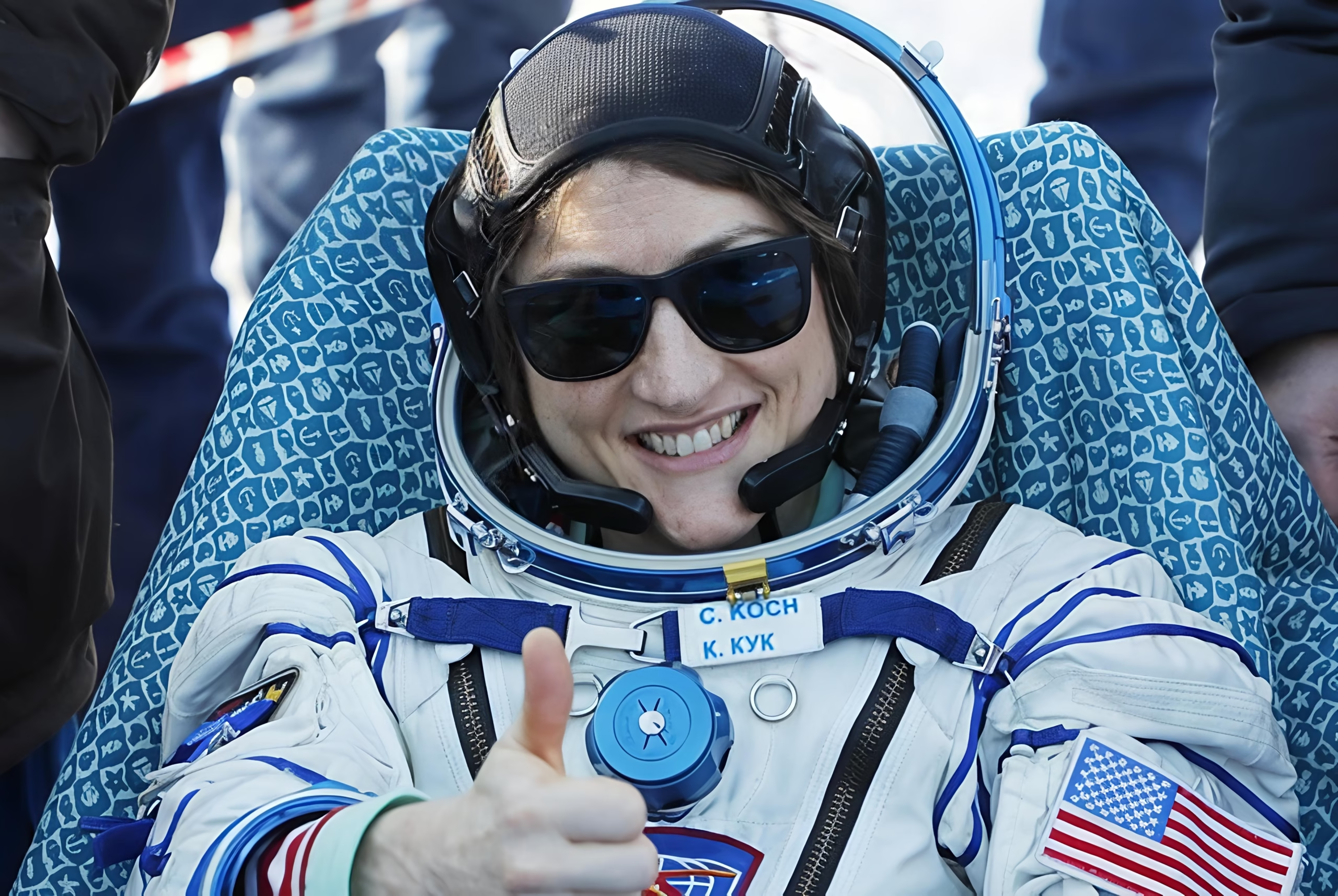
As someone who’s always looked up at the night sky with wonder, imagining what it would be like to venture beyond our world, I find Christina Koch’s story absolutely captivating. She’s not just an astronaut; she’s a pioneer who’s about to make history as the first woman to orbit the Moon aboard NASA’s Artemis II mission. But this isn’t only about one incredible journey—it’s about opening doors for everyone, especially in fields like science, technology, engineering, and math where diverse voices are needed more than ever.
In this Christina Koch’s Historic Journey with Artemis II, I’ll take you through Koch’s remarkable background, the intense preparations for Artemis II, her key role in the mission, and how it’s sparking a revolution in STEM inclusivity. Plus, we’ll hear directly from her through quotes shared at recent NASA conferences. If you’ve ever dreamed of the stars or want to inspire the young minds around you, stick with me—this is a tale that could change how we all see what’s possible.
From Small-Town Roots to the Stars: Who Is Christina Koch?
Picture this: a young girl growing up in Jacksonville, North Carolina, gazing at the stars and dreaming big. That’s where Christina Koch’s adventure began. Born in Grand Rapids, Michigan, she moved south and attended the North Carolina School of Science and Mathematics, a place that fueled her passion for discovery. She didn’t stop there—Koch earned bachelor’s degrees in electrical engineering and physics from North Carolina State University, followed by a master’s in electrical engineering. Years later, her alma mater honored her with a Ph.D. for her groundbreaking work in Christina Koch’s Historic Journey with Artemis II.
Before blasting off into orbit, Koch built a career that reads like an explorer’s diary. She kicked things off as an electrical engineer at NASA’s Goddard Space Flight Center, diving into instrument development for space missions. Then came the real test of grit: a year-long stint at the South Pole with the U.S. Antarctic Program.
Can you imagine enduring months of darkness and freezing temperatures to study astrophysics? It was there she learned to handle isolation and extreme conditions—skills that would later prove essential in space. Koch also tackled fieldwork in Greenland’s icy expanses, Alaska’s rugged terrains, and the remote islands of American Samoa, all while advancing research in physics and remote sensing.
Her big break came in 2013 when NASA selected her as an astronaut candidate. Fast forward to 2019, and Koch launched on her first mission to the International Space Station (ISS), where she shattered records by staying aboard for 328 days—the longest continuous spaceflight by any woman. During that time, she completed six spacewalks, including the world’s first all-female spacewalk alongside Jessica Meir.
These feats weren’t just personal triumphs; they laid the groundwork for her selection to Artemis II, where she’ll bring her expertise as a mission specialist. Koch’s path shows us that with determination, even the most distant dreams can become reality. Have you ever faced a challenge that prepared you for something bigger? Koch’s story reminds us that those moments are the building blocks of greatness.
The Countdown Begins: Artemis II’s Mission and Why It Matters Now
Artemis II is more than a spaceflight—it’s NASA’s bold step back to the Moon, the first crewed lunar orbit since the Apollo era ended in 1972. Scheduled for launch no earlier than February 2026, this 10-day mission will see the Orion spacecraft carrying four astronauts on a loop around the Moon, testing critical systems for future landings. It’s a crucial test drive before Artemis III puts boots on the lunar surface, including the first woman and first person of color.
What makes this mission so thrilling? It’s not just about technology; it’s about humanity’s next chapter in exploration. With the current buzz around space travel—think private companies like SpaceX and international collaborations—Artemis II arrives at a perfect time. As we sit here in early 2026, the world is watching, eager for updates on how this will pave the way to Mars. Koch, teamed up with commander Reid Wiseman, pilot Victor Glover (who’ll be the first Black astronaut to leave low-Earth orbit), and Canadian Space Agency’s Jeremy Hansen, represents a diverse crew that’s as symbolic as it is skilled. This isn’t your grandparents’ space program; it’s one that’s inclusive and forward-thinking.
Behind the Scenes: Christina Koch’s Historic Journey with Artemis II, Grueling Training for the Unknown
If you think becoming an astronaut is all glamour, think again. Christina Koch’s Historic Journey with Artemis II, has been a marathon of mental and physical challenges since her selection in April 2023. Training kicked off in earnest that June at NASA’s Johnson Space Center in Houston, where the crew has spent years in high-fidelity simulators mimicking every aspect of the mission.
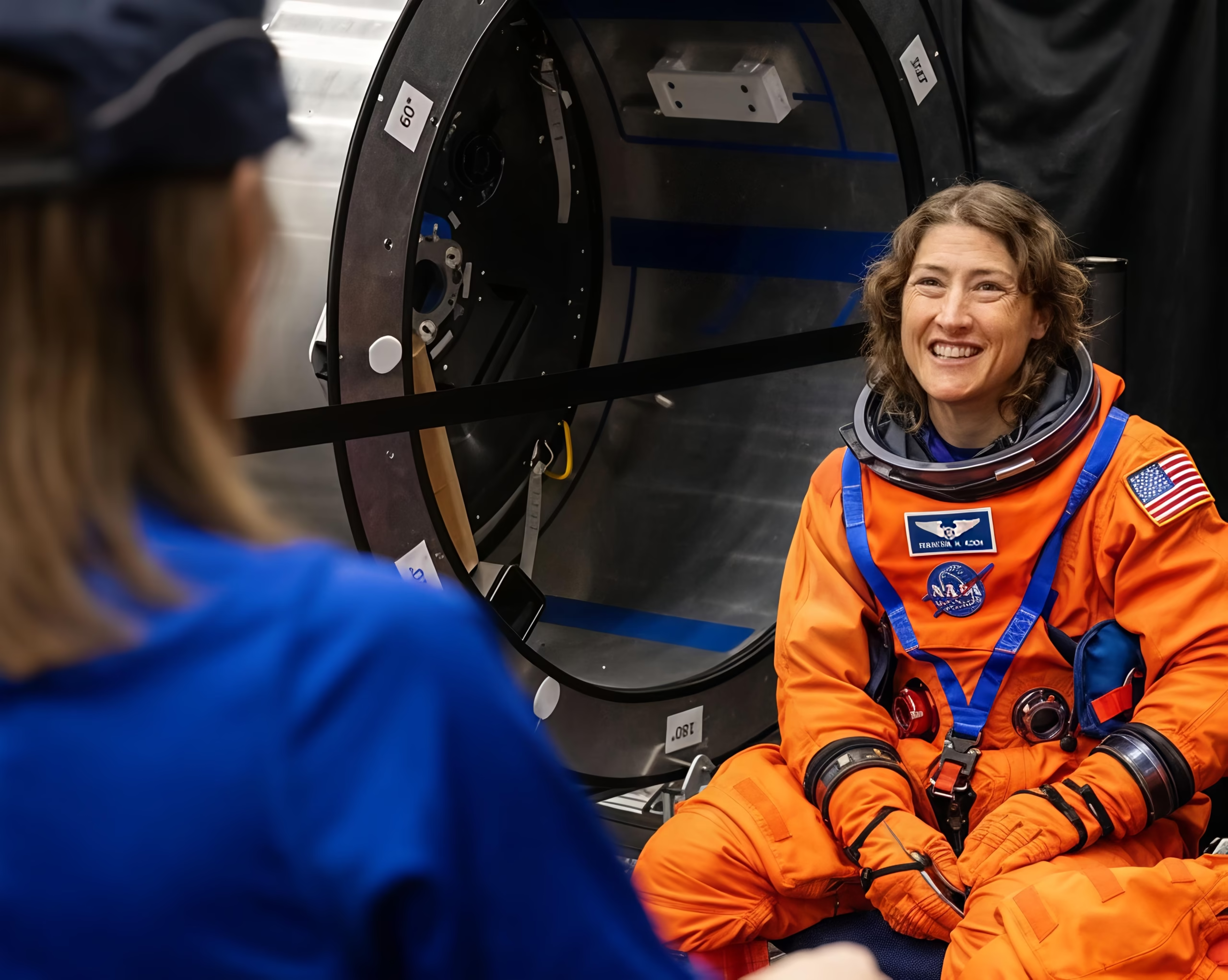
One of the most fascinating parts? Geology fieldwork that takes them to Earth’s most Moon-like spots. In Iceland, Koch and her team trekked across volcanic landscapes, learning to identify rocks and craters that mirror the lunar surface. They also explored the Kamestastin impact crater in Labrador, Canada, guided by experts like gelogist Gordon Osinski. These outings aren’t just educational—they forge unbreakable team bonds. As Koch shared in a recent interview, “A well-bonded crew with good empathy, communication, and climate is key to handling the unexpected.” Imagine hiking in harsh conditions, practicing sample collection—it’s like boot camp for space explorers.
Then there’s the emergency training, which sounds straight out of an action movie. In August 2025, the crew suited up for night launch simulations at Kennedy Space Center, practicing escapes from Launch Pad 39B using egress baskets and even driving armored vehicles. They’ve drilled water landings in massive pools, ensuring they can exit the Orion capsule safely after splashdown. Koch, drawing from her Antarctic isolation, excels in these scenarios, emphasizing adaptability: “We’re writing the book as we go. It’s our responsibility to pioneer procedures that aren’t already established.”
Technical training dives deep into Orion’s innovations. Christina Koch’s Historic Journey with Artemis II, has mastered life support systems, from carbon dioxide removal to maintaining a breathable atmosphere—vital when you’re 240,000 miles from home. Unlike her ISS stay with its routine protocols, Artemis II demands quick thinking for novel challenges. “Some of the new systems are all about sustaining life in deep space,” she explained in a PBS segment. This preparation isn’t just about survival; it’s about thriving, collecting data, and ensuring the spacecraft’s readiness for longer missions.
Through it all, Koch’s engineering prowess shines. She’s not only training but contributing to refinements, making her an integral part of NASA’s evolution. If you’ve ever prepared for a big project, you know that thrill of anticipation mixed with hard work—multiply that by a million, and you’ve got Koch’s daily life.
Christina Koch’s Historic Journey with Artemis II, Crucial Role: More Than Just a Passenger
As mission specialist, Koch will be the eyes and hands for science during the lunar flyby. Her tasks include monitoring spacecraft systems, conducting experiments, and gathering data that will inform future Artemis endeavors. With her background, she’s perfectly suited to troubleshoot engineering issues and optimize performance, ensuring Orion passes its deep-space test.
But her impact goes deeper. As the first woman to orbit the Moon, Koch symbolizes progress in a field historically dominated by men. Alongside Glover and Hansen, the crew’s diversity sends a powerful message: space is for all. This aligns with NASA’s Artemis goals—to establish a sustainable lunar presence and inspire global participation. Koch’s role extends to outreach, where she mentors aspiring astronauts, proving that barriers are meant to be broken.
Fueling the Future: How Artemis II Boosts STEM Diversity
Let’s talk about something close to my heart: diversity in STEM. For too long, these fields have lacked representation, but Artemis II is changing that narrative. NASA’s program commits to landing diverse astronauts on the Moon, creating role models that encourage underrepresented groups to join the fray.
At the 2023 Space Symposium, NASA’s Ken Bowersox put it perfectly: “When young people see the Artemis II crew, they can envision themselves in space. It takes everyone to reach the Moon and Mars.” Koch echoes this, stressing “go for all and by all” in her talks. With women making up 30% of the Kennedy Space Center launch team, led by the first female launch director, Charlie Blackwell-Thompson, the shift is tangible.
Experts like Danielle Bell from Northwestern University highlight the ripple effect: “Seeing women like Koch as leaders inspires young people everywhere.” In Florida, where the mission will launch, local media notes the excitement: “We now have female role models captaining space expeditions.” Even with evolving policies, NASA’s focus on inclusion remains strong, building a pipeline through education and outreach.
Koch’s influence is personal too. Through school visits and programs, she’s igniting passions in kids from all backgrounds. As a woman in writing and science advocacy, I see how her story motivates—it’s proof that STEM isn’t exclusive; it’s expansive.
Voices from the Frontier: Quotes from NASA’s Latest Conferences
Hearing from Koch herself adds that human touch. At the December 2025 Artemis II Partnerships Summit, she inspired attendees: “You have a whole generation excited about STEM, seeing what hard work and teamwork can achieve.”
In a March 2025 conference, she reflected on exploration’s essence: “Gaining perspective on what it means to be human—that’s the gift of space.” And during a PBS appearance, Koch shared the crew’s vision: “Our mission succeeds when we see footsteps on the Moon again.”
From her Red Chair Chat at NC State: “It’s vital to explore for all and by all, answering humanity’s call.” These words, fresh from recent events, underscore her commitment to legacy and inspiration.
A Legacy in the Making: Why Koch’s Story Resonates Today
As we edge closer to February 2026, Christina Koch’s Historic Journey with Artemis II, reminds us that space exploration is about unity and progress. It’s not just technicians and scientists—it’s dreamers like you and me. Her path from Antarctica to the Moon shows that with resilience, anyone can reach new heights.
In wrapping up, Christina Koch isn’t just orbiting the Moon; she’s orbiting our imaginations, pushing us toward a more inclusive future. Whether you’re a student eyeing STEM or a parent nurturing curiosity, her story is a call to action. Let’s cheer her on and let her inspire us to chase our own stars.
Source: https://www.nasa.gov/feature/our-artemis-crew/
FAQs: Christina Koch’s Historic Journey with Artemis II
Who is Christina Koch and what makes her Artemis II role historic?
Christina Koch is a NASA astronaut and engineer set to be the first woman to orbit the Moon. Her record-breaking ISS mission and diverse experiences make her a trailblazer in space exploration.
What is the launch date for Artemis II?
Christina Koch’s Historic Journey with Artemis II, mission is scheduled for no earlier than February 2026, marking the first crewed lunar orbit in over 50 years.
How is Artemis II promoting diversity in STEM?
By featuring a diverse crew and focusing on inclusion, NASA aims to inspire underrepresented groups, building a broader talent pool for future space endeavors.
What kind of training has Christina Koch undergone for this mission?
Koch’s training includes simulations, geology fieldwork in Iceland and Canada, emergency drills, and mastering Orion’s life support systems since 2023.
Why should young people care about Christina Koch’s story?
Her journey shows that hard work and passion can break barriers, encouraging kids—especially girls—to pursue STEM careers and dream big.
How can I follow updates on Artemis II?
Stay tuned to NASA’s website, social media, and conferences for the latest on the mission, crew preparations, and launch details.
Если вы планируете визит в Италию, рекомендую присмотреться на агротуризм в Тоскане — это отличная способ оценить красотой природы и блюдами местной кухни. Агроотдых Италия Тоскана дарит уникальные варианты маршрутов, дающие возможность открыть для себя с традиционным укладом и великолепием региона. Для тех, кто любит шопингом, аутлет-центры во Флоренции, включая легендарный The Mall, нередко имеют позитивные отзывы и следует их посмотреть для привлекательных покупок [url=https://holidaygid3.ru/]дольчеаква италия[/url] .
Для тех туристов, которые желают создать маршрут по Венеции или зоне Амальфитанского побережья на машине, критически важно осознавать, как доехать до ключевых точек, скажем до Аппиевой дороги или Доломитовых Альп, и разумно выстроить экскурсии. Схема маршрута по Венеции на 24 часа обеспечивает возможность оценить ключевые достопримечательности, в числе которых гондольную прогулку — плата за гондолы в Венеции разнится, но переживания незабываемы. Когда кто-то собирается на Сицилию или в Дольчеаква, там точно так же есть огромное число великолепных мест и привлекательных маршрутов.