
Sea-based rocket launch technology in depth. Learn how ocean rocket launches work, their advantages, challenges, real examples, and future role in global spaceflight.
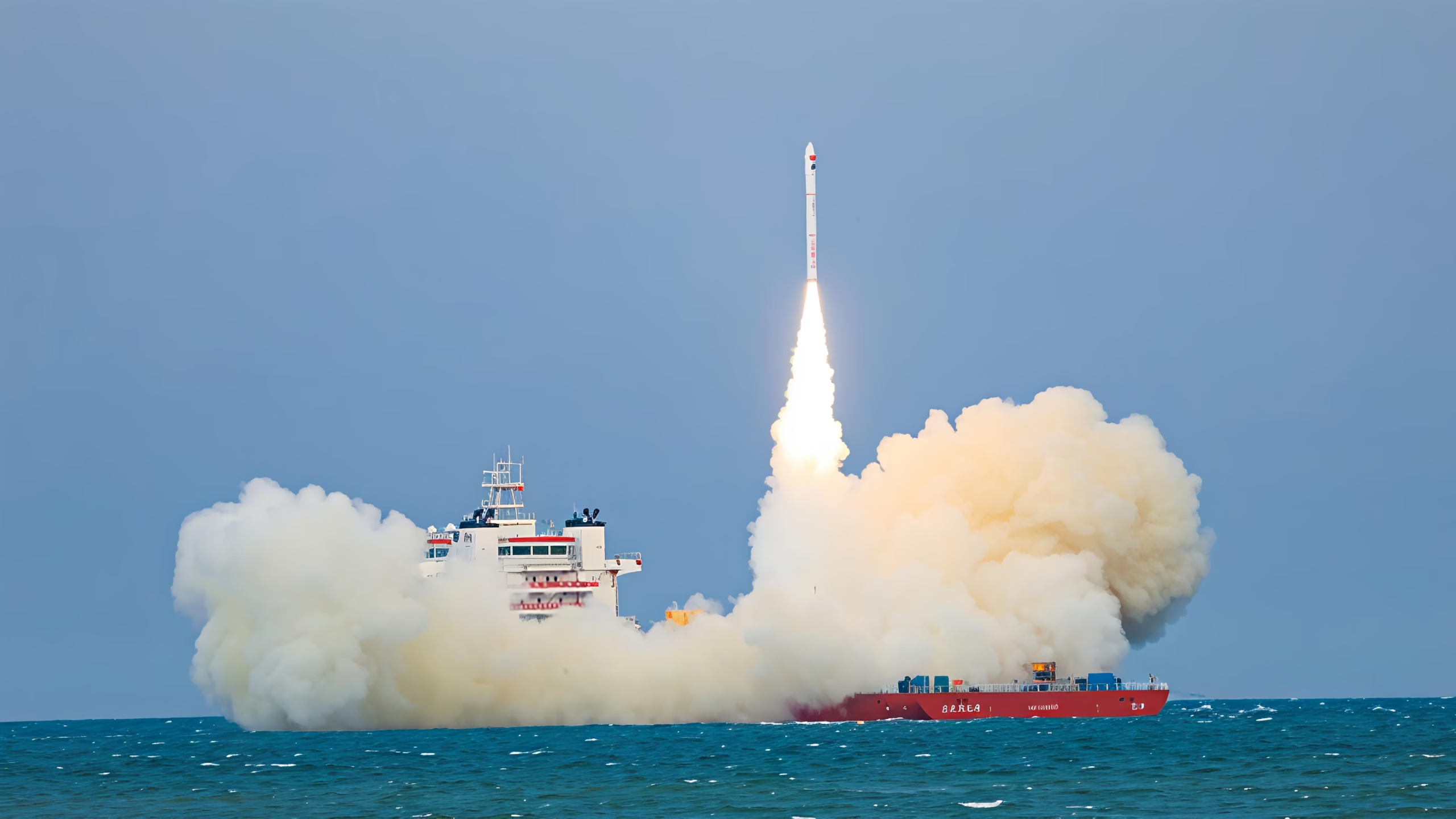
When most people imagine a rocket launch, they picture a towering launch pad surrounded by concrete, flame trenches, and restricted zones stretching for miles. Places like Cape Canaveral, Baikonur, or Sriharikota come to mind instantly. But in recent years, rockets have begun lifting off from a very different place — the open ocean.
This approach, known as sea-based rocket launch technology, is quietly becoming one of the most flexible and strategic ways to reach space. It may sound unusual at first, but launching rockets from the sea solves many problems that land-based spaceports struggle with.
In this article, we will explore what sea-based rocket launch technology really is, how it works step by step, why countries and private companies are investing in it, and what its future looks like. No heavy jargon, just a clear and human explanation of one of modern spaceflight’s most interesting innovations.
What Is Sea-Based Rocket Launch Technology?
Sea-based rocket launch technology refers to launching rockets from floating platforms, ships, or barges positioned in the ocean, instead of using fixed launch pads on land.
The rocket is assembled and tested on land, transported to sea, and launched from a mobile platform at a carefully selected ocean location. Once the rocket leaves the platform, the rest of the mission — stage separation, orbital insertion, and satellite deployment — works just like any traditional launch.
This method is not science fiction. It has been used successfully for decades and is now seeing renewed interest as the space industry grows more commercial, competitive, and time-sensitive.
Why Launch Rockets from the Sea?
At first glance, launching rockets from land seems simpler. So why go through the trouble of taking a rocket out to sea?
The answer lies in flexibility, safety, and performance.
Freedom to Choose the Best Launch Location
On land, spaceports are locked into one geographic position. At sea, a launch platform can move almost anywhere. This allows operators to choose the most efficient latitude for a mission, reducing fuel usage and increasing payload capacity.
Safer Launch Environment
Rockets carry massive amounts of fuel. If something goes wrong, debris can cause serious damage on land. At sea, failed stages and debris fall into open water, far from cities and infrastructure.
Fewer Political and Environmental Restrictions
Land launch sites often face land-use conflicts, environmental regulations, and population growth nearby. Sea launches avoid many of these issues entirely.
Strategic and Military Benefits
For defense missions, sea-based launches offer mobility, secrecy, and rapid deployment options that fixed launch sites cannot match.
A Brief History of Sea-Based Rocket Launches
Sea-based launches are not a new idea.
One of the most famous examples was Sea Launch, an international consortium that used a converted oil drilling platform to launch Zenit rockets from the equatorial Pacific Ocean. The system proved that large orbital rockets could be launched reliably from the sea.
More recently, China has revived and expanded sea-based launches, using both government and commercial rockets to place satellites into orbit from offshore platforms. Private companies like Galactic Energy have also demonstrated that sea launches can be fast, repeatable, and commercially viable.
How Sea-Based Rocket Launch Technology Works
Let’s walk through the entire process step by step, from the factory floor to orbit.
Step 1: Rocket and Payload Preparation on Land
Every sea launch begins on land.
The rocket is assembled in a controlled environment where engineers can carefully integrate engines, stages, avionics, and the payload. Satellites are tested, fueled if necessary, and encapsulated inside the payload fairing.
At this stage, the rocket looks no different from one destined for a land-based launch pad.
Step 2: Transporting the Rocket to Sea
Once assembly and testing are complete, the rocket is transported to the sea launch platform. Depending on the system, this may involve:
- Rolling the rocket onto a floating platform
- Loading it onto a specially designed launch ship
- Securing it on an unmanned barge
The platform then sails to a designated launch zone, often hundreds of kilometers offshore.
Step 3: Positioning and Stabilizing the Platform
The ocean is never perfectly still, so stabilization is one of the most critical aspects of sea-based launches.
Modern platforms use:
- Dynamic positioning systems
- Computer-controlled thrusters
- Gyroscopes and inertial sensors
Some platforms partially submerge to reduce wave motion, creating a surprisingly stable launch environment even in moderate seas.
Step 4: Final Checks and Fueling at Sea
Once on location, the launch team conducts final checks:
- Weather conditions
- Sea state and wind profiles
- Navigation and tracking systems
- Airspace and maritime clearance
Fueling may occur at sea or may already be completed on land, depending on rocket design and safety procedures.
Step 5: Countdown and Liftoff
At launch time, the rocket’s engines ignite, and it rises vertically from the platform. Advanced guidance systems instantly compensate for any minor platform movement.
Within seconds, the rocket is well above the ocean, and the sea launch platform becomes just another point on the map.
Step 6: Ascent, Orbit, and Payload Deployment
From this point onward, the mission is identical to a land-based launch. Stages separate, engines cut off at precise moments, and satellites are released into their planned orbits.
After launch, the platform returns to port, ready for refurbishment and the next mission.
Types of Sea-Based Rocket Launch Systems
Not all sea launches are the same. Several system designs are in use today.
Floating Launch Platforms
Converted oil rigs or purpose-built platforms that serve only as launch pads.
Ship-Based Launch Systems
Rockets launched directly from reinforced ship decks.
Barge-Based Systems
Unmanned barges controlled remotely by nearby support vessels.
Submarine-Launched Systems
Primarily military platforms capable of launching rockets while submerged or surfaced.
Real-World Examples of Sea-Based Rocket Launches
Sea Launch Program
Demonstrated large-scale commercial sea launches using Zenit rockets.
China’s Sea Launch Expansion
China regularly launches Long March and CERES-1 rockets from coastal waters, supporting both civilian and defense missions.
Commercial Small Rocket Launches
Private companies now use sea platforms to deploy small satellite constellations efficiently.
Advantages of Sea-Based Rocket Launch Technology
Sea launches offer several compelling benefits:
- Flexible orbital access
- Enhanced public safety
- Reduced land infrastructure requirements
- Strategic mobility
- Faster adaptation to mission needs
These advantages make sea launches especially attractive for countries with dense populations or limited land availability.
Challenges and Limitations
Despite its strengths, sea-based launch technology is not without challenges.
Weather Sensitivity
Ocean conditions can delay launches more frequently than land sites.
Complex Logistics
Operating offshore requires ships, crews, and specialized maritime equipment.
Cost Considerations
While infrastructure costs are lower, operational expenses can be higher.
Maintenance Constraints
Technical problems at sea are harder to fix than those on land.
The Future of Sea-Based Rocket Launch Technology
As satellite demand continues to rise, especially for Earth observation, communications, and defense, sea-based launch systems are likely to become more common.
Reusable rockets, autonomous platforms, and improved stabilization technologies are making ocean launches more reliable and cost-effective with each mission.
For nations seeking rapid, flexible access to space, the ocean may become the most important launch site of all.
Source: https://x.com/i/status/2011957710330212715
Frequently Asked Questions (FAQs)
What is sea-based rocket launch technology?
It is a method of launching rockets from floating platforms or ships in the ocean rather than from fixed land launch pads.
Why are rockets launched from the sea?
Sea launches provide better safety, orbital flexibility, and freedom to choose optimal launch locations.
Are sea-based launches reliable?
Yes. Multiple successful missions have proven that sea-based launches can be as reliable as land-based ones when properly managed.
Which countries use sea-based rocket launches?
China, Russia, and earlier international programs like Sea Launch have all used sea-based systems successfully.
Can heavy rockets be launched from the sea?
Yes, though most current sea launches focus on small to medium rockets due to platform constraints.
Is Sea-based rocket launch technology the future of spaceflight?
It is not a replacement for land launches but will play a growing complementary role in global space access.
What Is the Sunbird Nuclear Fusion Rocket—and Why Are Scientists Calling It a Space Game-Changer?