Europe’s Ariane 64 Amazon Kuiper mission reaches a major launch campaign milestone as the fully assembled central core stands tall on the pad in French Guiana. Discover what this means for the first flight on February 12, 2026, carrying Amazon Leo satellites, and why it boosts European space independence.
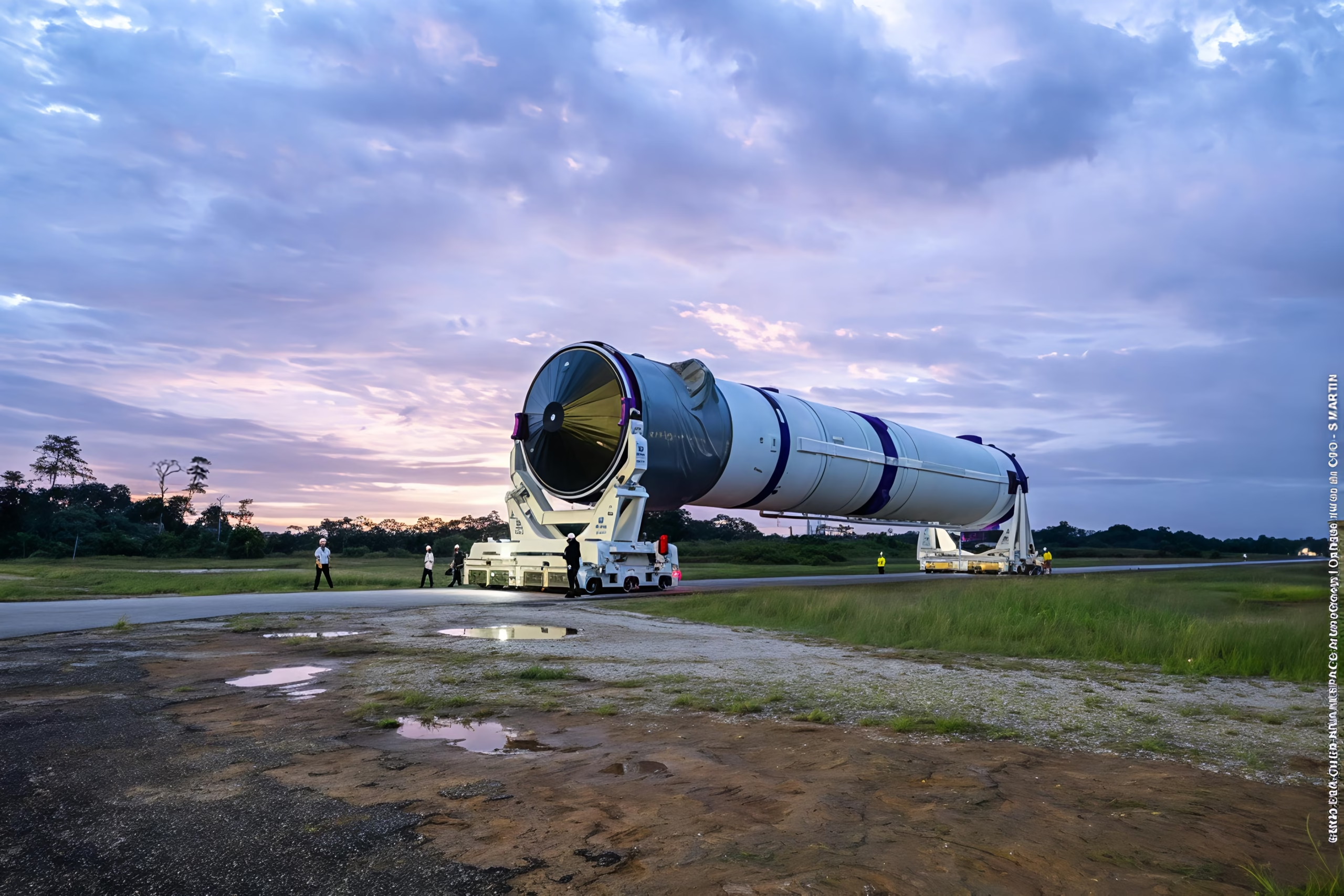
Have you ever watched a rocket standing proudly on its launch pad and felt that rush of excitement? That’s exactly what’s happening right now at Europe’s Spaceport in French Guiana. The central core of the Ariane 64 – the powerful heart of Europe’s next-generation heavy-lift rocket – has been carefully transferred from the integration building and positioned vertically on the ELA-4 launch pad. This isn’t just another step; it’s a game-changer for European space access.
Teams at ArianeGroup have poured years of effort into this moment. The launcher, now upright and ready for the next integration phases, embodies cutting-edge engineering designed to handle the most demanding missions. With the first flight scheduled for February 12, 2026, carrying a batch of Amazon Leo satellites, this milestone signals that Europe is back in the heavy-lift game – and stronger than ever.
Let’s dive into what this achievement really means, why it matters so much, and what’s coming next in this exciting campaign.
Understanding the Ariane 64 Amazon Kuiper mission: Europe’s Versatile Powerhouse
Ariane 6 represents a fresh start for European launch capabilities. Developed by ArianeGroup under ESA leadership, it comes in two main configurations: Ariane 62 (with two solid boosters) and Ariane 64 (with four). The version making headlines now is the Ariane 64 – the heavy-hitter built for maximum payload capacity.
The central core consists of the main cryogenic stage (powered by the Vulcain 2.1 engine using liquid hydrogen and oxygen) and the upper stage (featuring the Vinci engine for precise orbital insertions). These stages were fully assembled in the Launcher Assembly Building (BAL) before the big move to the pad.
Why the excitement over this transfer? Moving a rocket this size isn’t simple. The central core is massive, delicate in terms of systems integration, and requires precision to avoid any damage. Engineers used specialized transporters to roll it out horizontally, then carefully raised it to vertical in the mobile gantry at ELA-4. Now standing tall, it’s stable and connected for upcoming tests and additions.
This configuration gives Ariane 64 impressive performance: up to about 21.6 tons to geostationary transfer orbit in its heavy-lift mode. That’s ideal for large constellations, scientific probes, or heavy government payloads. Compared to its predecessor Ariane 5, Ariane 6 offers better flexibility, lower costs per launch, and a modular design that adapts to customer needs.
Why This Milestone Matters for the Future of Spaceflight
Reaching this point proves that the long development journey is paying off. Ariane 6 has faced delays, technical hurdles, and intense competition from reusable rockets like Falcon 9. But milestones like this show Europe’s industrial base is ramping up reliably.
The transfer demonstrates ArianeGroup’s ability to deliver a powerful, modular launcher. It’s the result of collaboration across Europe: engines from Germany and France, boosters from Italy, fairings from Switzerland, and assembly in French Guiana. This isn’t just tech – it’s a testament to shared expertise turning vision into reality.
For Europe, independent access to space is strategic. Relying less on foreign providers strengthens sovereignty in telecommunications, Earth observation, navigation, and defense. With growing demand for satellite mega-constellations, Ariane 64 positions Europe to capture a bigger share of the commercial market.
The upcoming mission VA267/LE-01 will be particularly symbolic. Launching 32 Amazon Project Kuiper (Leo) satellites marks the start of 18 planned flights for Amazon’s broadband network. It’s a vote of confidence from a major player choosing European rockets for critical infrastructure.
What’s Next: From Pad Integration to Liftoff
With the central core vertical, the campaign accelerates. Teams are now focusing on several critical steps:
First, integrating the four P120C solid rocket boosters. These Italian-built boosters provide the extra thrust for heavy payloads. Attaching them around the core is a complex operation involving precise alignment and electrical connections.
Next comes the long fairing transfer. The payload fairing protects satellites during ascent through the atmosphere. Once in the launch zone, it will be hoisted and mated to the top of the stack.
Then, the launch readiness review – a thorough check of every system, from propulsion to avionics.
Finally, the countdown sequence leading to liftoff on February 12, 2026. Weather, range safety, and final verifications will decide the exact moment, but the goal is clear: a successful debut flight.
Each phase involves hundreds of engineers, technicians, and partners working in sync. Safety remains paramount in the humid, equatorial environment of French Guiana.
The Bigger Picture: How Ariane 64 Amazon Kuiper mission Fits into Global Space Competition
The space launch world has changed dramatically. Reusability, rapid cadence, and cost reduction dominate headlines. Ariane 6 isn’t fully reusable like some competitors, but it prioritizes reliability, schedule predictability, and versatility for high-value missions.
By offering both light (Ariane 62) and heavy (Ariane 64) options, it covers a wide range of customer needs without overbuilding. This flexibility could attract missions that don’t fit neatly into other providers’ slots.
Moreover, Ariane 6 supports Europe’s ambitions in deep space. Future missions could include lunar gateways, Mars sample returns, or large telescopes. The rocket’s upper stage excels at multiple restarts and precise placements – key for complex trajectories.
As we approach the inaugural flight, anticipation builds. A successful debut will open doors for follow-on missions, including more constellation deployments, scientific payloads, and perhaps even crewed elements in partnership with other programs.
Challenges Overcome and Lessons Learned
Getting here wasn’t easy. Development stretched over a decade, with qualification tests, engine firings, and pad validations. The COVID-19 pandemic delayed progress, and supply chain issues tested resilience. Yet, the teams adapted, iterated, and delivered.
This milestone highlights the importance of persistence in space tech. Every successful transfer builds confidence for future flights. It also inspires the next generation of engineers – showing that big challenges yield big rewards.
Wrapping Up: A New Era for European Space
The sight of the Ariane 64 central core standing vertical on the pad is more than a photo op – it’s proof that Europe is ready to lead again in heavy-lift launches. With liftoff just weeks away, the world watches as this new chapter unfolds.
Whether you’re a space enthusiast, industry professional, or just curious about humanity’s push beyond Earth, this moment reminds us how collaboration and innovation drive progress. The stars feel a little closer today.
Source: https://x.com/i/status/2014397753653186807
FAQs: Ariane 64 Amazon Kuiper mission
What exactly is the central core of Ariane 64 Amazon Kuiper mission?
The central core includes the main cryogenic stage (with Vulcain 2.1 engine) and the upper stage (with Vinci engine). It’s the primary structure assembled before adding boosters and fairing.
When is the first Ariane 64 Amazon Kuiper mission launched?
The inaugural flight (VA267) is targeted for February 12, 2026, from Europe’s Spaceport in French Guiana, deploying 32 Amazon Leo satellites.
How does Ariane 64 differ from Ariane 62?
Ariane 64 uses four P120C solid boosters for heavier payloads, while Ariane 62 uses two for medium-lift missions. Both share the same core stages for cost efficiency.
Why is this transfer milestone so important?
It confirms the launcher is fully assembled and vertically positioned, allowing booster integration, fairing mating, and final testing – key steps toward launch readiness.
What payload will the first Ariane 64 Amazon Kuiper mission carry?
The debut mission will launch the first batch of 32 satellites for Amazon’s Project Kuiper low Earth orbit constellation, aimed at global broadband connectivity.
Who built the main components of Ariane 6?
ArianeGroup leads overall, with contributions from across Europe: Vulcain and Vinci engines (France/Germany), P120C boosters (Italy), and fairings (Switzerland), among others.
How does Ariane 6 improve on Ariane 5?
It offers greater modularity, lower production costs, higher launch cadence potential, and better adaptability to diverse missions while maintaining high reliability.