
Discover what NASA’s Artemis 2 science payload will study in 2026, from radiation exposure to life support systems and deep space exploration.
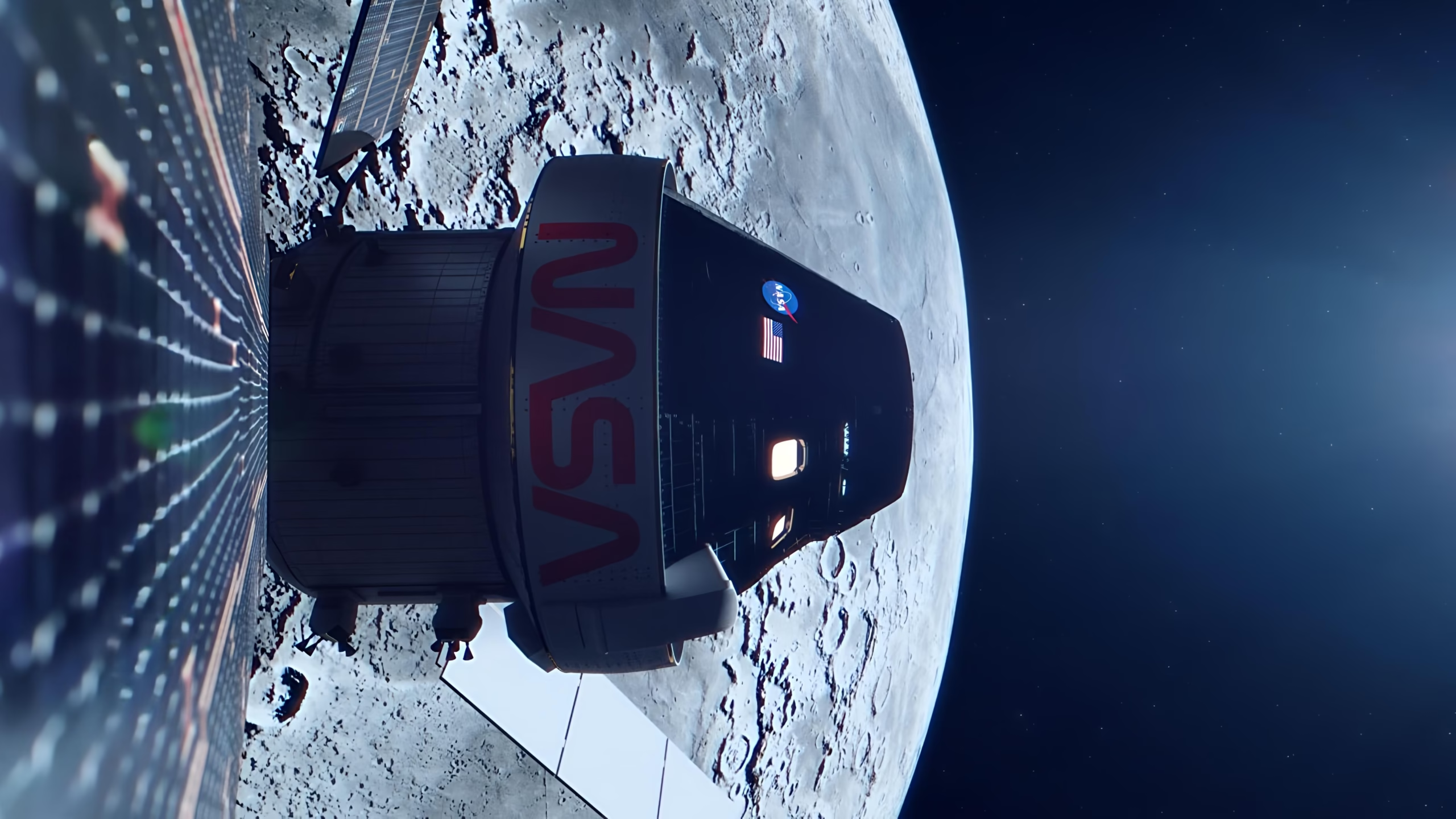
Hey there, space enthusiasts! Imagine this: four brave astronauts hurtling through the void, looping around the Moon for the first time in over 50 years. No landing, just a high-stakes flyby that’s all about pushing the boundaries of what we know—and what we can survive—in deep space. That’s Artemis 2 in a nutshell, NASA’s bold step toward putting boots back on the lunar surface and, eventually, on Mars.
If you’re like me, you’ve got a million questions buzzing in your head: What exactly are they studying up there? How does this prep us for the Red Planet? And what’s the deal with all that radiation? Stick with me as we unpack the science payload of this epic mission. By the end, you’ll feel like you’re right there in mission control, cheering them on.
This isn’t just another space jaunt; it’s a crucial test drive for humanity’s future among the stars. Set for launch no earlier than April 2026 from Kennedy Space Center, Artemis 2 builds on the uncrewed Artemis 1 success in 2022, proving we can send people farther than ever before. 11 Let’s break it down, heading by heading, to satisfy every curiosity you’ve got about what we’ll learn from orbiting the Moon.
What Exactly is the Artemis 2 Mission All About?
First things first—let’s set the scene. Artemis 2 is the second installment in NASA’s Artemis program, aimed at establishing a sustainable human presence on the Moon by the end of this decade. Unlike Artemis 1, which was a robotic rehearsal, this one’s got humans on board: a crew of four zipping around the Moon in the Orion spacecraft, propelled by the mighty Space Launch System (SLS) rocket.
Artemis 2 science payload: the mission lasts about 10 days, during which the astronauts will travel thousands of miles beyond the Moon’s far side before slingshotting back to Earth on a free-return trajectory. No moonwalk this time— that’s saved for Artemis 3—but it’s all about shaking down the hardware in real deep-space conditions.
Why does this matter? Well, it’s our first crewed venture into cislunar space since Apollo 17 in 1972. The crew will be farther from Earth than any human has been in generations, giving us a unique platform to conduct science that simply can’t be done from low Earth orbit like the International Space Station (ISS). Think of it as a dress rehearsal for longer, more ambitious trips. And with the current timeline pointing to an early 2026 launch, preparations are in full swing—the rocket’s already at the pad, undergoing final checks. 11 If delays hit (and space travel loves its surprises), we’ll be watching closely, but the excitement is palpable.
Who Are the Brave Souls on Board and When Will They Launch?
Meet the crew: NASA’s Reid Wiseman, Victor Glover, and Christina Koch, plus Canadian Space Agency’s Jeremy Hansen. These folks aren’t just passengers—they’re test pilots, scientists, and guinea pigs all rolled into one. Wiseman commands the ship, Glover pilots, Koch handles mission specialist duties, and Hansen brings international flair as a specialist too for this Artemis 2 science payload. Fun fact: None of them were alive for the last Apollo Moon mission, so this is fresh territory for everyone involved.
As for the timeline, as of January 2026, NASA’s targeting no later than April for liftoff. 11 The Orion capsule, powered by the European Service Module (ESM) from the European Space Agency (ESA), is key here. The ESM handles propulsion, power via massive solar arrays, and even supplies air and water for the crew. 12 It’s like the spacecraft’s lifeblood, and testing it with humans aboard is a huge milestone. Delays could push it back, but recent rollouts to the launch pad signal we’re getting close. 3 Keep your eyes on NASA updates— this could be the year we see humans circle the Moon again!
Artemis 2 science payload: What Are the Core Scientific Goals?
At its heart, Artemis 2 science payload is a science bonanza wrapped in an engineering test. The mission’s primary aim is to validate the Orion spacecraft’s performance in deep space, but that opens the door to a slew of experiments. 11 From a vantage point nearly 9,000 km beyond the Moon, the crew will gather data that’s impossible to get elsewhere. We’re talking about studying how humans and tech hold up in the harsh environment of cislunar space, where Earth’s protective magnetic field fades away.
Key goals include testing integrated systems like navigation, communication, and propulsion under real conditions. But the real gems are the human-centered studies: how our bodies react to radiation, how life support keeps us alive, and even subtle interactions between Earth and the Moon. All this feeds into NASA’s bigger picture—economic benefits from lunar resources, scientific discoveries about our cosmic neighborhood, and prepping for crewed Mars jaunts by the 2030s. 14 It’s not just about the Moon; it’s about proving we can thrive far from home.
How Will Artemis 2 Test Life Support Systems for Deep Space Survival?
Picture this: You’re sealed in a capsule the size of a small RV, breathing recycled air for 10 days. That’s the reality for the Artemis 2 crew, and testing Orion’s life support is mission critical. 11 The system generates breathable oxygen, scrubs out carbon dioxide and water vapor from exhalations, and maintains cabin pressure. The astronauts will push it to the limits, simulating high metabolic rates during exercise and low ones during sleep to ensure it handles varying demands.
The ESM plays a starring role, supplying 240 kg of drinking water, 90 kg of oxygen, and 30 kg of nitrogen. 12 This isn’t just routine—it’s vital data for future missions where resupply isn’t an option. Think about Mars: a trip there could last years, so nailing closed-loop systems now means the difference between success and disaster. Early tests on ISS help, but deep space adds radiation and microgravity twists that Artemis 2 will expose. 15 If it works, we’re one giant leap closer to sustainable space living.
Why Is Radiation Monitoring a Big Deal on This Mission?
Deep space is a radiation minefield, and Artemis 2 science payload is our chance to map it out. Without Earth’s atmosphere and magnetic shield, cosmic rays and solar particles bombard everything. 15 The crew will experience this firsthand, using sensors in Orion to measure exposure levels. It’s part of confirming the spacecraft’s shielding, but also about human health—tracking how radiation affects sleep, movement, and overall well-being.
Enter wearable tech: Wrist monitors will log the astronauts’ activity and rest patterns, helping researchers understand deep space’s toll on the body. 22 Data scarcity in this realm is huge; most of what we know comes from ISS, which is still protected. Artemis 2’s findings will inform shielding designs, medication protocols, and even habitat builds for the Moon and Mars. 18 Imagine shielding suits or meds that counteract radiation sickness— this mission could unlock those, making long-haul trips safer.
What Can We Learn About Earth-Moon Interactions from Orbit?
Orbiting the Moon isn’t just scenic—it’s a front-row seat to Earth-Moon dynamics. The mission traverses cislunar space, where gravitational pulls, space weather, and magnetic fields interplay in ways we barely understand. 11 Crew observations and sensors will study these, like how solar winds affect the lunar exosphere or Earth’s magnetotail extends toward the Moon.
This ties into broader science: Understanding these interactions helps predict space weather, which can fry satellites or endanger astronauts. For Mars, it’s about navigating similar environments—dust storms, thin atmospheres, and radiation belts. 6 Plus, it informs lunar base sites, where regolith could shield against radiation. Artemis 2’s data will refine models, making future ops smoother and safer.
How Does All This Tie Into Future Mars Missions?
Here’s the exciting part: Artemis 2 is the gateway to Mars. By proving Orion can handle deep space with a crew, we’re validating tech for the 200-million-mile trek to the Red Planet. 11 Life support tests ensure we can recycle resources efficiently; radiation data guides health safeguards; and Earth-Moon studies hone navigation for interplanetary travel.
NASA sees the Moon as a proving ground—learn to live there, then scale up for Mars. 1 The Gateway station, which Artemis 2 demos proximity ops for, will be a lunar orbit hub, testing habitats and propulsion ESA’s contributing modules like Lunar I-Hab. 12 Bottom line: Success here means Mars in the 2030s isn’t a pipe dream—it’s a plan.
Are There Other Cool Experiments and Payloads on Board?
Beyond the biggies, Artemis 2 science payload pack health monitoring galore. Advanced experiments track physiological changes, from sleep disruptions to cognitive shifts in deep space. 18 The crew serves as both researchers and subjects, logging data that could revolutionize space medicine. Orion’s payload bay might host small tech demos, but the focus is human factors. 20 It’s all about building a database for the Artemis era and beyond.
In wrapping up, Artemis 2 isn’t just a loop around the Moon—it’s humanity’s bold statement that we’re ready for more. The science payload will yield insights into survival, exploration, and our place in the cosmos, fueling dreams of Martian colonies. As we await that April 2026 launch, let’s stay tuned; the stars are calling.
Source: https://www.nasa.gov/mission/artemis-ii/
FAQs: Artemis 2 science payload
When is Artemis 2 science payload mission launching?
Targeted for no later than April 2026, with final preparations underway at Kennedy Space Center.
Who is on the Artemis 2 crew?
Commander Reid Wiseman, Pilot Victor Glover, Mission Specialist Christina Koch (all NASA), and Mission Specialist Jeremy Hansen (CSA).
Will Artemis 2 land on the Moon?
No, it’s a flyby to test systems; landings start with Artemis 3.
How does Artemis 2 help with Mars missions?
It tests life support, radiation protection, and deep-space ops essential for longer trips to Mars.
What kind of radiation will the crew face?
Cosmic rays and solar particles in cislunar space, measured to improve future shielding.
Is there international involvement?
Yes, ESA provides the Service Module, and Canada contributes an astronaut.
How long is the Artemis 2 science payload mission?
About 10 days, including the lunar flyby.
What if the mission gets delayed?
NASA has contingency plans, but it would push back the Artemis timeline slightly.
Starship Set to Launch Again Next Month: Elon Musk’s Bold Next Step in Space Exploration