
The Most Dangerous Do-or-Die Moment of Artemis II —could NASA’s Artemis II crew pull off a flawless gravity brake, or risk being stranded in space? Explore the high-stakes drama, mission details, and what it means for our lunar future in this gripping deep-dive.
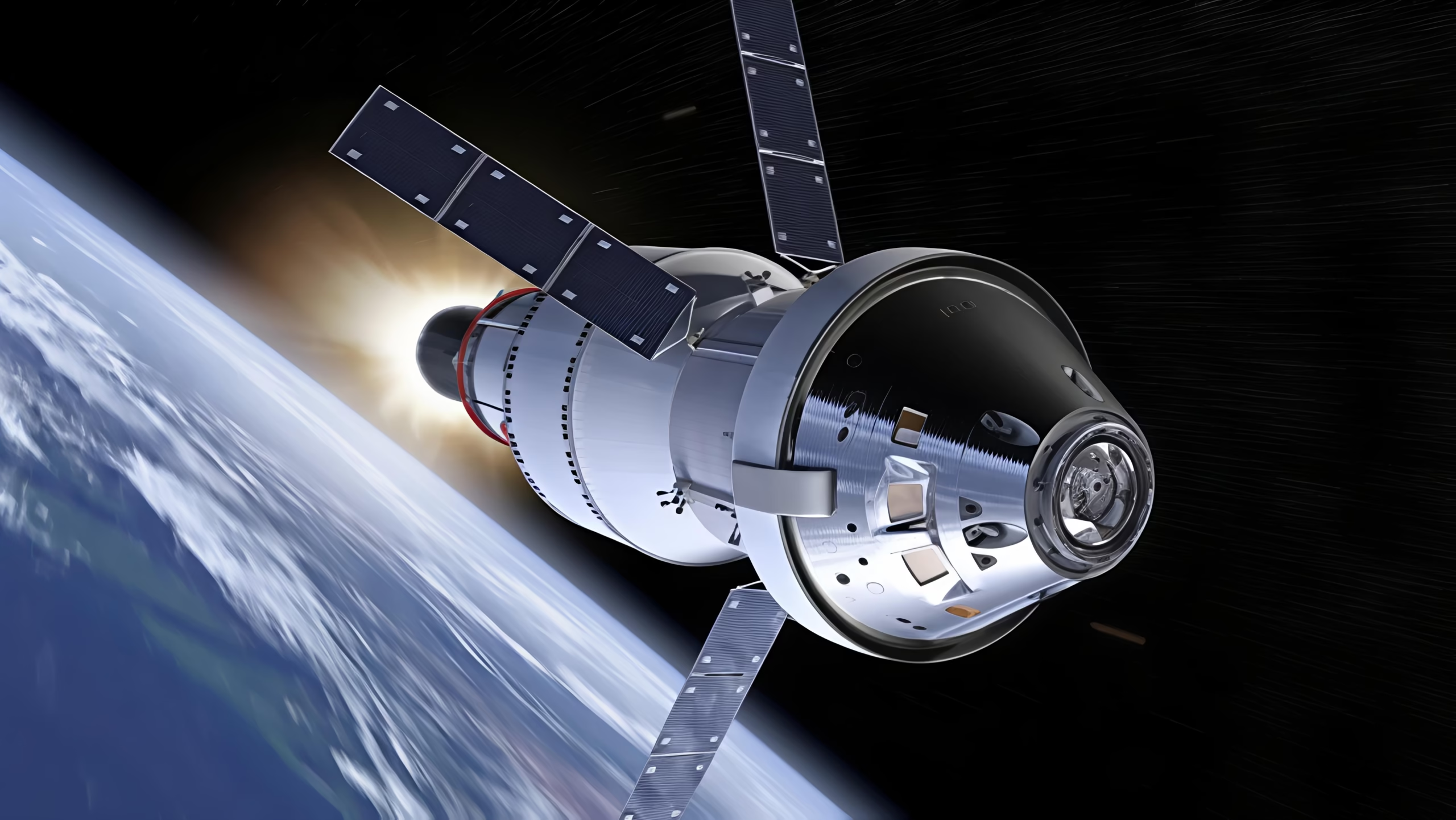
As someone who’s always been captivated by the mysteries of space, I can’t help but feel a mix of thrill and nerves when thinking about NASA’s Artemis II mission. Set for launch in early February 2026, this will be the first time in over five decades that humans venture beyond low Earth orbit to circle the Moon. But what really gets my pulse racing is the so-called “do-or-die brake test” at 8,000 kilometers per hour above the lunar surface.
It’s not just a fancy phrase—it’s a pivotal moment where the Orion spacecraft relies on the Moon’s gravity to sling it back home. If everything aligns perfectly, it’s a triumph; if not, the astronauts could face unimaginable perils. Join me as I delve into this edge-of-your-seat aspect of the mission, unpacking the science, risks, and why it matters for humanity’s return to the stars.
Understanding the Most Dangerous Do-or-Die Moment of Artemis II Mission: A Bold Step Back to the Moon
Let’s start with the basics, because context makes all the difference. Artemis II is NASA’s flagship endeavor under the broader Artemis program, aimed at establishing a sustainable human presence on the Moon by the end of this decade. Unlike its predecessor, the uncrewed Artemis I in 2022, this mission puts real people in the hot seat—four astronauts embarking on a 10-day journey around the Moon and back.
The crew includes seasoned NASA veterans: Commander Reid Wiseman, Pilot Victor Glover, Mission Specialist Christina Koch, and Canadian Space Agency’s Jeremy Hansen. It’s historic not just for the distance but for the diversity—Glover will be the first Black astronaut to leave Earth’s orbit, and Koch the first woman on such a deep-space trip. Launching atop the massive Space Launch System rocket from Kennedy Space Center, the Orion capsule will travel about 280,000 miles to the Moon, far surpassing the International Space Station’s orbit.
What sets this apart from Apollo-era missions? Modern tech, for one—Orion is equipped with advanced life support, radiation shielding, and solar arrays that generate enough power for the long haul. But the real test comes during the lunar encounter, where speeds ramp up dramatically. As the spacecraft approaches the Moon, it’ll clock in at around 8,280 kilometers per hour relative to the surface, setting the stage for that critical brake maneuver.
What Is the Do-or-Die Brake Test Above the Moon?
Most Dangerous Do-or-Die Moment of Artemis II—where things get intriguing. The “brake test” isn’t about slamming on physical breaks-space doesn’t work that way. Instead, it’s a gravity-assisted maneuver, often called a lunar slingshot or free-return trajectory adjustment. As Orion nears the Moon at that blistering 8,000 kmph pace, it won’t fire its engines to slow down into orbit like some missions do. Rather, it’ll skim just 7,400 kilometers above the lunar surface, letting the Moon’s gravitational pull act as a natural brake and redirector.
Think of it like a cosmic game of billiards: the spacecraft enters the Moon’s gravity well at high speed, curves around the far side, and gets flung back toward Earth without needing extra fuel. This saves resources and reduces complexity, but precision is everything. Engineers calculate the approach angle down to fractions of a degree—if it’s too shallow, Orion might skip off into deep space; too steep, and it could crash into the Moon or enter an unstable path.
Most Dangerous Do-or-Die Moment of Artemis II-why call it “do-or-die”? Because there’s no room for error. Unlike missions with backup propulsion for corrections, Artemis II relies heavily on this passive brake. A minor glitch in navigation, a solar flare disrupting electronics, or even micrometeorite damage could throw off the trajectory. In worst-case scenarios, the crew might end up on a path that doesn’t return them to Earth, potentially stranding them with limited supplies. It’s a high-wire act that tests Orion’s systems under real deep-space conditions, from thermal controls to communication blackouts during the flyby.
From what I’ve learned, this maneuver echoes the free-return paths of Apollo 8 and 10, but with updated tech like autonomous guidance software. Still, the sheer velocity—equivalent to Mach 6.7 on Earth—amplifies every risk, making it a true proving ground for future landings.
The Risks Involved: Why This Brake Test Keeps Experts on Edge
I have to admit, pondering the dangers gives me chills. At 8,000 kmph, even tiny issues can cascade. Radiation is a big one—beyond Earth’s magnetic field, cosmic rays could zap avionics mid-maneuver, leading to guidance failures. Then there’s the heat: though not as intense as re-entry, the flyby’s frictional forces with any trace atmosphere or gravitational stresses could strain the capsule’s structure.
Past missions offer sobering lessons. Remember Apollo 13? A oxygen tank explosion forced an improvised lunar slingshot, but they made it back by a hair. Artemis II has redundancies, like multiple computers and emergency thrusters, but no one’s tested them with crew at lunar distances. If the brake fails, rescue is impossible—there’s no Space Station nearby, and it would take days for help to arrive, if at all.
NASA’s own assessments highlight thermal anomalies from Artemis I, where the heat shield showed unexpected wear. While not directly tied to the brake test, it underscores how interconnected systems are. Add in communication lags—up to 48 seconds round-trip—and the astronauts must rely on onboard AI for split-second decisions. As a woman inspired by trailblazers like Koch, I worry about the human toll: enduring isolation, potential motion sickness from the whip-around, and the psychological strain of knowing one miscalculation could be fatal.
Yet, NASA’s mitigating these with rigorous simulations. The crew’s trained for contingencies, including manual overrides, and ground teams will monitor via the Deep Space Network. It’s calculated risk, but one that pushes boundaries.
How NASA Is Preparing for This High-Speed Lunar Encounter
Preparation is key, and NASA’s leaving nothing to chance for this Most Dangerous Do-or-Die Moment of Artemis II . Since Artemis I’s success, teams have poured over data, refining Orion’s software for better trajectory predictions. The Space Launch System, too, undergoes tweaks—recent rollouts in January 2026 tested integration at the pad.
Astronaut training is immersive: virtual reality sims replicate the brake test’s g-forces and visuals, while underwater analogs mimic zero-gravity tasks. Engineers model every variable, from lunar gravity variations to solar wind effects. For the brake itself, precise burns earlier in the flight set the stage, ensuring the approach velocity hits that 8,000 kmph sweet spot.
International collaboration shines here—Canada’s Hansen brings expertise, and Europe’s service module provides propulsion backup. If needed, a small engine firing could correct the path post-flyby, though the goal is a fuel-free return. It’s inspiring to see how global teamwork turns potential doom into doable.
Broader Impacts: What This Means for Future Space Exploration
Most Dangerous Do-or-Die Moment of Artemis II-Zooming out, this brake test isn’t just about Artemis II—it’s a linchpin for the program. Success validates Orion for Artemis III’s 2027 landing, where actual orbital braking will be needed. Failures could delay timelines, balloon costs, and give rivals like China’s Chang’e program an edge in lunar dominance.
For me, it’s about inspiration. Proving humans can safely brake at lunar speeds opens doors to Mars, where similar gravity assists await. It also advances tech like reusable spacecraft, potentially making space more accessible. Economically, it boosts jobs in STEM; scientifically, data from the flyby could reveal new lunar insights, like volatile deposits.
Critics question the rush—is safety compromised for prestige? But with delays already pushing from 2024 to 2026, NASA’s prioritizing caution.
Lessons from History: Comparing to Past Lunar Missions
History adds perspective. Apollo 8’s 1968 flyby nailed a similar slingshot at comparable speeds, but without today’s computing power. They faced engine fears but succeeded, reading Genesis from lunar orbit. Artemis builds on that, with better shielding against the van Allen belts.
Contrast with Artemis I: uncrewed, it broke distance records at over 432,000 kilometers from Earth, testing the very trajectory II will follow. No major brake issues, but power glitches remind us space is unforgiving.
The Astronaut Perspective: Facing the Brake Test Head-On
What do the crew think about this Most Dangerous Do-or-Die Moment of Artemis II? In interviews, Wiseman emphasizes teamwork: “It’s about trusting the machine and each other.” Koch, a record-holder for longest female spaceflight, highlights the wonder: “That moment above the Moon will redefine human limits.” Their poise amid risks is admirable, fueled by passion for exploration.
Source: https://x.com/i/status/2011865124848488468
FAQs: Most Dangerous Do-or-Die Moment of Artemis II
What exactly happens during the 8,000 kmph brake test?
The Orion capsule uses the Moon’s gravity to naturally slow and redirect its path back to Earth, without major engine burns, in a precise flyby maneuver.
How dangerous is this Most Dangerous Do-or-Die Moment of Artemis II?
It’s high-risk due to the need for exact trajectory; errors could lead to stranding, but redundancies and training minimize chances.
Why is the speed 8,000 kmph significant?
This velocity relative to the Moon ensures the gravity pull is strong enough for the slingshot effect, but demands flawless navigation.
When is Artemis II launching, and how long is the mission?
Launch is targeted for February 6, 2026, with a 10-day duration including the lunar flyby.
How does this differ from Apollo missions?
Apollo used similar free-returns but with less advanced tech; Artemis adds modern autonomy and international crew.
What if the brake test fails?
Contingency plans include thruster corrections or abort modes, though options are limited in deep space.