
NASA Artemis II mission will send astronauts around the Moon in 2026, marking humanity’s first crewed deep-space flight since Apollo. Mission details explained.
Imagine standing on the precipice of a new era in space exploration, where the Moon isn’t just a distant memory from history books but a stepping stone to the stars. That’s exactly where we find ourselves today with NASA’s Artemis II mission. Set to launch no earlier than February 6, 2026, this 10-day crewed flight around the Moon marks the first time humans will venture beyond low Earth orbit in over 50 years.
It’s not just a trip—it’s a bold declaration that we’re going back to the Moon, and this time, we’re staying. In this article, we’ll dive into the details of Artemis II, from its objectives to the brave crew leading the charge. Whether you’re a space enthusiast or just curious about what’s next for humanity, stick around as we unpack this exciting journey.
Understanding the NASA Artemis II Mission: Vision for Lunar Exploration
To grasp the significance of NASA Artemis II mission, we need to zoom out and look at the bigger picture: the Artemis program. Named after the Greek goddess of the Moon and twin sister to Apollo, this initiative represents NASA’s ambitious plan to return humans to the lunar surface and establish a sustainable presence there. Unlike the Apollo missions of the 1960s and 1970s, which were sprint-like dashes to plant flags and collect rocks, Artemis is a marathon aimed at building infrastructure for long-term exploration.
The program kicked off with Artemis I in 2022, an uncrewed test flight that successfully orbited the Moon and tested the Space Launch System (SLS) rocket and Orion spacecraft. Now, Artemis II builds on that foundation by adding a human element,
sending astronauts on a flyby to validate systems in deep space. Future missions like Artemis III will involve actual landings at the lunar South Pole, where water ice could provide resources for fuel and life support. Beyond that, Artemis envisions a lunar gateway—a space station in orbit around the Moon—and collaborations with international partners and private companies like SpaceX.
What makes Artemis truly revolutionary is its inclusivity. It’s designed to include the first woman and first person of color on the Moon, fostering diversity in space exploration. Moreover, the program ties into broader goals, such as preparing for Mars missions by learning how to live off-Earth. As we face climate challenges here on our planet, the technologies developed through Artemis could revolutionize energy, recycling, and resource management. It’s not just about reaching the Moon; it’s about pushing the boundaries of what’s possible for all of us.
NASA Artemis II Mission Overview: A High-Stakes Test Flight
At its core, Artemis II is a critical test drive for NASA’s deep-space capabilities. This mission will see four astronauts launch from Kennedy Space Center in Florida aboard the mighty SLS rocket, propelling the Orion spacecraft into space. Once in orbit, the crew will spend about 10 days traveling to the Moon, looping around it in a free-return trajectory, and then heading back to Earth for a splashdown in the Pacific Ocean.
The trajectory is fascinating—it’s called a free-return because it uses the Moon’s gravity to slingshot the spacecraft back home without needing major engine burns if something goes wrong. This safety feature echoes the Apollo 13 mission, where a similar path saved the crew. During the flight, the astronauts will venture farther from Earth than anyone has since Apollo 17 in 1972, reaching about 230,000 miles away at the Moon’s far side.
Why now? After delays due to technical hurdles like battery issues in Orion and production challenges with SLS components, NASA has refined the timeline. 0 The launch window opens on February 6, 2026, with backup opportunities on February 7, 8, 10, and 11, followed by windows in March and April if needed. 3 These dates are carefully chosen based on orbital mechanics, ensuring minimal eclipse times and optimal reentry conditions. Preparations are in full swing, with the rocket’s rollout to the launch pad expected soon, followed by a wet dress rehearsal to simulate countdown procedures.
This isn’t a landing mission— that’s for Artemis III, targeted for 2027 or later. Instead, NASA Artemis II mission focuses on proving that humans can survive and operate in deep space with the new hardware. It’s a high-wire act, but one that’s essential for the program’s success.
Meet the Crew: The Faces Behind the NASA Artemis II mission
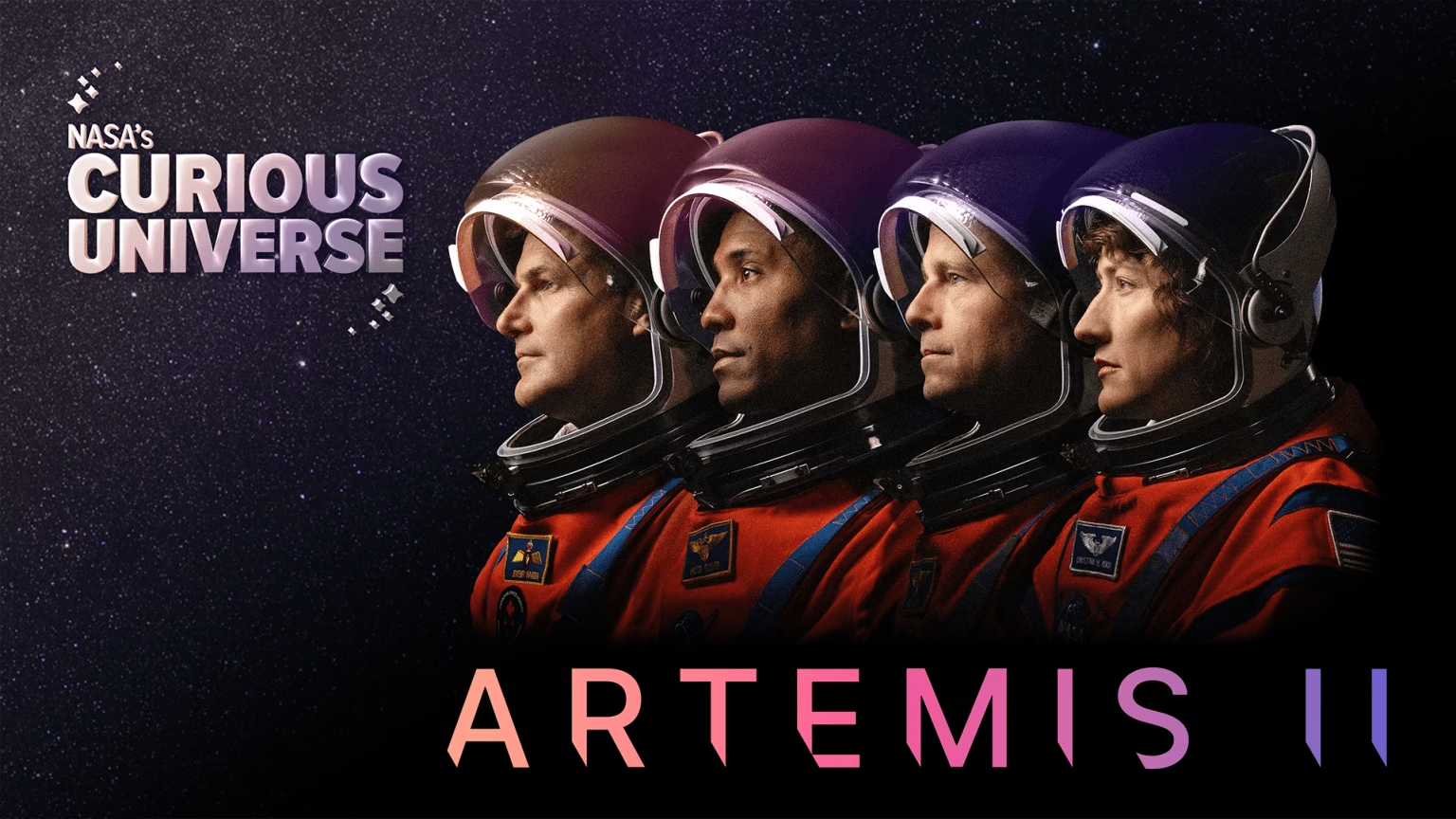
No space mission is complete without its heroes, and Artemis II boasts an exceptional team of four astronauts who embody the spirit of exploration. Leading the charge is Commander Reid Wiseman, a seasoned NASA astronaut with experience from the International Space Station (ISS). Wiseman’s leadership will be crucial during manual piloting exercises and system checks.
Joining him is Pilot Victor Glover, who made history as the first Black astronaut to live on the ISS during a six-month stint. Glover’s expertise in engineering and aviation will help navigate the Orion’s controls. Then there’s Mission Specialist Christina Koch, holder of the record for the longest single spaceflight by a woman at 328 days. Koch’s background in physics and her Antarctic research experience make her ideal for handling scientific tasks.
Rounding out the crew is Jeremy Hansen from the Canadian Space Agency, marking Canada’s first deep-space astronaut. Hansen, a former fighter pilot, brings international collaboration to the forefront, symbolizing how Artemis is a global effort.
These individuals aren’t just skilled professionals; they’re storytellers and inspirations. They’ve trained rigorously for years, simulating every scenario from launch aborts to radiation exposure. Imagine the conversations they’ll have—sharing views of Earth from afar, testing life-support systems, and perhaps even conducting outreach to schools back home. Their diverse backgrounds remind us that space is for everyone, and their journey will inspire the next generation of explorers.
The Launch and Mission Timeline: Step-by-Step Breakdown
Let’s walk through what the mission will look like, day by day, to give you a sense of the adventure.
NASA Artemis II mission: It all starts with launch day, no earlier than February 6, 2026, from Launch Complex 39B at Kennedy Space Center. 2 The SLS, the most powerful rocket ever built, will roar to life, lifting Orion into space. Within minutes, the crew will reach orbit and begin initial checkouts.
Days 1-2: In high Earth orbit, the astronauts will perform two laps around our planet. This phase includes manual flying tests, where they’ll align the spacecraft and practice maneuvers critical for future docking operations.
Day 3: A powerful trans-lunar injection burn sends Orion toward the Moon. The crew will monitor systems as they coast through space, dealing with radiation from the Van Allen belts.
Days 4-6: Approaching the Moon, the spacecraft enters a distant retrograde orbit. The highlight? A close flyby of the lunar far side, offering views no human has seen firsthand since Apollo. They’ll test communications, navigation, and life-support in this remote environment.
Days 7-9: Using lunar gravity, Orion slingshots back toward Earth on its free-return path. This is a time for data collection and any final experiments.
Day 10: Reentry and splashdown. Orion will hit Earth’s atmosphere at 25,000 mph, using its heat shield to withstand temperatures up to 5,000 degrees Fahrenheit before parachuting into the ocean.
Throughout, the crew will conduct about 20 experiments, from radiation monitoring to biological studies, all while managing the psychological aspects of isolation. It’s a packed schedule, but one that promises invaluable data.
Key Objectives: What NASA Artemis II mission Aims to Achieve
Beyond the thrill of the flight, Artemis II has clear goals that pave the way for sustained lunar presence. Primarily, it’s about validating the Orion spacecraft’s performance with humans aboard. This includes testing the environmental control systems that recycle air and water, crucial for longer missions.
Scientific objectives focus on deep-space operations: How does radiation affect the crew and electronics? Can the propulsion system handle precise burns? The mission will also gather data on lunar geology during the flyby, aiding site selection for landings.
From a broader perspective, Artemis II tests international partnerships. Canada’s contribution includes the Canadarm3 robotic system for future gateways, while Europe’s service module powers Orion. Success here boosts confidence for Artemis III’s landing and eventual Mars pushes.
Challenges like cosmic radiation and microgravity effects are front and center. The crew will use new shielding materials and exercise regimens to mitigate risks, providing lessons for all future deep-space travel.
Technology Spotlight: SLS Rocket and Orion Spacecraft
Powering this mission are two engineering marvels: the SLS rocket and Orion capsule.
The SLS stands 322 feet tall, generating 8.8 million pounds of thrust at liftoff—more than the Saturn V. Its core stage, built by Boeing, uses four RS-25 engines from the Space Shuttle era, flanked by solid rocket boosters from Northrop Grumman.
Orion, developed by Lockheed Martin, is a capsule designed for deep space. It features advanced avionics, solar arrays for power, and a European-built service module for propulsion and life support. Inside, it’s roomier than Apollo capsules, with space for four astronauts and supplies.
These technologies aren’t just for show; they’re built to evolve. Future SLS blocks will be more powerful, and Orion variants could support Mars trips. By proving them in Artemis II, NASA ensures reliability for the long haul.
Overcoming Hurdles and Looking Ahead
Artemis II hasn’t been without setbacks. Delays from the pandemic, technical glitches, and budget constraints pushed the timeline from 2024 to 2026. 8 Yet, these challenges have strengthened the program, with rigorous testing ensuring safety.
Post-Artemis II, the focus shifts to landings and base-building. Artemis III aims for the South Pole by 2027, with habitats and rovers following. This could lead to resource mining, scientific discoveries, and even tourism.
What does this mean for you? It sparks innovation in fields like medicine and materials science, creating jobs and inspiring dreams. As we watch Artemis II unfold, remember: this is our collective step forward.
News Source: https://x.com/i/status/2011156303930945683
Official website link: Artemis II – NASA https://www.nasa.gov/mission/artemis-ii/
Frequently Asked Questions (FAQs) About Artemis II
When is the NASA Artemis II mission launch scheduled?
The mission is set to launch no earlier than February 6, 2026, with potential dates through April if delays occur. The exact time depends on final preparations and orbital alignment.
Who are the astronauts on NASA Artemis II mission?
The crew includes NASA Commander Reid Wiseman, Pilot Victor Glover, Mission Specialist Christina Koch, and Canadian Space Agency Mission Specialist Jeremy Hansen.
What is the duration and path of the mission?
It’s a 10-day flight orbiting Earth twice before heading to the Moon for a flyby and returning via a free-return trajectory.
Will they land on the Moon?
No, Artemis II is a flyby to test systems. Landings start with Artemis III.
How does this differ from Apollo missions?
Artemis focuses on sustainability and diversity, using modern tech for long-term presence, unlike Apollo’s short visits.
What are the main risks?
Radiation, system failures, and reentry heat are key, but redundancies and training minimize them.
How can I watch the launch?
Tune into NASA’s live streams or visit viewing sites near Kennedy Space Center—expect crowds!
What’s next after NASA Artemis II mission?
Artemis III’s lunar landing, followed by base establishment and Mars preparations.