
Discover how ESA’s Rising Female Leaders are transforming Europe’s space ambitions through innovation, leadership, and international collaboration.
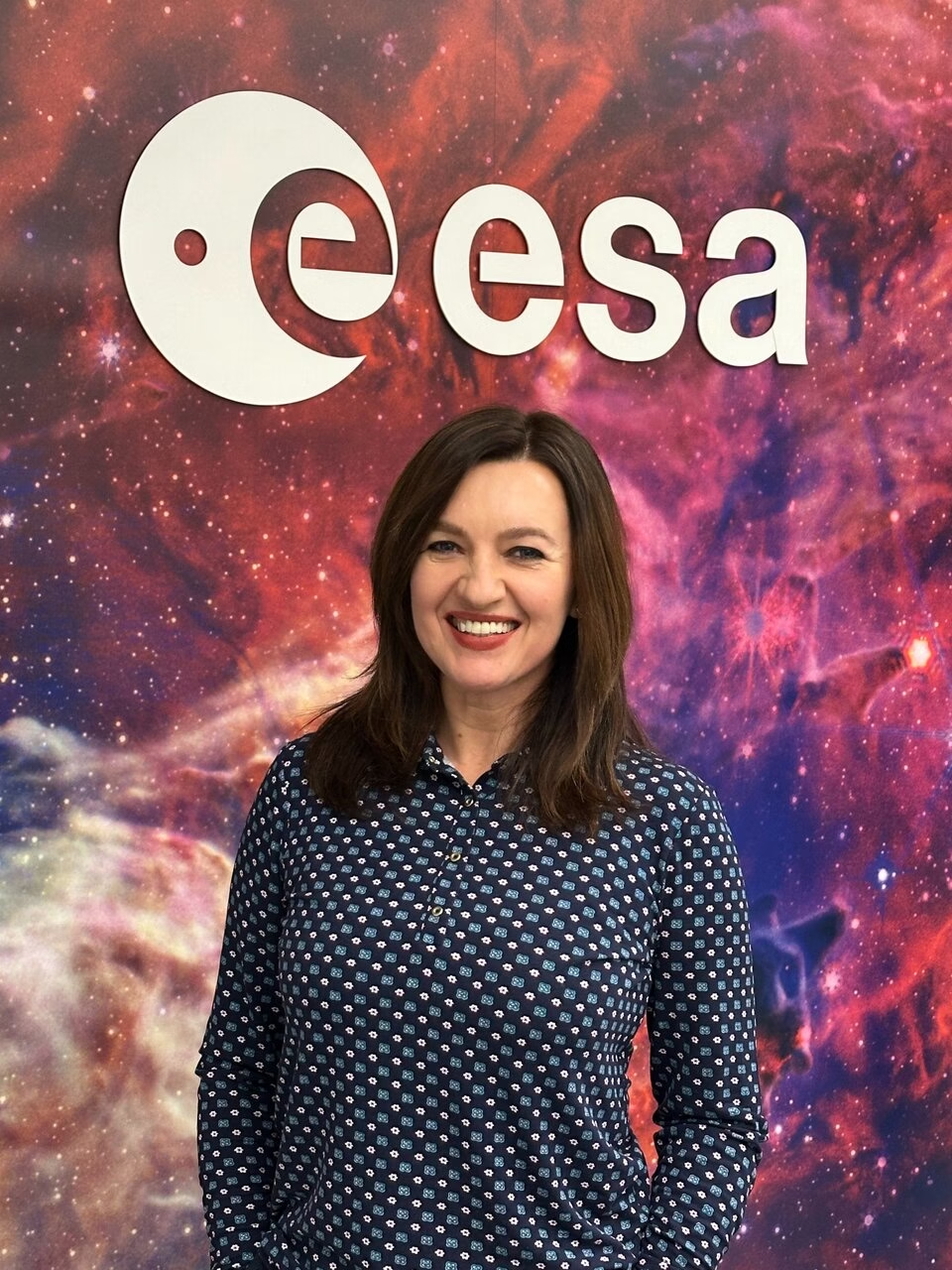
In the vast expanse of space exploration ESA’s Rising Female Leaders, where stars whisper secrets of the universe and rockets pierce the heavens, a quiet revolution is underway. It’s not just about launching satellites or probing distant planets—it’s about who is at the helm. The European Space Agency (ESA) is leading the charge in fostering gender diversity through ESA’s Rising Female Leaders, with women now comprising 37% of its new recruits and 27% of top management roles. This isn’t mere statistics; it’s a testament to the power of inclusion in one of the world’s most demanding fields.
At the forefront of this transformation are four remarkable women: Céline Begon, Christine Boelsche, Céline Folsché, and Ildiko Raczne Szoke. These leaders aren’t just breaking barriers—they’re redefining them, steering ESA toward a more equitable and innovative future. In this deep dive, we’ll explore their journeys, the challenges they’ve overcome, and how their work is propelling Europe into the stars. Whether you’re a space enthusiast, a STEM advocate, or someone inspired by stories of resilience, their tales remind us that the final frontier is for everyone.
The Imperative of Gender Balance in Space Exploration
Before we meet these trailblazers, let’s contextualize their impact. The space sector has long been a male-dominated arena, with historical figures like Yuri Gagarin and Neil Armstrong etching their names in the annals of history. Yet, as ESA’s Director General Josef Aschbacher has emphasized, diversity isn’t a checkbox—it’s a catalyst for progress. Studies from organizations like the International Astronautical Federation show that teams with balanced gender representation innovate 20% faster and make fewer errors in high-stakes environments.
ESA’s commitment shines through its recruitment stats: that 37% figure for new hires means young women are entering the fold in droves, bringing fresh perspectives to everything from satellite design to mission planning. And at 27% in top management, women are influencing strategic decisions that shape Europe’s role in global space endeavors. Initiatives like the agency’s Women@ESA network and targeted mentorship programs are fueling this shift, ensuring that talent isn’t sidelined by bias.
But numbers only tell part of the story. It’s the individuals behind them who humanize the mission. Let’s turn our gaze to the women who embody this evolution.
Céline Begon: Architect of Tomorrow’s Missions
Céline Begon might not yet be a household name, but within ESA’s corridors, she’s a force of nature. As a project manager in the agency’s Directorate of Technology, Innovation and Engineering, Begon oversees the development of cutting-edge propulsion systems—those invisible engines that propel spacecraft across the void. Her path to the stars wasn’t a straight shot; it wound through the engineering halls of France’s prestigious École Polytechnique, where she graduated with honors in aerospace mechanics.
What sets Begon apart is her relentless focus on sustainability. In an era where space debris threatens to clutter low-Earth orbit like cosmic litter, she’s championing “green propulsion” technologies. These eco-friendly thrusters, powered by non-toxic propellants, reduce the environmental footprint of satellite launches. “Space is finite,” Begon once shared in an internal ESA forum. “We must explore it responsibly, ensuring that our ambitions don’t outpace our stewardship.”
Her leadership style? Collaborative and empathetic. Under her guidance, a recent project team—diverse in gender, nationality, and expertise—delivered a prototype ahead of schedule, earning accolades at the 2025 International Space Symposium. For women eyeing careers in engineering, Begon’s mantra rings true: persistence paired with passion turns obstacles into orbits.
Begon’s influence extends beyond tech. She’s a vocal advocate for work-life integration, drawing from her own experiences as a mother of two. By pushing for flexible remote policies at ESA, she’s helped retain female talent post-maternity, proving that family and frontier aren’t mutually exclusive.
Christine Boelsche: Navigating the Data Deluge
If space exploration is a symphony, Christine Boelsche is the conductor of its digital crescendo. As head of ESA’s Earth Observation Data Analytics division, she wrangles petabytes of satellite imagery to decode our planet’s pulse—from climate shifts to urban sprawl. Based in Germany’s bustling space hub of Oberpfaffenhofen, Boelsche’s days are a blend of algorithm tweaking and stakeholder symposia.
A physicist by training from the University of Heidelberg, Boelsche stumbled into space via a summer internship at the German Aerospace Center (DLR). What began as curiosity evolved into a career decoding the likes of the Copernicus program, ESA’s flagship for environmental monitoring. Her breakthrough came in 2023, when she led the integration of AI-driven analytics into Sentinel-2 satellites, enabling real-time deforestation tracking with 95% accuracy. This isn’t abstract science; it’s actionable intelligence that’s informed policy in the Amazon and beyond.
Boelsche’s journey underscores the intersection of space and societal good. “Data from orbit isn’t just pixels,” she explains. “It’s a mirror reflecting humanity’s choices.” Her work on gender-inclusive data sets—ensuring algorithms don’t perpetuate biases—has made ESA’s tools more equitable, a nod to her belief that tech must serve all.
Mentorship is Boelsche’s quiet superpower. She co-founded ESA’s “Data Divas” initiative, a peer group for women in data science, where sessions blend technical deep dives with candid chats on imposter syndrome. For aspiring analysts, her advice is gold: “Embrace the unknown. In space, questions outnumber answers, and that’s where magic happens.”
Céline Folsché: Forging International Alliances
Diplomacy in space? It sounds oxymoronic amid the roar of engines, but Céline Folsché makes it look effortless. As ESA’s senior policy advisor on international cooperation, she bridges continents, negotiating partnerships that amplify Europe’s voice in forums like the United Nations Committee on the Peaceful Uses of Outer Space.
Hailing from Belgium’s bilingual heartland, Folsché cut her teeth in international law at the University of Brussels before pivoting to space governance. Her crowning achievement? Orchestrating the 2024 ESA-NASA memorandum on lunar exploration, which pooled resources for the Artemis Accords. This pact not only secures Europe’s stake in Moon missions but also embeds ethical guidelines for resource utilization—ensuring space remains a shared commons.
Folsché’s edge lies in her cultural fluency. Fluent in four languages, she navigates the nuances of deals with partners from Tokyo to Brasília, always prioritizing mutual benefit. “Space diplomacy is like chess,” she likens it. “Every move anticipates the board’s evolution.”
Yet, her role isn’t without hurdles. As one of few women in high-level negotiations, Folsché has faced skepticism, but she counters with data and demeanor. Her advocacy for gender quotas in international space consortia has rippled outward, influencing bodies like the Asia-Pacific Space Cooperation Organization.
For those drawn to the geopolitical side of space, Folsché offers inspiration: global challenges demand global minds, and diversity is the ultimate diplomat.
Ildiko Raczne Szoke: Innovating from the Ground Up
Rounding out our quartet is Ildiko Raczne Szoke, whose Hungarian roots infuse ESA’s launch infrastructure with ingenuity. As director of the agency’s Ground Systems Engineering department at ESTEC in the Netherlands, she ensures that every mission—from Ariane rocket liftoffs to rover deployments—sticks the landing, metaphorically and literally.
Szoke’s academic odyssey took her from Budapest’s Eötvös Loránd University, where she majored in telecommunications, to ESA via a competitive fellowship. Her signature project? The revamp of ESA’s deep-space network antennas, which boosted signal reliability for missions like Juice, the Jupiter explorer set for 2031 arrival. These upgrades, incorporating adaptive optics, have slashed data loss by 40%, a boon for probing icy moons teeming with potential life.
What fuels Szoke? A blend of precision and poetry. “Ground systems are the unsung heroes,” she notes. “They tether our dreams to reality.” Her team’s diversity—spanning engineers from 15 nations—mirrors ESA’s ethos, yielding solutions that no single perspective could conjure.
Szoke’s commitment to inclusion runs deep. She’s spearheaded “Launch Her Way,” a program pairing female interns with veteran mentors, demystifying the often-intimidating world of rocketry. Her story resonates with Eastern European talents breaking into Western-dominated fields: roots matter, but reach defines legacy.
ESA’s Blueprint for a Balanced Cosmos
These four women aren’t anomalies; they’re harbingers. ESA’s gender parity push is multifaceted, weaving through education outreach like the Fly! program, which introduces girls to aviation and space from primary school. Partnerships with universities ensure curricula spotlight women pioneers, from Sophie Wilson in computing to Valentina Tereshkova, the first woman in space.
Challenges persist—pay gaps linger at 15% in aerospace, per Eurostat data, and underrepresentation in hardware roles hovers at 20%. Yet, ESA’s trajectory is upward. By 2030, the agency aims for 40% women in management, backed by bias-training workshops and transparent promotion metrics.
The ripple effects? A more innovative Europe on the world stage. Diverse teams at ESA have accelerated breakthroughs like quantum-secure communications, vital for defending against cyber threats in orbit.
Why This ESA’s Rising Female Leaders Matters: A Call to the Stars
In celebrating Begon, Boelsche, Folsché, and Szoke, we glimpse a future where space isn’t a boys’ club but a global endeavor. Their stories—rooted in grit, graced by grace—invite us all to look up. For students, professionals, policymakers: the universe awaits your voice.
ESA’s progress proves that equity isn’t charity; it’s strategy. As Europe eyes Mars and beyond, these leaders ensure the journey reflects our world’s mosaic. What’s your next step toward the stars? The cosmos, after all, has room for dreamers of every stripe.
Starship Set to Launch Again Next Month: Elon Musk’s Bold Next Step in Space Exploration
FAQs: ESA’s Rising Female Leaders
Who are the ESA’s Rising Female Leaders?
ESA’s emerging female leaders include Céline Begon, a propulsion expert; Christine Boelsche, a data analytics pioneer; Céline Folsché, a diplomacy strategist; and Ildiko Raczne Szoke, a ground systems innovator. They represent the agency’s growing cadre of women driving space advancements.
What percentage of ESA’s new recruits are women?
Currently, women make up 37% of ESA’s Rising Female Leaders, a significant leap that underscores the agency’s dedication to fostering talent diversity in space exploration.
How does ESA promote gender balance in management?
ESA’s Rising Female Leaders advances gender equality through targeted initiatives like the Women@ESA network, mentorship programs, and flexible work policies. Women now hold 27% of top management positions, with goals to reach 40% by 2030.
What challenges do women face in the space industry?
Despite progress, women in aerospace encounter issues like a 15% pay gap and underrepresentation in technical roles. ESA counters these with bias training and inclusive recruitment to build a more equitable sector.
How can I get involved in ESA’s gender diversity efforts?
Aspiring individuals can join ESA’s outreach programs like ESA’s Rising Female Leaders Fly! for young girls, apply for internships via the agency’s career portal, or support advocacy groups pushing for STEM equity in Europe.
What impact do diverse teams have on space missions?
Research indicates diverse teams innovate 20% faster and reduce errors in complex tasks. At ESA, this translates to breakthroughs in sustainable tech and international collaborations, enhancing mission success rates.