
Launched by SpaceX, the Advanced GPS III-9 Satellite doesn’t fire missiles—but it controls them. Discover how this next-gen satellite gives the US Space Force battlefield dominance.
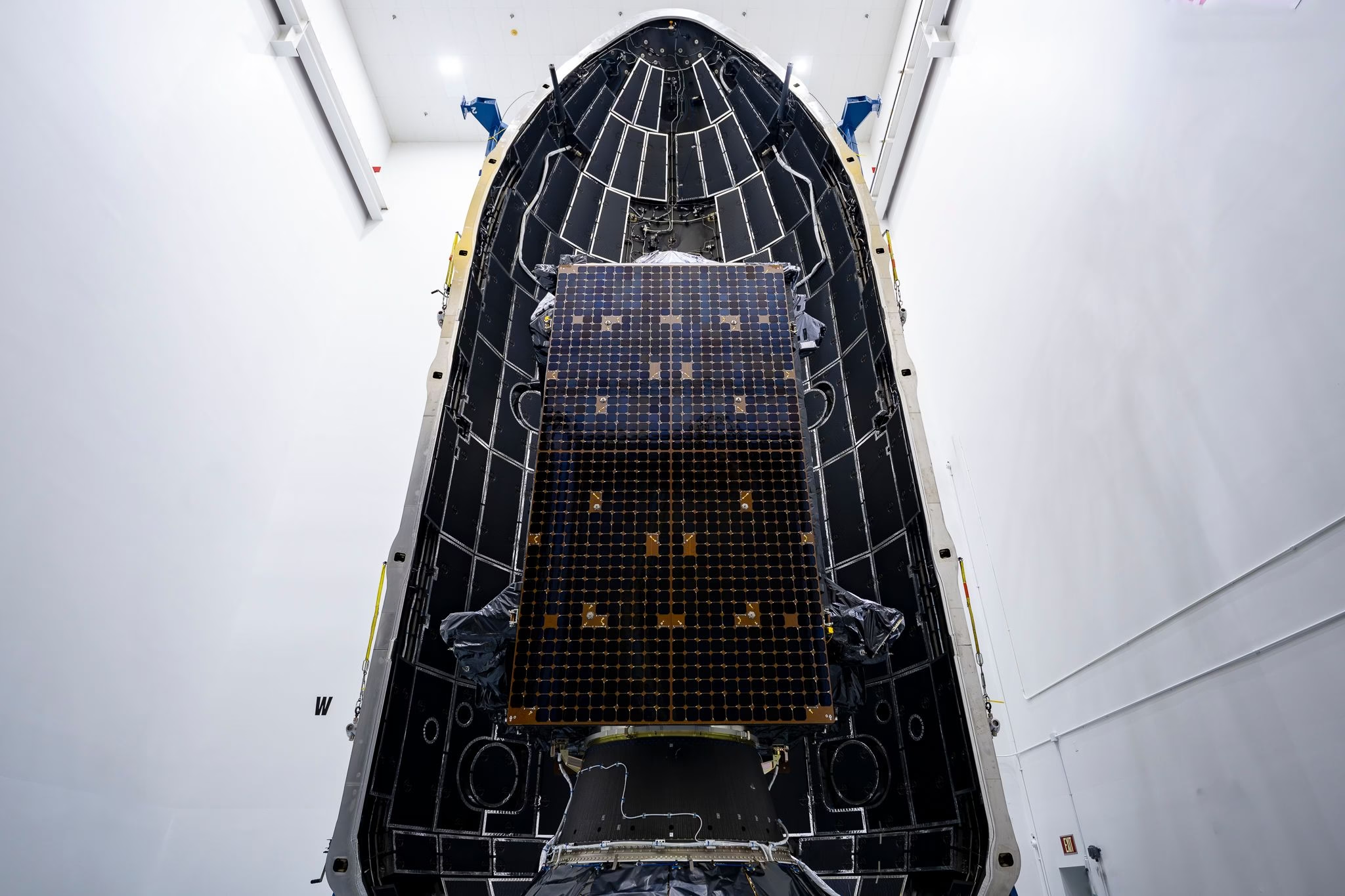
In an era where precision is everything—from guiding missiles to coordinating troop movements—the US Space Force is pushing the boundaries of technology. Imagine a satellite soaring through space, beaming down signals that could mean the difference between victory and defeat in a high-stakes conflict. That’s the reality with the GPS III-9, the latest powerhouse in America’s navigation arsenal.
Launched aboard a SpaceX Falcon 9 rocket, this advanced bird isn’t just another dot in the sky; it’s a game-changer for military operations. If you’ve ever wondered how modern warfare relies on invisible threads from orbit, stick around as we dive deep into how GPS III-9 works its magic for the US Space Force. We’ll break it down step by step, keeping things straightforward and engaging, so you can grasp why this tech matters in today’s world.
The Evolution of the Advanced GPS III-9 Satellite: From Basic Navigation to Battlefield Dominance
Let’s start at the beginning. The Global Positioning System (GPS) has been around since the 1970s, originally designed for military use before trickling down to your smartphone’s maps app. But the GPS III series? That’s next-level stuff. Built by Lockheed Martin, these satellites represent the third major upgrade to the constellation, with GPS III-9 being the ninth in line (hence the name, also known as Space Vehicle 09 or SV09).
What sets GPS III-9 apart from its predecessors? For one, it’s engineered for resilience in an increasingly contested space domain. Older GPS satellites were reliable, sure, but they weren’t built to handle the electronic warfare threats of today—think jamming signals from adversaries trying to throw off US forces. GPS III-9 steps up with enhanced anti-jamming capabilities, making it tougher for enemies to disrupt. This isn’t just about better accuracy; it’s about ensuring that soldiers, pilots, and sailors can trust their coordinates even when the heat is on.
Picture this: A fighter jet screaming through enemy airspace, relying on GPS for pinpoint targeting. Without advanced features like those in GPS III-9, a simple jammer could turn that mission into chaos. But with this satellite’s upgrades, the US Space Force maintains the upper hand. And speaking of launches, the story of how GPS III-9 got to orbit is a testament to American ingenuity and speed.
The Dramatic Launch: SpaceX’s Falcon 9 Delivers the Advanced GPS III-9 Satellite to Orbit
On January 28, 2026 the night sky over Cape Canaveral Space Force Station lit up as a SpaceX Falcon 9 rocket thundered into the heavens. This wasn’t your average launch; it was SpaceX’s third accelerated mission for the US Space Force under the National Security Space Launch program. Why accelerated? Because time is critical in national defense. Originally slated for a United Launch Alliance (ULA) Vulcan rocket, the mission switched to Falcon 9 for a quicker turnaround—proving that flexibility is key in space operations.
The Falcon 9, a reusable workhorse, carried GPS III-9 into a medium Earth orbit about 20,000 kilometers up. The first stage booster even landed back on Earth, showcasing SpaceX’s cost-saving tech. But beyond the spectacle, this launch highlighted the US Space Force’s commitment to rapid deployment. In a world where threats can emerge overnight, getting advanced assets like GPS III-9 online fast isn’t optional—it’s essential.
Once in orbit, GPS III-9 joined a constellation of over 30 satellites, but its advanced design makes it stand out. It weighs around 3,800 kilograms, packed with atomic clocks for ultra-precise timing and powerful transmitters for stronger signals. These aren’t just tweaks; they’re revolutionary for how the US Space Force operates.
Breaking Down the Tech: How GPS III-9 Actually Works
Alright, let’s get technical without overwhelming you. At its core, GPS works by triangulating your position using signals from multiple satellites. Each one broadcasts its location and the exact time the signal was sent. Your receiver (like in a military vehicle) calculates the distance based on how long the signal took to arrive, then plots your spot on Earth.
GPS III-9 elevates this with several key advancements. First up: the M-code signal. This is a military-exclusive, encrypted waveform that’s jam-resistant and harder to spoof. Unlike civilian signals, M-code uses spread-spectrum techniques to bury the data in noise, making it invisible to unauthorized users. For the US Space Force, this means secure navigation in denied environments—places where enemies actively try to block or fake GPS data.
Then there’s the improved signal strength. GPS III-9 broadcasts with up to eight times the power of older models, punching through interference like urban canyons or dense foliage. This boosts accuracy to within a meter or less, crucial for precision-guided munitions. Ever heard of “smart bombs”? They rely on this kind of tech to hit targets with minimal collateral damage.
The satellite also features better atomic clocks—rubidium and cesium types—that keep time to within nanoseconds over years. Why does timing matter? Because GPS isn’t just about position; it’s about synchronization. Think coordinated drone swarms or timed missile launches—everything hinges on perfect timing.
Onboard, GPS III-9 has a suite of sensors and processors for autonomous health monitoring. If something glitches, it can self-correct or alert ground control at Schriever Space Force Base in Colorado. This reduces downtime, ensuring the constellation stays robust. And for longevity? These birds are designed to last 15 years, with radiation-hardened components to survive space’s harsh radiation and temperature swings.
But how does all this tie back to the US Space Force? It’s about providing Positioning, Navigation, and Timing (PNT) services that underpin every branch of the military. From Navy ships plotting courses to Army units in the field, GPS III-9 ensures seamless operations.
Strategic Advantages: Why the Advanced GPS III-9 Satellite Gives the US Space Force an Edge
Now, let’s talk impact. The US Space Force, established in 2019, oversees all space-based assets, and GPS is its crown jewel. With GPS III-9 operational (designated USA-574 once active), the force gains enhanced resilience against great-power competitors like China or Russia, who have their own navigation systems and anti-satellite weapons.
One big win: Anti-jamming. In simulations, M-code has shown it can resist jamming levels 100 times stronger than what legacy signals handle. This is huge for operations in hotspots like the South China Sea or Eastern Europe, where electronic warfare is rampant. Soldiers can navigate confidently, knowing their GPS won’t flake out.
Another perk: Global coverage with redundancy. Adding GPS III-9 means fewer gaps in the constellation, providing 24/7 availability worldwide. For special ops teams in remote areas, this could be lifesaving.
Beyond defense, there’s a civilian upside—though our focus is military. The L1C signal on GPS III-9 is interoperable with systems like Europe’s Galileo, improving international cooperation. But for the Space Force, it’s all about dominance: Precise PNT enables hypersonic weapons, autonomous vehicles, and cyber-synced battlespaces.
Looking ahead, GPS III-9 paves the way for GPS IIIF satellites, which add even more features like laser retroreflectors for better tracking and regional military protection signals up to 60 times more jam-resistant in targeted areas. It’s a stepping stone to a future where space is the ultimate high ground.
Challenges and the Road Ahead for Space-Based Navigation
Of course, no tech is perfect. Space is a tough neighborhood—solar flares, debris, and cyber threats all pose risks. The US Space Force is countering with initiatives like the Next-Generation Operational Control System (OCX), which will fully manage GPS III capabilities. But adversaries are advancing too; China’s BeiDou and Russia’s GLONASS are catching up, forcing constant innovation.
Budget-wise, each GPS III satellite costs around $500 million, but the ROI is immense—trillions in economic value from GPS alone. The Space Force’s push for commercial partnerships, like with SpaceX, keeps costs down and speeds up launches.
As we wrap this up, think about how GPS III-9 isn’t just hardware; it’s a symbol of American resolve in space. In an interconnected world, controlling navigation means controlling outcomes. Whether you’re a defense enthusiast or just curious about tech, understanding this satellite shows how far we’ve come—and where we’re headed.
Reference: https://x.com/i/trending/2016365960265936973
FAQs About the Advanced GPS III-9 Satellite
What is GPS III-9, and why is it important?
GPS III-9 is the ninth satellite in the Advanced GPS III-9 Satellite series, launched to enhance military navigation. It’s crucial for providing jam-resistant, precise signals that support US Space Force operations in contested environments.
How does the M-code signal work on GPS III-9?
M-code is an encrypted military signal that uses advanced modulation to resist jamming and spoofing. It ensures secure, accurate positioning for warfighters, even under electronic attacks.
What was unique about the GPS III-9 launch?
It was SpaceX’s third accelerated mission for the US Space Force, switching from a ULA Vulcan to Falcon 9 for faster deployment, highlighting rapid-response capabilities.
How accurate is the Advanced GPS III-9 Satellite compared to older satellites?
It offers meter-level accuracy with stronger signals, up to eight times more powerful, improving reliability in challenging conditions like urban areas or dense terrain.
What future upgrades are planned beyond GPS III-9?
The GPS IIIF series will include enhanced anti-jamming in specific regions, better tracking, and more resilience, building on the foundation laid by GPS III-9.
Does the Advanced GPS III-9 Satellite benefit civilians too?
Yes, it includes the L1C signal for better compatibility with global systems, indirectly improving everyday navigation apps, though its primary role is military.
How long will the Advanced GPS III-9 Satellite last in orbit?
Designed for a 15-year lifespan, with robust components to handle space radiation and other hazards, ensuring long-term service for the US Space Force.
https://spacetime24.com/advanced-u-s-space-force-gps-iii-9-satellite/