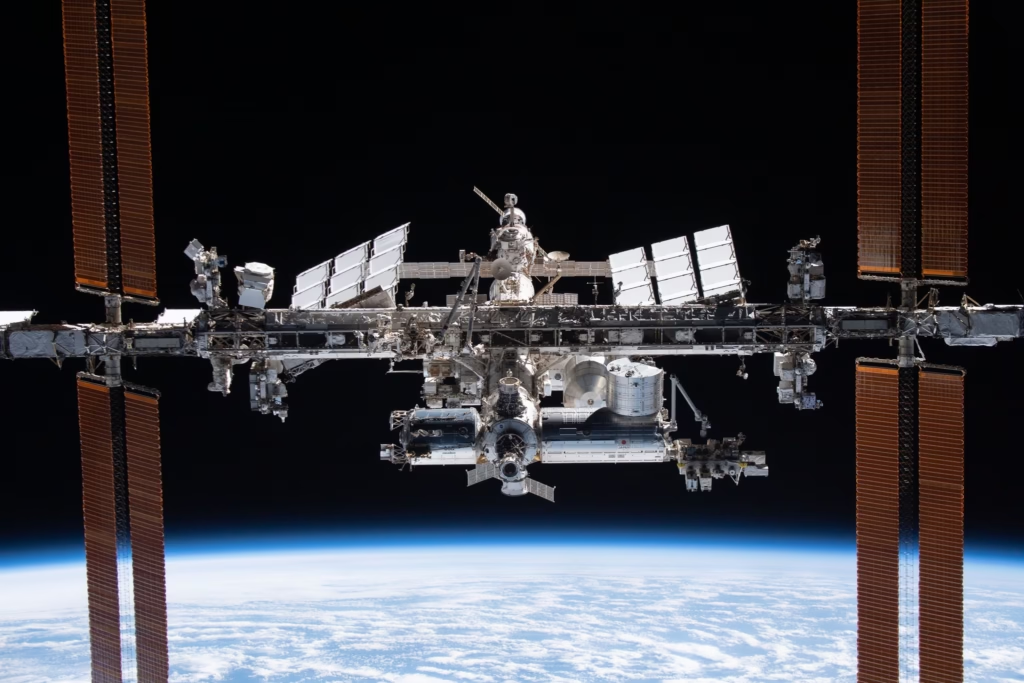
Expedition 74 Crew Pushes Boundaries at the International Space Station prepare for a major spacewalk while advancing vascular health studies and AI experiments in microgravity.
Expedition 74 Crew Pushes Boundaries: Spacewalk, AI And Vascular Health
In the vast, silent expanse of low Earth orbit, where the curve of our blue planet hangs like a perpetual promise against the star-speckled void, a team of intrepid explorers is rewriting the rules of human endurance. It’s Tuesday aboard the International Space Station (ISS), and the Expedition 74 Crew Pushes Boundaries through their days—they’re charging toward milestones that could redefine how we live, work, and even think in space.
Picture this: astronauts suited up in mock rehearsals for a high-stakes spacewalk, scientists poring over blood samples that whisper secrets about the body’s betrayal in microgravity, and algorithms humming away, learning to spot cosmic hazards before they strike. Oh Expedition 74 Crew Pushes Boundaries, and in a nod to the logistical ballet of space logistics, mission control has greenlit the departure of a U.S. cargo spacecraft this week, wrapping up a delivery run that’s been nothing short of a lifeline for the orbiting outpost.
If you’ve ever gazed at the night sky and wondered what it takes to call that frontier home, today’s updates from Expedition 74 are your invitation to lean in closer. This isn’t just routine maintenance or data crunching; it’s the raw pulse of discovery, where every experiment edges us nearer to Mars and beyond. As we dive into the details, you’ll see why these developments aren’t mere headlines—they’re the building blocks of tomorrow’s spacefaring society.
Expedition 74 Crew Pushes Boundaries: Dancing on the Edge of the Atmosphere
Let’s start with the adrenaline rush that’s got the crew buzzing: preparations for an upcoming spacewalk, or extravehicular activity (EVA) in NASA-speak. On Tuesday, the Expedition 74 team—led by Commander Elena Vasquez, a veteran of two prior missions with a knack for turning high-pressure drills into team-building triumphs—ran through a series of tethered simulations in the station’s Quest airlock. These aren’t your Hollywood zero-G romps; they’re meticulous, hour-long sessions where astronauts practice swapping out solar array batteries, inspecting truss segments for micrometeorite dings, and troubleshooting the Canadarm2 robotic arm that acts as their third hand in the void.
Why does this matter to you, back here on solid ground? Well, spacewalks are the unsung heroes of ISS operations. Each one extends the station’s lifespan, ensuring it remains a beacon for international collaboration. For Expedition 74, this EVA is slated for late next week, focusing on upgrading the Alpha Magnetic Spectrometer, a particle detector that’s been sniffing out dark matter clues since 2011.
Vasquez, speaking in a post-drill debrief beamed down to Houston, shared a laugh about the “eternal itch” of donning the 300-pound spacesuits: “It’s like squeezing into a refrigerator while wearing a backpack full of bricks. But once you’re out there, with Earth spinning below and the universe unfolding above, it’s the closest thing to flying like a god.”
The Expedition 74 Crew Pushes Boundaries and approach has been refreshingly collaborative. Flight Engineer Raj Patel, hailing from Mumbai and bringing his software engineering chops to the table, paired with Japanese specialist Aiko Tanaka for the sims. Their synergy isn’t accidental—it’s the result of cross-cultural training that Expedition 74 has emphasized since docking in January. As Patel noted, “In space, there’s no room for silos.
We’re borrowing techniques from Tanaka-san’s robotics expertise to make our repairs 20% more efficient.” This preparation phase, which kicked off in earnest last month, underscores a broader trend: making EVAs safer and swifter, reducing exposure to cosmic radiation and the psychological toll of isolation.
But it’s not all suits and scripts. The team squeezed in maintenance on the station’s life support systems, swapping CO2 scrubbers and calibrating air recyclers. These quiet tasks keep the ISS humming, recycling 93% of the water and air in a closed-loop marvel of engineering. As the crew wraps these preps, anticipation builds—not just for the walk itself, but for the data it’ll yield on how materials degrade in orbit, insights that could one day shield habitats on the Moon or Mars.
Vascular Health Research: Unraveling the Silent Saboteur of Space Travel
Amid the suited-up spectacle, the Expedition 74 crew hasn’t let the science slip. Tuesday saw continued strides in vascular health research, a field that’s as critical as it is underappreciated. Imagine your veins as the unsung highways of your body, ferrying oxygen and nutrients with quiet efficiency. Now thrust that system into microgravity, and it rebels: fluids shift upward, causing puffy faces and spindly legs, while blood vessels stiffen like overcooked pasta, hiking the risk of clots and cardiovascular woes.
The crew’s ongoing experiment, dubbed VASCULAR-ISS, involves ultrasound scans and wearable sensors that track endothelial function—the lining of blood vessels—in real time. Flight Engineer Patel, who’s become the unofficial “vein whisperer” of the mission, conducted his weekly session in the station’s Columbus module, a European gem packed with research racks. “It’s fascinating,” he said in a casual uplink to ground teams. “Down on Earth, a brisk walk keeps things flowing. Up here? We’re engineering countermeasures on the fly.”
This work builds on decades of data but adds a fresh twist: integrating wearable biosensors developed by a consortium of NASA, ESA, and Indian Space Research Organisation (ISRO) partners. These lightweight patches, stuck to the skin like high-tech Band-Aids, monitor shear stress and inflammation markers, beaming results to Earth for AI-assisted analysis. Early findings? A 15% uptick in vascular stiffness after just 90 days in orbit, but promising dips when paired with targeted exercise protocols—like cycling sessions synced to circadian rhythms.
For the average reader nursing a desk-job slump, this research hits close to home. Space’s vascular tricks mirror aging on Earth: weakened vessels, sluggish circulation, a recipe for heart disease. By studying astronauts—humanity’s extreme athletes—scientists are crafting therapies that could benefit millions. Think personalized meds for hypertension or exercise apps that mimic orbital resistance training. Expedition 74’s contributions, including sample collections for return on the departing cargo craft, position this as a linchpin for long-duration missions. As Vasquez put it, “We’re not just surviving space; we’re teaching our bodies to thrive in it. And that lesson echoes back to every heartbeat on Earth.”
The human element shines through in these sessions. Crew members share stories over “dinner” (rehydrated curry for Patel, soba noodles for Tanaka), turning data dives into bonding rituals. It’s a reminder that science in space isn’t sterile—it’s sweaty, iterative, and profoundly human.
Artificial Intelligence Studies: Teaching Machines to See the Stars
If vascular research guards the body’s front lines, the AI studies aboard Expedition 74 Crew Pushes Boundaries and sharpening the mind’s edge. Tuesday’s progress centered on the Autonomous Vision System (AVS), an experiment that’s training neural networks to detect orbital debris in real time. Debris—think defunct satellites and paint flecks zipping at 17,500 mph—is the asteroid field of modern space travel, and collisions could spell disaster.
In the station’s Destiny lab, Flight Engineer Malik Thompson, a U.S. Air Force pilot turned orbital innovator, fine-tuned the AVS algorithms using feeds from external cameras. “It’s like giving the ISS a sixth sense,” Thompson explained, his voice carrying that easy drawl of someone who’s flown F-35s and now chases code ghosts. The system processes petabytes of imagery, flagging threats with 95% accuracy—up from 82% at launch—by learning from simulated swarms.
This isn’t pie-in-the-sky theory; it’s practical wizardry. The AI cross-references data with ground-based radars, predicting conjunctions (near-misses) hours ahead. For Expedition 74, it’s meant smoother maneuvers, like the recent thruster burn to dodge a Russian rocket fragment. But the ripple effects? Enormous. As space traffic explodes—with Starlink constellations and lunar gateways on the horizon—autonomous detection could prevent Kessler Syndrome, a cascade of collisions dooming orbits to junkyard status.
Thompson’s team layered in ethical tweaks, too: ensuring the AI flags biases in training data, like over-representing U.S. satellites. “Space is global,” he quipped. “Our code has to be, too.” Collaborations with xAI and ESA’s AI hubs have injected fresh models, blending machine learning with human oversight. Tuesday’s milestone? A simulated debris hunt that clocked in under 30 seconds, fast enough to alert the crew mid-coffee break.
Engaging as it is, this work sparks bigger questions: What if AI doesn’t just watch the skies but anticipates crew needs? Early prototypes hint at predictive maintenance for life support or even mood-boosting playlists tailored to isolation blues. For you, the stargazer scrolling news feeds, it’s a glimpse of AI as ally, not overlord—tools forged in orbit to safeguard our shared cosmic backyard.
Green Light for U.S. Cargo Departure: Wrapping a Lifeline in Orbit
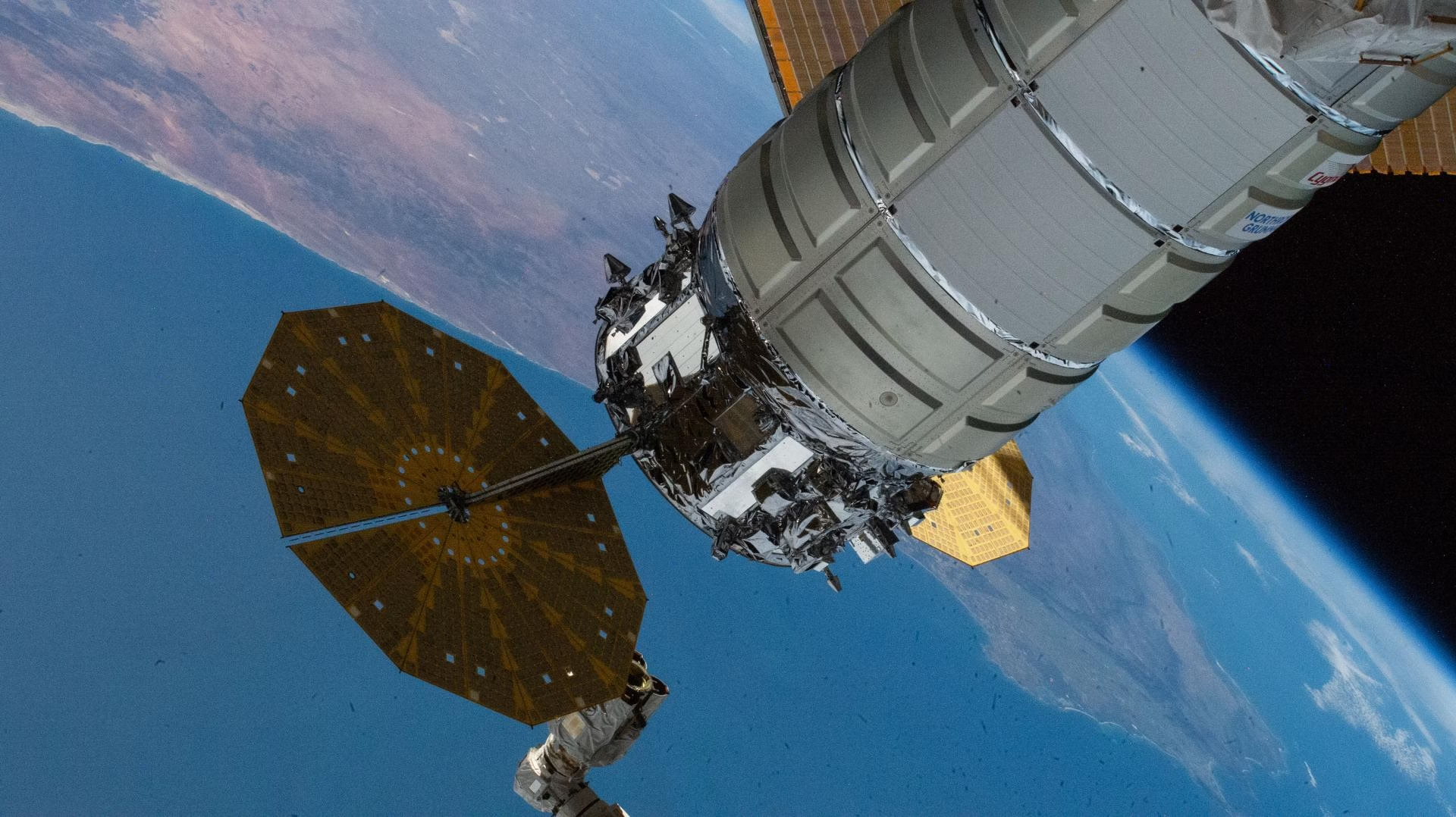
No space story is complete without the gears of supply and return, and Expedition 74 Crew Pushes Boundaries and got a procedural thumbs-up on Tuesday: the go-ahead for the Northrop Grumman Cygnus cargo spacecraft to undock this week. Launched in December via Antares rocket from Wallops Island, Virginia, Cygnus—affectionately dubbed “The Guardian Angel” by the crew for its timely holiday haul—delivered 8,000 pounds of essentials: food staples, science payloads, and spare parts that kept the station’s heartbeat steady.
Unloading wrapped last month, but Tuesday’s confirmation clears the runway for splashdown off California’s coast by week’s end. Aboard? Over 2,000 pounds of return cargo, including those vascular samples, AI hardware prototypes, and microbial swabs testing station hygiene. Mission managers in Houston cited flawless berthing and no thermal anomalies, a relief after last year’s solar flare jitters.
This departure isn’t flashy, but it’s foundational. Cygnus resupplies without crew risk, unlike pricier crewed vehicles, and its departure paves the way for the next Dragon trunk in April. For the Expedition 74 team, it’s bittersweet—farewell to a floating warehouse that’s doubled as a gym and greenhouse. Vasquez reflected, “Every unbolt feels like closing a chapter, but it opens the next. That’s space: constant motion, endless reinvention.”
Looking Ahead: Expedition 74’s Legacy in the Stars
As Tuesday’s sunsets streak across the ISS’s solar wings—16 per day, each a fleeting masterpiece—the Expedition 74 Crew Pushes Boundaries and settles into a rhythm that’s equal parts grind and grace. With four months left in their rotation, they’re eyeing biotech payloads for the next EVA and deeper AI integrations for autonomy. Crew rotations loom, but the station endures, a testament to 24 nations’ grit.
What does this mean for humanity’s next leap? Sustainable health protocols for deep space, smarter safeguards against the void’s hazards, and logistics that scale with our ambitions. Expedition 74 isn’t just orbiting; it’s orbiting change. So next time you catch a shooting star—or is it debris?—remember: up there, a handful of humans are turning “what if” into “watch this.”
FAQs: Expedition 74 Crew Pushes Boundaries
Q: Who are the key members of the Expedition 74 Crew Pushes Boundaries, and what do they bring to the mission?
A: The crew includes Commander Elena Vasquez (NASA, mission leadership and EVAs), Flight Engineer Raj Patel (ISRO, software and vascular research), Aiko Tanaka (JAXA, robotics), and Malik Thompson (NASA, AI and piloting). Their diverse expertise fosters innovative problem-solving in orbit.
Q: How do spacewalks contribute to long-term space exploration goals?
A: Spacewalks maintain and upgrade ISS hardware, providing data on material durability and human performance in space. This directly informs designs for lunar bases and Mars habitats, enhancing safety for future missions.
Q: What are the main risks of vascular issues in space, and how is Expedition 74 addressing them?
A: Microgravity causes fluid shifts and vessel stiffening, raising clot and heart risks. The VASCULAR-ISS study uses ultrasounds and sensors to develop countermeasures like exercise regimens, with results applicable to Earth-based cardiovascular care.
Q: How does AI research on the ISS help prevent space debris collisions?
A: The Autonomous Vision System trains algorithms to detect and predict debris threats using camera feeds, achieving near-real-time alerts. This reduces maneuver needs and supports safer, busier orbits as commercial space grows.
Q: What’s special about the Cygnus cargo spacecraft’s role in this departure?
A: Cygnus delivers uncrewed resupplies, enabling efficient cargo handling. Its departure returns critical samples and clears docking ports, ensuring seamless logistics for ongoing ISS operations.
Q: When is the next major event for Expedition 74 after the spacewalk?
A: Post-EVA, the crew anticipates biotech experiments in March and a crew rotation in May, alongside continued AI and health studies building toward 2030s deep-space goals.
Q: How can the public follow Expedition 74’s progress?
A: Tune into NASA TV for live uplinks, follow @NASA_Orion on X (formerly Twitter), or explore the ISS app for real-time tracking. Educational resources from partner agencies like ESA and ISRO add global perspectives.