
Celebrating NASA’s Mars Reconnaissance Orbiter 20th Anniversary with a striking HiRISE image of a fresh crater near Sirenum Fossae, revealing clues about Mars’ evolving surface.
Imagine a spacecraft that has quietly circled Mars more than 70,000 times, snapping pictures sharp enough to spot a dinner table from 150 miles up. That is exactly what NASA’s Mars Reconnaissance Orbiter (NASA’s Mars Reconnaissance Orbiter 20th Anniversary) – better known as MRO – has been doing since it slipped into orbit around the Red Planet two decades ago. On March 10, 2026, the agency marked this milestone by sharing a striking reminder of the orbiter’s enduring power: a high-resolution view of a relatively fresh impact crater nestled near the rugged terrain of Sirenum Fossae.
This is not just another pretty picture from space. It is a window into Mars’ dynamic past and present, captured by an instrument that has rewritten our understanding of the planet. As we celebrate NASA’s Mars Reconnaissance Orbiter 20th Anniversary at Mars, this image invites us to look closer at one small crater and see the bigger story of water, geology, and the promise of human exploration that lies ahead.
A Remarkable Journey Begins: Celebrating NASA’s Mars Reconnaissance Orbiter 20th Anniversary
The story of MRO starts back on a warm Florida morning in 2005. On August 12, a powerful Atlas V rocket roared off Launch Complex 41 at Cape Canaveral, carrying the spacecraft on a seven-month cruise to the Red Planet. Engineers had packed it with six sophisticated science instruments, a massive high-gain antenna for beaming data home, and solar panels designed to keep everything running in the harsh environment of deep space.
Arrival was no small feat. On March 10, 2006, MRO fired its main engines for a nerve-wracking 27 minutes, slowing down just enough to be captured by Mars’ gravity. Then came six months of careful aerobraking – dipping into the thin Martian atmosphere hundreds of times to trim its orbit without burning extra fuel. By late 2006, the orbiter had settled into its final path: a polar orbit that lets it pass over every part of Mars every few days while staying close enough for razor-sharp observations.
From the very beginning, the mission’s goal was clear. Scientists wanted to understand the history of water on Mars – not just whether it existed, but how long it lasted and where it went. They also needed detailed maps to help future landers and rovers find safe places to touch down. Twenty years later (NASA’s Mars Reconnaissance Orbiter 20th Anniversary), MRO has done far more than anyone dared hope. It is still healthy, still taking pictures, and still serving as the reliable communications relay that keeps other Mars missions connected to Earth.
Meet the Star of the Show: HiRISE
At the heart of MRO’s success sits the High Resolution Imaging Science Experiment, or HiRISE – the most powerful camera ever sent to another planet. Built by the University of Arizona, this instrument can resolve features as small as a dinner table from orbit. That is ten times better than any previous Mars orbiter camera.
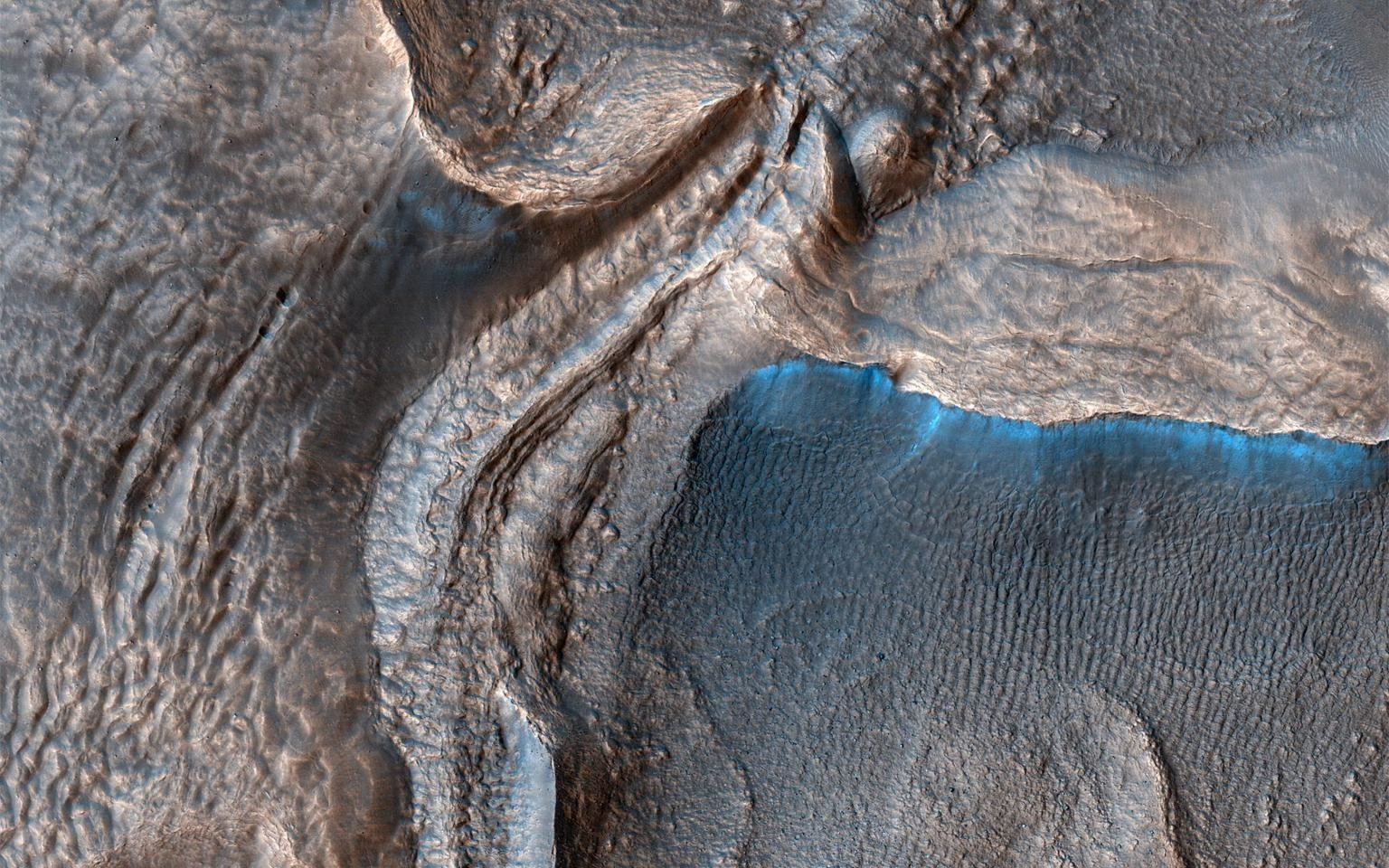
HiRISE does not just take snapshots. It captures stereo pairs for 3D views, color images that reveal subtle mineral differences, and long strips that stitch together into breathtaking panoramas. Over the years, it has delivered more than 100,000 images, including the one being highlighted for the anniversary.
The crater near Sirenum Fossae is a perfect example of what makes HiRISE special. First released in 2015 but now spotlighted for the 20th anniversary, the image shows a roughly 100-foot-wide impact scar with a crisp, unworn rim and a bright blanket of ejecta – the material blasted outward when a meteorite struck. These features tell planetary scientists the crater is geologically young, perhaps only a few million years old or even less. On a planet where erosion is slow, that kind of sharpness is rare.
Inside the Crater: Clues to Recent Activity
Zoom in further and the story gets even more intriguing. The steep inner walls are etched with gullies – sinuous channels that look remarkably like those carved by water on Earth. Even more fascinating are the dark streaks known as recurring slope lineae, or RSL, visible on the equator-facing slopes. These streaks appear seasonally, darkening in summer and fading in winter.
For years, many researchers hoped RSL might be evidence of salty liquid water trickling down the slopes. The latest understanding, however, points to a different but still exciting process: dry flows of sand and dust triggered by seasonal warming. Either way, the fact that MRO can monitor these changes over time is a scientific goldmine. Scientists revisit this particular crater regularly, comparing new images with older ones to watch for fresh activity. Each new observation adds another piece to the puzzle of how Mars behaves today.
Sirenum Fossae itself is a fascinating neighborhood on Mars. Located in the southern highlands, this region features long, parallel fractures formed by ancient tectonic stresses. The crater sits right at the edge of this fractured landscape, giving scientists a front-row seat to how impacts, faulting, and seasonal processes interact.
Two Decades of Discovery: NASA’s Mars Reconnaissance Orbiter 20th Anniversary
While the anniversary image is eye-catching, it represents just one frame in an enormous library of data. Since 2006, MRO has returned hundreds of terabits of information – enough to fill thousands of high-definition movies. That data has transformed our view of Mars from a cold, dry desert into a world that once had rivers, lakes, and possibly even oceans.
HiRISE and MRO’s other instruments have mapped ancient shorelines, identified clay minerals that could only form in long-standing water, and spotted vast underground ice deposits. The orbiter’s ground-penetrating radar has revealed layers of ice the size of Lake Superior buried just beneath the surface in some places. Its spectrometer has found evidence of hot-spring-like environments that, on Earth, teem with microbial life.
MRO has also played a critical supporting role in every major Mars surface mission of the past two decades. When NASA needed to choose a landing site for the Phoenix lander, MRO images helped confirm it was safe. The same went for Curiosity and Perseverance rovers – the orbiter scouted for hazards and even relayed their data back to Earth when direct communication was limited. Today, it continues that vital relay work for ongoing missions while scouting potential landing zones for future human explorers.
Perhaps most remarkably, MRO has shown us that Mars is still changing. Dust devils carve fresh tracks, dunes march across the landscape, and new craters appear every few years. The orbiter has even photographed the scars left by meteors that struck while it was watching – a real-time record of planetary evolution.
Why NASA’s Mars Reconnaissance Orbiter 20th Anniversary Matters for the Future
As NASA prepares to send astronauts to Mars in the coming decades, MRO’s two decades of work are proving more valuable than ever. The orbiter has identified water-ice resources that could one day be mined for drinking water, oxygen, and rocket fuel. It has mapped terrain hazards and found mineral deposits that tell us where to look for signs of ancient life.
The crater near Sirenum Fossae is a perfect case study. Its gullies and seasonal streaks remind us that Mars still holds surprises – and that understanding those surprises will be essential when humans take their first steps on the surface. Every image MRO sends back helps engineers design better spacesuits, landers, and habitats.
Looking ahead, the mission team plans to keep the orbiter operating as long as its solar panels and instruments allow. With careful fuel management, MRO could easily reach its 25th or even 30th anniversary at Mars. Meanwhile, newer spacecraft like the Mars Sample Return orbiters and eventual human missions will build directly on the foundation MRO has laid.
A Lasting Legacy: NASA’s Mars Reconnaissance Orbiter 20th Anniversary
Twenty years ago, few people imagined that a single orbiter could still be making headlines in 2026. Yet here we are, marveling at a crisp image of a crater that looks almost as fresh as the day it formed. That longevity speaks to the skill of the engineers who built MRO, the dedication of the scientists who operate it, and the sheer scientific value of studying our neighboring planet.
As we celebrate this milestone, the crater near Sirenum Fossae stands as a symbol of MRO’s quiet but profound impact. It reminds us that exploration is not just about reaching a destination – it is about staying long enough to truly understand what we find.
The next time you look up at the red dot in the night sky, remember that a faithful spacecraft is still up there, circling, watching, and sending home stories from another world. And thanks to its two decades of service, those stories are clearer and more compelling than ever before.
FAQs: Celebrating NASA’s Mars Reconnaissance Orbiter 20th Anniversary
What exactly is the Mars Reconnaissance Orbiter?
MRO is a NASA spacecraft launched in 2005 that has been orbiting Mars since March 2006. It carries cameras, spectrometers, and radar designed to study the planet’s surface, subsurface, and atmosphere in unprecedented detail.
When did MRO reach its 20th anniversary at Mars?
The orbiter achieved orbit insertion on March 10, 2006. NASA marked the 20-year milestone on March 10, 2026, with the release of the featured crater image.
What makes the crater near Sirenum Fossae special?
This relatively young impact crater has a sharp rim, bright ejecta blanket, gullies on its inner slopes, and seasonal dark streaks called recurring slope lineae. Scientists monitor it regularly to track changes over time.
Are the dark streaks on the crater walls caused by water?
Current evidence suggests they are flows of dry sand and dust triggered by seasonal warming rather than liquid water. Earlier observations sparked debate, but continued monitoring by MRO has helped refine our understanding.
How has MRO helped other Mars missions?
The orbiter has scouted safe landing sites, provided high-resolution maps, and served as a communications relay for landers and rovers including Phoenix, Curiosity, and Perseverance.
How many images has MRO taken?
Its HiRISE camera alone passed the 100,000-image mark in late 2025. The full mission has returned hundreds of terabits of data – more than any previous Mars orbiter.
Will MRO keep operating after its 20th anniversary?
Yes. The spacecraft remains healthy, and mission managers plan to continue science and relay operations for as long as possible to support future human exploration.
Why is studying craters like this one important for future astronauts?
These features reveal recent geological activity, potential ice resources, and surface hazards. The knowledge gained helps engineers design safer landing systems and identify usable water ice for long-term stays on Mars.
In the end, NASA’s Mars Reconnaissance Orbiter 20th Anniversary and it’s journey proves that patience and precision in space exploration pay off in ways we are only beginning to appreciate. Here is to many more years of discovery from our steadfast observer above the Red Planet.