
Northrop Grumman Cygnus XL cargo spacecraft departs the International Space Station today at 7 a.m. ET. Learn the mission timeline, cargo details, reentry plans, and what it means for NASA’s Commercial Resupply Services program.
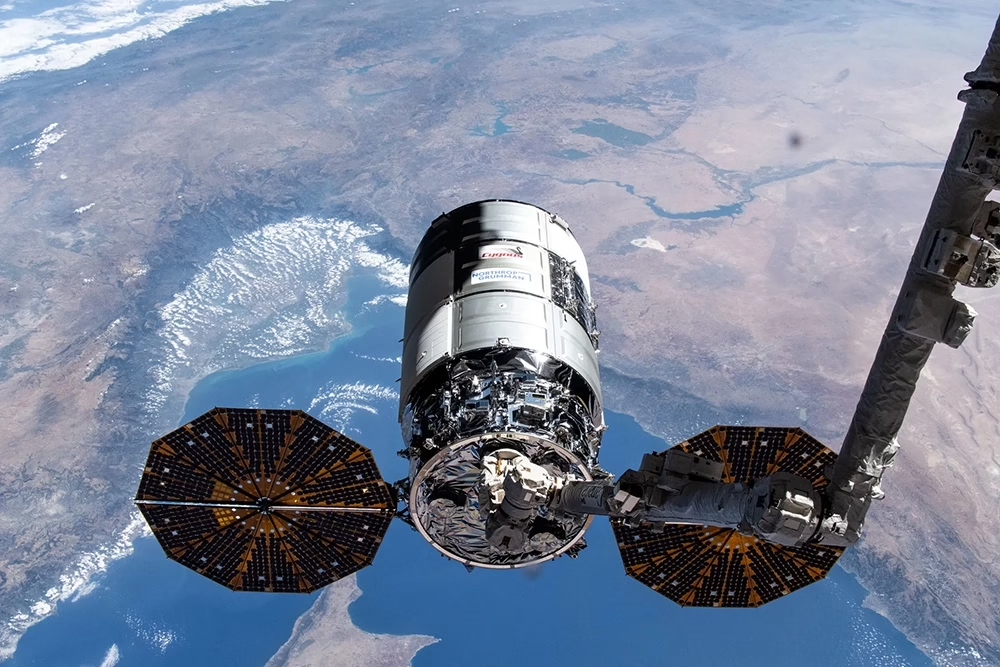
The International Space Station is about to lose one of its most dependable visitors. At precisely 7 a.m. Eastern Time (1100 UTC) today, Northrop Grumman’s uncrewed Cygnus XL spacecraft will slip away from the orbiting laboratory after weeks of close partnership. This quiet undocking marks the end of another successful Commercial Resupply Services mission and clears the way for the next chapter of crewed and cargo operations 250 miles above Earth.
For anyone who has followed the steady rhythm of space-station life, the moment feels both routine and remarkable. The station never sleeps. Supplies arrive, experiments run, waste is packed, and then the visitors leave so the next ones can dock. Today’s departure of the Cygnus XL is the latest reminder that private ind12001200ustry and NASA are working in seamless harmony to keep humanity’s outpost alive.
The Cygnus XL is no ordinary spacecraft. Built by Northrop Grumman, it represents the evolved version of the original Cygnus design, boasting greater cargo capacity and improved solar arrays that drink in more sunlight for power. Over the years these spacecraft have quietly become the backbone of American resupply efforts, ferrying everything from fresh food and clothing to cutting-edge science hardware that researchers on the ground could never test in Earth’s gravity.
This particular mission began months ago when the Cygnus lifted off from Wallops Flight Facility in Virginia aboard an Antares rocket. Once safely in orbit, it chased the station, performed a flawless rendezvous, and was gently grappled by the Canadarm2 robotic arm before being berthed to the Unity module. Inside its pressurized cargo module sat more than 8,000 pounds of equipment, crew provisions, and research payloads. Outside, on the exposed pallet, rode external hardware destined for installation during spacewalks.
Now the cycle reverses. The crew aboard the station has spent the last few days loading the Cygnus with trash, obsolete equipment, and completed experiment samples that need to return to Earth for analysis or simply be disposed of safely. Engineers on the ground have double-checked every thruster, every command sequence, and every backup plan. At 7 a.m. ET the station’s robotic arm will once again reach out, unberth the spacecraft, and hold it steady a few meters away. Ground controllers will then command the Cygnus to fire its attitude-control thrusters, gently pushing it clear of the station’s keep-out zone.
From that point forward the spacecraft operates on its own. It will perform a series of departure burns to move into a lower orbit, collect final science data if any late-breaking experiments are aboard, and ultimately meet a fiery end in Earth’s atmosphere over a remote stretch of ocean. Nothing will be wasted; even the final plunge helps scientists study atmospheric re-entry physics.
Why does this matter beyond the obvious? Because every successful Cygnus departure proves that commercial spaceflight has matured. Ten years ago the idea of private companies routinely delivering and removing cargo from a $100-billion orbiting laboratory sounded ambitious. Today it is simply Tuesday. Northrop Grumman’s reliability has freed NASA to focus on deeper exploration goals—Artemis missions to the Moon, eventual crewed flights to Mars, and the development of new stations in low-Earth orbit once the current International Space Station reaches the end of its certified life.
The departure also highlights the international flavor of the station itself. While the Cygnus is American-built and American-operated, it works alongside spacecraft from Russia, Europe, and Japan. The choreography required to keep ports open and traffic flowing is a daily masterclass in orbital diplomacy and engineering precision.
Space enthusiasts tracking today’s event can follow live coverage through NASA’s official channels and Northrop Grumman’s mission pages. Cameras mounted on the station’s exterior and inside the Cygnus will beam back breathtaking views of the separation against the curving blue limb of Earth. For those who wake up early, the 7 a.m. ET release offers a front-row seat to a moment that feels both ordinary and historic at the same time.
Looking ahead, Northrop Grumman already has the next Cygnus spacecraft in various stages of preparation. The company continues to refine the design, exploring ways to increase payload mass, add return capability for sensitive samples, and even extend mission duration. Each departure is not an ending but a data point that makes the next arrival safer and more efficient.
The International Space Station remains one of humanity’s greatest engineering achievements, and its continued operation depends on these reliable supply lines. Today’s Cygnus XL departure is a small, quiet victory in that ongoing story—a spacecraft doing exactly what it was built to do, then stepping aside so the next chapter can begin.
As the clock ticks toward 7 a.m. ET, the crew aboard the station will pause their work, gather at a window if their schedule allows, and watch the familiar shape of the Cygnus drift away into the blackness. On the ground, flight controllers will monitor every telemetry value, ready to step in if anything unexpected arises. But after dozens of successful missions, confidence is high. The Cygnus XL has done its job. Now it is time to head home—one last time.
Urgent Orbit Exit: NASA Crew-11 Medical Evacuation Emergency That Changed ISS History
Frequently Asked Questions
What exactly is the Cygnus XL spacecraft?
The Cygnus XL is Northrop Grumman’s enhanced cargo vehicle designed specifically for NASA’s Commercial Resupply Services program. It features a larger pressurized module and upgraded solar arrays compared with earlier versions, allowing it to carry more supplies and equipment to the International Space Station.
Why is the departure scheduled for 7 a.m. ET?
The timing is chosen to give flight controllers optimal lighting conditions for visual monitoring, to align with ground-station coverage windows, and to ensure the spacecraft clears the station’s safety zone before the crew begins their next work period. The precise 1100 UTC release was calculated weeks in advance based on orbital mechanics and crew schedule.
Will the crew on the station be involved in the departure?
Yes, but only indirectly. Astronauts used the station’s robotic arm to unberth the spacecraft. Once the Cygnus is free, all subsequent maneuvers are handled autonomously by ground teams and the spacecraft’s own flight computer.
What happens to the Cygnus after it leaves the station?
It will conduct a series of controlled de-orbit burns over the following days or weeks. Eventually it re-enters Earth’s atmosphere and burns up safely over the ocean, destroying any remaining trash and non-returnable hardware.
How much cargo did this Cygnus XL deliver?
While exact figures for every mission vary, typical Cygnus flights carry between 7,000 and 9,000 pounds of combined pressurized and unpressurized cargo, including food, clothing, science experiments, spare parts, and crew supplies.
Is this the last Cygnus mission?
Not at all. Northrop Grumman holds a multi-year contract with NASA and has additional flights already manifested through at least 2028, with potential extensions beyond that as the station’s operations continue.
Can I watch the departure live?
NASA and Northrop Grumman will stream the event on their respective websites and YouTube channels beginning roughly one hour before the scheduled release. Check nasa.gov/live or northropgrumman.com for the exact link closer to the time.
What comes next for the station after this departure?
The port previously occupied by Cygnus will soon welcome another visiting vehicle—possibly a SpaceX Dragon, a Russian Progress, or another Cygnus later in the year—ensuring continuous supply flow and research momentum.
Today’s departure is more than just a spacecraft leaving home. It is proof that the complex ballet of low-Earth orbit operations continues to run smoothly thanks to the dedication of thousands of engineers, scientists, and astronauts. For those of us watching from the ground, it is a chance to appreciate how far commercial spaceflight has come and how much further it still intends to go. Keep your eyes on the sky—another Cygnus will be back before you know it.