
The ESA Proba-3 mission faces uncertainty after a mysterious anomaly silenced its Coronagraph spacecraft. Can engineers recover the solar eclipse-creating satellite?
In the vast expanse of space, where precision is everything, even the smallest glitch can spell disaster. That’s the harsh reality facing the European Space Agency’s (ESA) ambitious Proba-3 mission right now. ESA Proba-3 Mission Faces Uncertainty and Launched just over a year ago, this groundbreaking project aimed to revolutionize how we study the Sun by creating artificial solar eclipses in orbit. But last month, one of the two spacecraft involved suffered a mysterious anomaly, going silent and casting a shadow over the entire endeavor. As teams scramble to regain contact, questions swirl about whether Proba-3 can recover or if this marks the end of an innovative era in solar observation.
For space enthusiasts and scientists alike, Proba-3 represents a leap forward in technology and discovery. It’s not just another satellite; it’s a duo designed to fly in perfect harmony, mimicking natural phenomena to unlock secrets of our star. In this article, we’ll dive into the mission’s origins, its remarkable achievements, the recent setback, and what it all means for the future of space exploration. If you’re curious about how formation-flying satellites could change our understanding of the Sun, read on.
ESA Proba-3 Mission Faces Uncertainty: What Is the Proba-3 Mission?
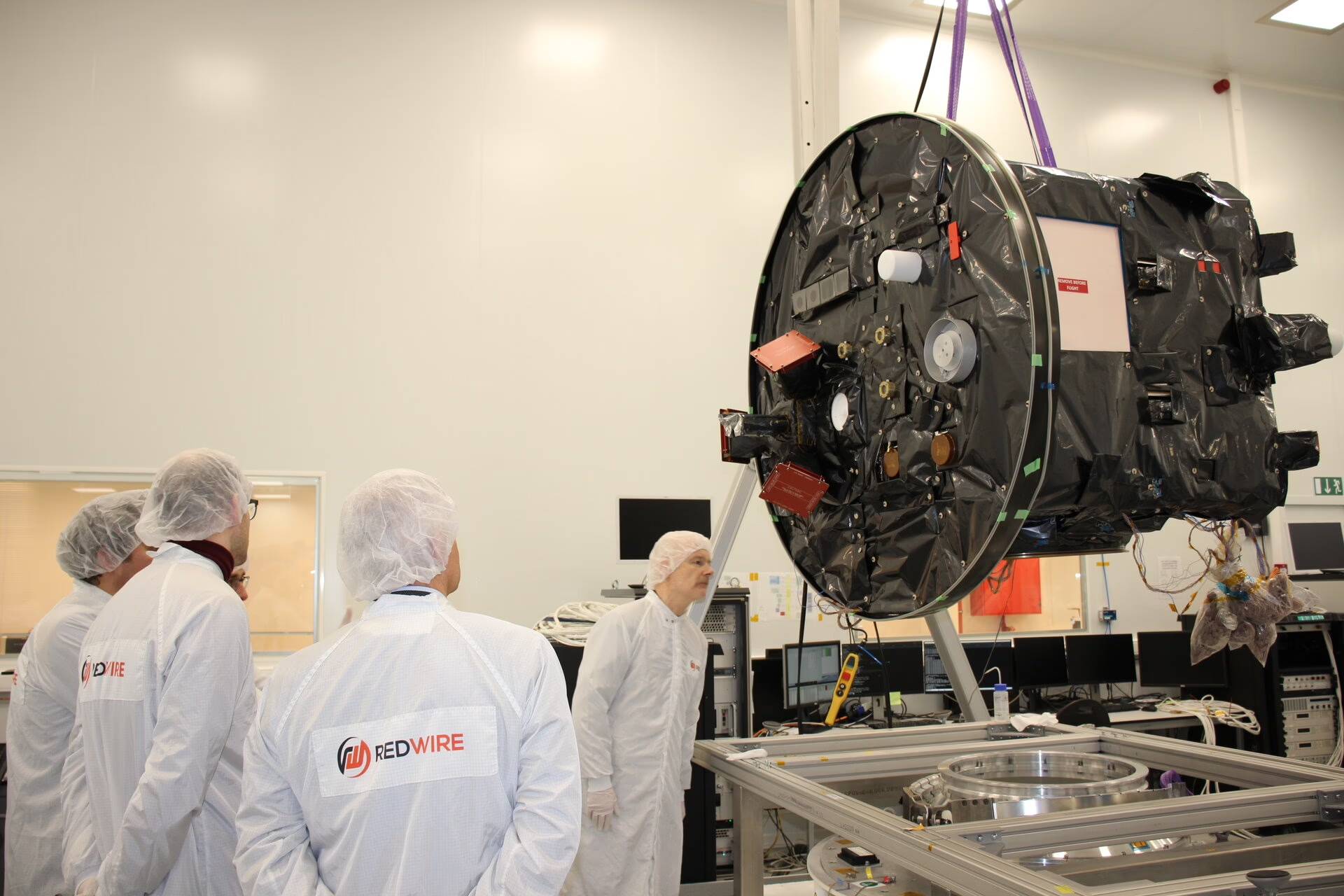
Proba-3, short for Project for On-Board Autonomy-3, is ESA’s third in a series of missions focused on testing cutting-edge technologies in space. Unlike its predecessors, which emphasized onboard autonomy and Earth observation, Proba-3 takes things to a new level with precision formation flying. The mission consists of two spacecraft: the Occulter and the Coronagraph. Together, they form what ESA calls a “virtual giant satellite,” capable of performing tasks that a single craft couldn’t achieve alone.
The primary goal? To study the Sun’s corona—the outermost layer of its atmosphere that’s usually only visible during rare total solar eclipses on Earth. By flying in tight formation, the Occulter blocks the Sun’s blinding disk, allowing the Coronagraph to capture detailed images of the corona without the interference of the Sun’s intense light. This setup enables prolonged observations, far beyond the brief minutes of a ground-based eclipse.
Launched on December 5, 2024, from India’s Satish Dhawan Space Centre aboard a PSLV-XL rocket, the pair reached orbit and began their dance. The spacecraft are positioned about 150 meters apart, maintaining alignment with millimeter precision— a feat that required advanced sensors, lasers, and autonomous software. This isn’t just about pretty pictures; understanding the corona helps scientists predict solar flares and coronal mass ejections, which can disrupt satellites, power grids, and communications on Earth.
Proba-3’s design is ingenious. The Occulter, weighing around 340 kilograms, acts as a shadow-caster with a disk that precisely eclipses the Sun for the trailing Coronagraph, which is about 200 kilograms and equipped with the ASPIICS (Association of Spacecraft for Polarimetric and Imaging Investigation of the Corona of the Sun) instrument. Their orbit is highly elliptical, allowing for six-hour observation windows at apogee, where gravitational perturbations are minimal. At perigee, they break formation to conserve fuel and realign later.
This mission isn’t solely scientific; it’s a tech demo. ESA hopes the formation-flying tech will pave the way for future projects, like swarms of satellites for interferometry or even space telescopes larger than anything we could launch in one piece.
Milestones and Discoveries Before the Setback
Before the recent troubles, Proba-3 was a resounding success. Just weeks after launch, the spacecraft separated safely and began commissioning. By March 2025, they achieved their first autonomous formation flight, aligning with incredible accuracy. A month later, in April 2025, they created their inaugural artificial eclipse, capturing stunning images of the solar corona.
Over the following months, the mission racked up impressive data. By December 2025, Proba-3 had simulated over 50 eclipses, amassing 250 hours of observation time—equivalent to thousands of Earth-based eclipse expeditions. Scientists marveled at time-lapse sequences showing solar prominences erupting from the corona, offering insights into solar activity during a peak in the Sun’s 11-year cycle.
One highlight came in September 2025, when ASPIICS recorded three prominence eruptions in just five hours, revealing dynamic plasma flows in unprecedented detail. These observations have already contributed to models of space weather, helping forecast events that could affect astronauts or infrastructure. Joe Zender, Proba-3’s project scientist, noted that the mission filled a critical gap in solar monitoring, providing data no other observatory could match.
The tech side shone too. Proba-3 demonstrated autonomous decision-making in off-nominal situations, breaking and reforming without ground intervention. This autonomy is key for deep-space missions where communication delays make real-time control impossible.
The Anomaly: What Went Wrong?
Everything changed over the weekend of February 14-15, 2026. An unexplained anomaly struck the Coronagraph spacecraft, triggering a cascade of failures. It began with a loss of attitude control—the spacecraft’s orientation in space. Without proper alignment, its solar panels couldn’t face the Sun, leading to a rapid battery drain.
Normally, such an event would activate safe mode, where the craft shuts down non-essential systems and orients itself to recharge. But here, the anomaly prevented that, escalating the problem. By the time ground teams noticed, contact was lost entirely. The spacecraft went “dark,” ceasing all transmissions.
ESA Proba-3 mission faces uncertainty-ESA announced the issue on March 6, 2026, stating that the root cause remains under investigation. Speculation points to possibilities like a software glitch, hardware failure, or even a micrometeorite impact, though nothing is confirmed. The Occulter spacecraft, meanwhile, remains healthy and operational.
This isn’t the first hiccup for space missions—remember NASA’s Voyager probes battling glitches decades into their journeys? But for Proba-3, the timing is cruel. The mission was in its prime, with years of potential data ahead.
ESA Proba-3 mission faces uncertainty: Recovery Efforts and Challenges
ESA Proba-3 mission faces uncertainty Mission teams at ESA’s European Space Operations Centre (ESOC) in Darmstadt, Germany, and the Redu ground station in Belgium are working around the clock. They’re analyzing telemetry from before the blackout to pinpoint the fault. One innovative idea: using the Occulter to approach and visually inspect the Coronagraph, assessing its orientation and possibly aiding in re-establishing contact.
However, challenges abound. The spacecraft are in a high orbit, making interventions tricky. Fuel limits for maneuvers, radiation exposure, and the need for precise calculations add complexity. If the battery is fully depleted, recovery might be impossible, as the craft could enter a permanent “survival mode” with minimal functions.
ESA remains optimistic, emphasizing that the teams are “working hard to recover the situation.” But doubts linger. If unsuccessful, the mission could end prematurely, losing out on extended observations during the solar maximum.
Broader Implications for Space Exploration
The Proba-3 anomaly underscores the risks of spaceflight. Formation flying, while promising, demands flawless reliability. A failure here could delay similar tech in upcoming missions, like ESA’s LISA (Laser Interferometer Space Antenna) for gravitational wave detection or NASA’s potential satellite constellations.
On the science front, losing Proba-3 would create a void in corona studies. Ground-based eclipses are infrequent, and other space instruments like SOHO or Parker Solar Probe have limitations. Proba-3’s unique capability for extended, high-resolution views is unmatched.
Yet, even in jeopardy, the mission has proven its worth. The data collected so far advances our knowledge of solar physics, and the tech validated could inspire resilient designs. Space exploration thrives on such trials; failures teach as much as successes.
Looking Ahead: Hope Amid Uncertainty
As of March 2026, Proba-3’s fate hangs in the balance. Will the Coronagraph “phone home,” or will this be a bittersweet chapter in ESA’s history? Only time—and tireless engineering—will tell. For now, the mission reminds us of space’s unforgiving nature and humanity’s relentless pursuit of knowledge.
ESA Proba-3 mission faces uncertainty: If Proba-3 recovers, it could resume operations, perhaps with safeguards against similar anomalies. If not, its legacy endures: pioneering formation flying and peering into the Sun’s hidden layers. Stay tuned; the stars have more stories to tell.
FAQs: ESA Proba-3 Mission Faces Uncertainty
What is the Proba-3 mission designed to do?
Proba-3 is an ESA mission using two spacecraft in formation to create artificial solar eclipses, allowing detailed study of the Sun’s corona for extended periods.
When did the anomaly occur on Proba-3?
The anomaly hit the Coronagraph spacecraft over the weekend of February 14-15, 2026, leading to loss of contact.
Is the entire Proba-3 mission lost?
Not necessarily. The Occulter is still operational, and teams are investigating recovery options, including using the healthy craft to assist.
Why is studying the solar corona important?
The corona is key to understanding solar activity, which affects space weather and can impact Earth’s technology and astronauts.
Has Proba-3 achieved any successes before this?
Yes, it created over 50 artificial eclipses, captured rare solar eruptions, and demonstrated millimeter-precision formation flying.
What could cause such an anomaly in space?
Possible causes include software errors, hardware malfunctions, or external factors like radiation or debris, though the exact reason is still under review.
How does formation flying work in Proba-3?
The two spacecraft maintain a fixed distance and alignment using lasers, GPS-like systems, and autonomous controls to function as one large instrument.