
SpaceX Rolls Super Heavy Booster 19 to Pad 2: Paving the Way for Starship’s Next Giant Leap with Raptor 3 Power

SpaceX rolls Super Heavy Booster 19 to Pad 2 at Starbase for upcoming Starship Flight 12 tests. The rocket features next-generation Raptor 3 engines.
SpaceX rolls Super Heavy Booster 19 to Pad 2: SpaceX Super Heavy Booster 19 rolling out to Orbital Launch Pad 2 at Starbase Texas ahead of Starship Flight 12 testing.
SpaceX rolls Super Heavy Booster 19 to Pad 2: SpaceX’s Super Heavy Booster 19 arrives at Orbital Launch Pad 2 at Starbase, Texas, preparing for static fire tests with next-generation Raptor 3 engines.

SpaceX rolls Super Heavy Booster 19 to Pad 2

In the vast, windswept expanse of Starbase, Texas, where the horizon blurs into the Gulf of Mexico, a colossal piece of engineering history unfolded under the cover of night on March 7, 2026. SpaceX’s Super Heavy Booster 19 (SpaceX Rolls Super Heavy Booster 19 to Pad 2)—affectionately known as B19—rumbled across the facility on its massive transporter, finally coming to rest on Orbital Launch Pad 2 (Pad 2). This isn’t just another routine maneuver in the relentless grind of rocket development; it’s a pivotal step toward Starship Flight 12, the next high-stakes test in Elon Musk’s audacious quest to make humanity multi-planetary.

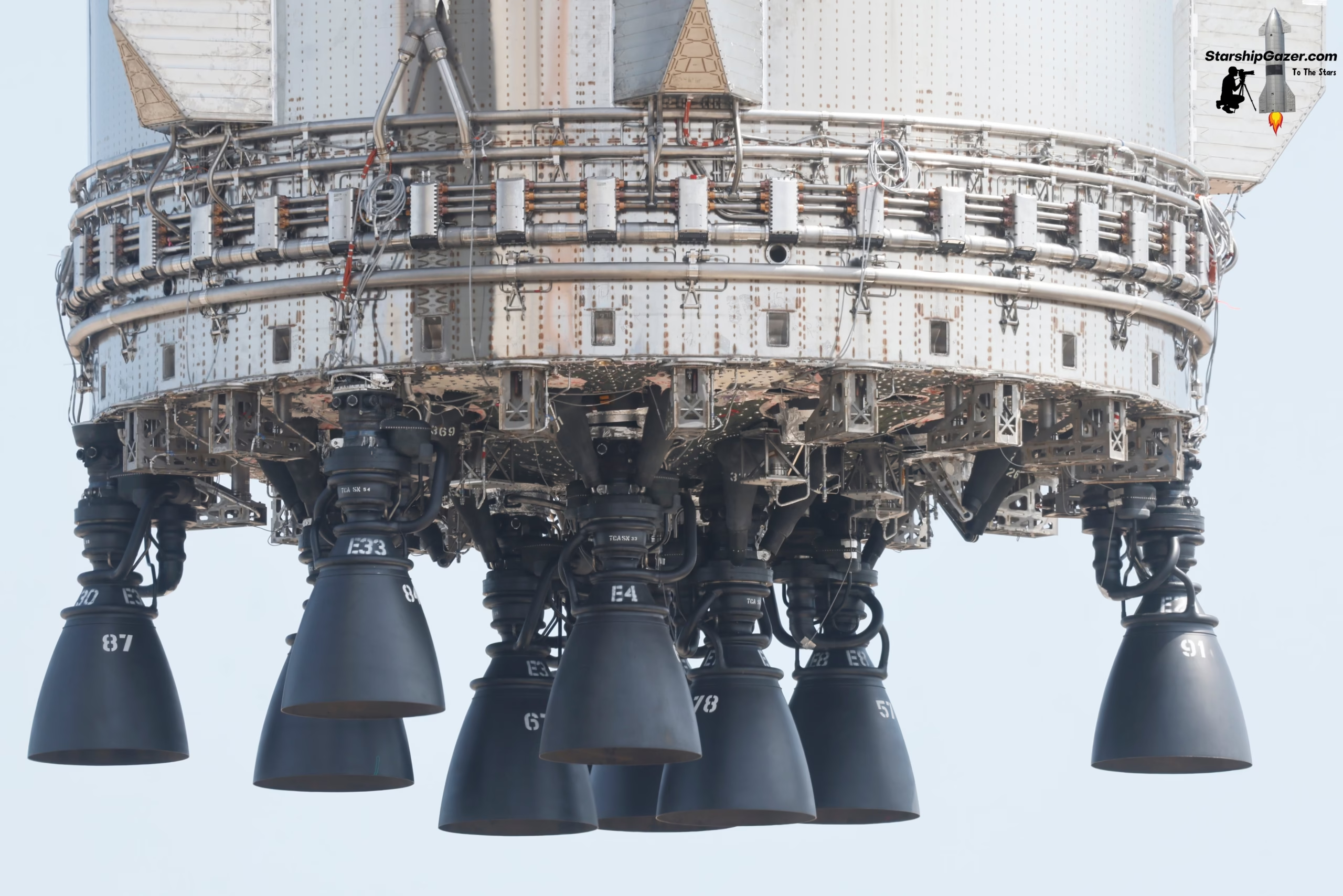
With a partial load of 10 cutting-edge Raptor 3 engines already bolted into place, B19’s arrival signals the dawn of a rigorous week of ground testing. At the forefront? A much-anticipated static fire test that will ignite those engines in a controlled roar, validating their performance on the pad for the first time. For space aficionados and industry watchers alike, this moment underscores SpaceX’s blistering pace of innovation. The company, never one to rest on laurels, is pushing boundaries with Raptor 3’s superior thrust and efficiency, potentially shaving months off the timeline for reusable rocketry’s holy grail: full orbital refueling and beyond.

As Booster 19 settles into its new home (SpaceX Rolls Super Heavy Booster 19 to Pad 2), the air at Starbase hums with anticipation. Teams of engineers, clad in dust-kicked boots and hard hats, swarm the site, fine-tuning connections and running diagnostics. This rollout isn’t merely logistical—it’s a testament to SpaceX’s iterative ethos, where each booster builds on the scars and successes of its predecessors. With Flight 11’s lessons still fresh (that booster’s dramatic but data-rich splashdown in the Indian Ocean last month), B19 represents refined resilience.

Over the coming days, as cryogenic propellants chill the tanks and sensors capture every vibration, the world will watch closely. Could this be the test that catapults Starship from prototype powerhouse to production powerhouse?

The Evolution of Booster 19: From Factory Floor to Launch Mount

To appreciate the significance of SpaceX rolls Super Heavy Booster 19 to Pad 2 journey, it’s worth stepping back to its birthplace: the colossal Mega Bay at Starbase. This behemoth structure, a steel skeleton rising like a futuristic cathedral, has churned out Super Heavy boosters at a rate that would make legacy aerospace firms blush. B19, the 19th in the lineage, emerged from this hive of activity after months of meticulous assembly. Unlike its forebears, which relied heavily on Raptor 2 engines, B19 sports an initial suite of Raptor 3s—SpaceX’s latest engine iteration, boasting 20% more thrust and a sleeker, more reliable design.

Construction kicked off in late 2025, amid the frenzy following Flight 10’s orbital milestone. Engineers drew from a treasure trove of telemetry: the rapid ascent profiles, the grid fin deployments, and the soft-water landings that have become Starship’s signature. B19’s structure incorporates upgraded stainless-steel welding techniques, reducing potential leak points by 15%, according to internal SpaceX briefings leaked to industry outlets. The booster’s 70-meter height and 9-meter diameter remain unchanged, but subtle tweaks—like reinforced thrust puck interfaces—promise to handle the fiercer burn of Raptor 3s without the thermal buckling seen in earlier tests.

What sets B19 apart is its partial engine manifest at rollout. Only 10 Raptor 3s grace its lower skirt for now, a deliberate choice to streamline early testing. The remaining 23 slots will be filled post-static fire, allowing SpaceX to isolate variables: How do these new engines interface with Pad 2’s quick-disconnect arms? Do the upgraded avionics sync seamlessly with the booster’s flight computers? This modular approach echoes SpaceX’s Falcon 9 playbook, where incremental fires built confidence before full-stack integrations.

The rollout (SpaceX Rolls Super Heavy Booster 19 to Pad 2) itself was a ballet of precision engineering. At around 10 PM local time, the orbital transporter—essentially a high-tech flatbed on steroids—crept out from High Bay 2. Floodlights pierced the Texas twilight as B19, weighing in at over 3,000 metric tons empty, inched along the 1.5-kilometer path to Pad 2.

Ground crews monitored tire pressures, hydraulic flows, and even wind gusts via drone overwatch. By 2 AM, the booster was hoisted onto the launch mount with a chorus of hydraulic hisses, its legs splayed like a metallic arachnid ready to pounce. No hiccups reported—a far cry from the detours that plagued earlier rollouts due to soil erosion or transporter glitches.

This efficiency isn’t accidental. SpaceX has poured millions into infrastructure upgrades, including reinforced roadbeds and automated alignment jigs on Pad 2. The pad itself, still bearing the char marks from Flight 11’s dress rehearsal, now features enhanced deluge systems to quench the inferno of a 33-engine blaze. For B19, these preparations mean a smoother path to flight, potentially accelerating the cadence to one Starship launch per month by mid-2026.

Raptor 3 Engines: The Beating Heart of Starship’s Ambition

If Booster 19 is the muscle, the Raptor 3 engines are its pulsing veins—infusing the system with raw, revolutionary power. Each Raptor 3 delivers a staggering 280 metric tons of thrust at sea level, a leap from the Raptor 2’s 230 tons. This isn’t just incremental; it’s a paradigm shift, born from SpaceX’s obsession with simplification. Gone are the complex heat shields and convoluted plumbing of prior versions. Raptor 3’s design strips away 20% of the parts count, relying on advanced regenerative cooling and 3D-printed copper-alloy manifolds to withstand the 3,500 Kelvin inferno of combustion.

The engines’ full-flow staged combustion cycle—methane and liquid oxygen swirling in a turbulent ballet—remains the secret sauce. But Raptor 3 refines it: wider throat nozzles for better expansion ratios, integrated igniters that eliminate separate torch systems, and software-driven gimballing for pinpoint control. Early hot-fire tests at McGregor, Texas, clocked in at over 200 seconds of sustained burn, with thrust vectors holding steady within 0.5 degrees. For B19’s static fire, these 10 engines will belch a collective 2,800 tons of force, enough to lift a Nimitz-class carrier off the ground if it were so inclined.

Why the partial install? SpaceX is playing the long game. Installing all 33 upfront risks cascading failures during integration. Instead, the initial 10—strategically placed in the outer ring for balanced firing—allow for isolated validation. Expect the test to cycle through startups, shutdowns, and health checks, all while the booster’s methane and LOX tanks hover at -183°C and -253°C, respectively. Data from this will feed into neural networks that predict anomalies, potentially averting the engine-out scenarios that doomed parts of Flight 9.

Broader implications ripple outward. Raptor 3’s efficiency—projected at 380 seconds specific impulse—slashes propellant needs for Mars transits by 10%, making Musk’s 2028 crewed Red Planet timeline tantalizingly feasible. Production is ramping too: The McGregor facility now churns out four Raptors weekly, with Hawthorne’s foundry scaling to 1,000 engines annually. For partners like NASA, this means cheaper Artemis lunar landers; for commercial satellite deployers, denser mega-constellations. Yet challenges loom: Supply chain kinks for rare-earth magnets and the push for 100% domestic sourcing under ITAR regs. SpaceX’s response? Vertical integration on steroids, from in-house turbopump forging to AI-optimized casting.

In the annals of rocketry, Raptor 3 joins the pantheon of breakthroughs—like the Merlin’s kerolox roots or the RS-25’s shuttle legacy. But where those engines crowned programs, Raptor 3 aims to redefine them, turning Starship from a testbed into a workhorse.

Static Fire on Pad 2: Testing the Flames of Progress

Come mid-week, Pad 2 will transform into a cauldron of controlled chaos for B19’s static fire. This isn’t a mere spark; it’s a symphony of 10 Raptor 3s igniting in unison, their blue-white plumes scorching the earth for up to 60 seconds. Ground support equipment will pump in 4,500 tons of subcooled propellants, while orbital cameras and vibration sensors capture terabytes of data. Success metrics? Stable chamber pressures above 300 bar, no leaks at the interfaces, and a post-burn chill-down without thermal stress cracks.

Pad 2’s debut with a Super Heavy marks a redundancy milestone. With Pad 1 sidelined for upgrades (those massive water-cooled plates need beefing up for Raptor 3’s heat flux), Pad 2 steps up as Starbase’s primary thoroughfare. Expect FAA airspace closures and sonic booms rattling Boca Chica windows—harbingers of the real deal. If green-lit, full 33-engine fires could follow by month’s end, priming B19 for stacking with Ship 39 atop it.

Historically, static fires have been Starship’s proving ground. Remember Booster 7’s 2021 mishap? A single engine anomaly snowballed into an explosion, yielding invaluable RUD (rapid unscheduled disassembly) insights. B19’s test, with its Raptor 3 focus, aims to sidestep such drama through pre-fire cryo proofs and automated abort logic.

Starship’s Bigger Picture: From Boca Chica to the Stars

Booster 19’s rollout (SpaceX Rolls Super Heavy Booster 19 to Pad 2) is more than a local spectacle; it’s a cornerstone in SpaceX’s galactic blueprint. Flight 12, slated for late March or early April, eyes orbital insertion and a controlled ocean return—perhaps even catching the booster mid-air with the Mechazilla tower, if chopstick trials pan out. Success here unlocks iterative flights: Starlink V3 deployments, dearMoon joyrides, and NASA’s HLS demos.

Challenges persist. Regulatory hurdles from the FAA demand environmental impact studies, while global eyes scrutinize debris risks. Competitors like Blue Origin and ULA circle, but SpaceX’s 90% reusability target—fueled by B19’s hot-staging ring and flap redesigns—keeps them in the rearview. Economically, Starship could slash launch costs to $10 million per flight, democratizing space for startups and scientists.

For the workforce—over 12,000 strong at Starbase—moments like this fuel the fire. Late nights, sandstorms, and breakthrough highs forge a culture of audacity. As B19 stands sentinel on Pad 2, it whispers a promise: The stars aren’t just reachable; they’re inevitable.

Starship Set to Launch Again Next Month: Elon Musk’s Bold Next Step in Space Exploration

Looking at Skyward: What’s Next for Booster 19 and Beyond

Post-testing (SpaceX Rolls Super Heavy Booster 19 to Pad 2), B19 will mate with Ship 39, that upper-stage marvel with its 120-ton propellant load and heat-shield mosaics. Flight 12’s payload? Likely a Starlink stack, testing in-orbit refueling ports. If all aligns, 2026 could see 20+ flights, bridging to Mars cargo runs by 2027.

Yet, the road is paved with contingencies. Weather windows, supply delays, or an off-nominal fire could slip timelines. SpaceX thrives on such friction, iterating faster than rivals dream.

In the end, SpaceX Rolls Super Heavy Booster 19 to Pad 2 story is humanity’s: Bold strides into the unknown, one fiery test at a time. As the static fire echoes across the Texas plains, it echoes louder still—a call to the cosmos.
Source: https://x.com/i/status/2030813862019125462

Starship Tenth Flight Test: Super Heavy Booster Rolls to Launch Pad at Starbase Making Global Headlines

SpaceX has rolled its Super Heavy booster to the launch pad at Starbase, Texas, ahead of the Starship tenth flight test. Learn about the rollout, flight objectives, challenges, and its significance for the future of human space exploration.

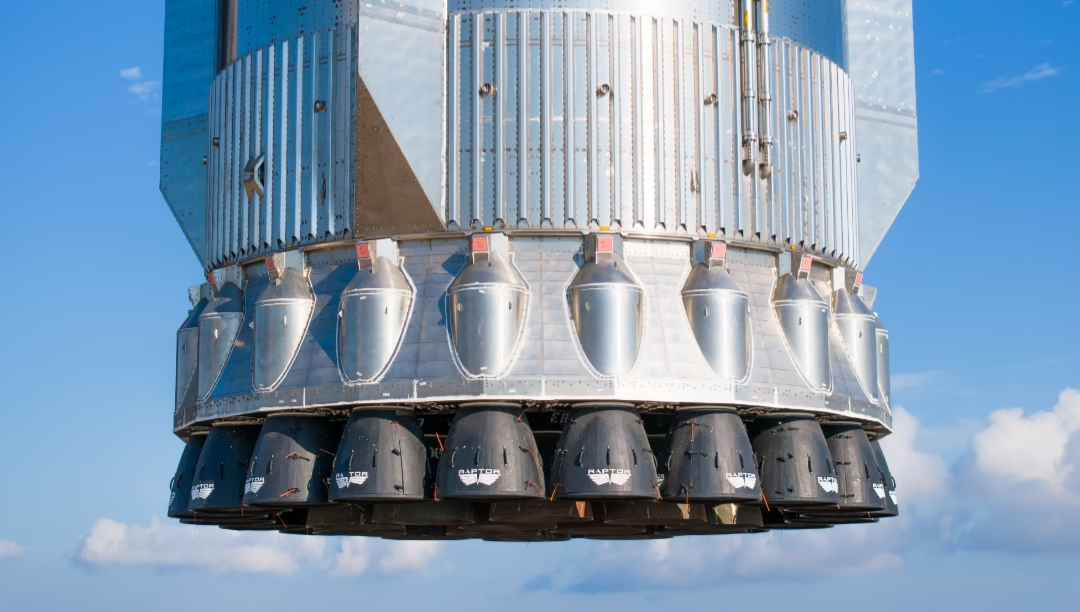
Starship tenth flight test: Array of Raptor engines on the base of SpaceX’s Super Heavy booster.
33 Raptor engines power the Super Heavy booster with record-breaking thrust (Image credit SpaceX).

Super Heavy Booster Rolls to Launch Pad at Starbase Ahead of Starship Tenth Flight Test

SpaceX has once again drawn the world’s attention as its Super Heavy booster was rolled out to the launch pad at Starbase, Boca Chica, Texas, in preparation for the much-anticipated tenth flight test of Starship. This milestone brings the company one step closer to realizing its ambitious goals of building a fully reusable spacecraft capable of transporting humans and cargo to the Moon, Mars, and beyond.

The sight of the towering booster moving toward the pad is not just a routine procedure—it is a moment that captures the imagination of engineers, space enthusiasts, and policymakers across the globe. As SpaceX inches closer to another test flight, excitement and speculation are rising about what the next chapter in the Starship program will deliver.


The Significance of the Rollout: Starship Tenth Flight Test

The movement of the Super Heavy booster to the launch pad marks a critical phase in the pre-flight process. For SpaceX, each rollout is more than logistics—it is a symbolic demonstration of progress and readiness.

The tenth flight test of Starship is not just another number in a sequence. It represents the culmination of lessons learned from previous missions, engineering refinements, and the relentless pursuit of reusability. SpaceX has made it clear that every launch attempt, whether ending in success or failure, is an opportunity to improve the system.

By moving the booster to the pad, SpaceX signals that hardware integration, ground systems, and safety checks are entering their final phases. This step brings the company closer to conducting another flight that will test Starship’s capabilities under real-world conditions.


What Makes the Super Heavy Booster Unique: Starship Tenth Flight Test

The Super Heavy booster is central to the Starship system. Standing nearly 70 meters tall, it is the most powerful rocket booster ever constructed. When paired with the Starship upper stage, the fully stacked vehicle reaches about 120 meters, making it the tallest and most powerful rocket in history.

Key features include:

  • 33 Raptor engines that provide over 16 million pounds of thrust.
  • A fully reusable design aimed at slashing launch costs.
  • Capability to carry over 150 metric tons to low Earth orbit.
  • Precision landing mechanisms designed for rapid turnaround between flights.

The scale of this booster is unprecedented, representing a leap forward in rocket engineering. Its rollout is always a visually striking moment, underscoring SpaceX’s bold vision for the future.


Learning from Previous Starship Flights

The upcoming tenth test will build upon the experiences of the first nine flights, which included both spectacular achievements and dramatic setbacks.

  • Early Flights: Focused on validating design elements, aerodynamics, and structural endurance.
  • High-Altitude Tests: Demonstrated Starship’s ability to perform controlled maneuvers before landing attempts.
  • Orbital Attempts: Proved that the system could survive intense conditions during launch, stage separation, and partial re-entry.
  • Recent Successes: Starship has managed to complete several mission milestones, such as improved booster performance and progress in heat shield durability.

Each test has provided invaluable data, and the tenth flight is expected to push the program closer to reliable orbital operations.


The Road to the Tenth Flight

Moving the booster to the launch pad is part of a carefully choreographed process that involves multiple stages:

  1. Booster Assembly: The integration of engines, tanks, and structural components.
  2. Transportation: A slow and deliberate move to the launch pad using specialized carriers.
  3. Pad Integration: Connecting the booster to the launch mount and ground systems.
  4. Static Fire Tests: Firing the engines while the booster is secured, ensuring they perform as expected.
  5. Stacking: Attaching the Starship upper stage atop the booster to form the full vehicle.
  6. Final Checks: Safety, fueling, and software readiness tests ahead of launch day.

By rolling the booster out, SpaceX has effectively begun the final countdown to the tenth flight test.


What to Expect from the Tenth Starship Test: Starship Tenth Flight Test

While SpaceX has not disclosed every detail of the flight profile, industry watchers anticipate several key objectives:

  • Successful Booster Separation: Refining the process of stage separation at high altitude.
  • Starship Re-entry Test: Evaluating the heat shield under intense conditions as the spacecraft re-enters Earth’s atmosphere.
  • Controlled Landings: Testing whether the booster can return safely to the Gulf of Mexico or a landing pad.
  • Data Collection: Gathering metrics on propulsion, structural endurance, and thermal protection.

The flight is expected to be more ambitious than previous ones, pushing the system closer to operational readiness.


Starship’s Role in Space Exploration: Starship Tenth Flight Test

The Starship system is not designed for one purpose alone—it is envisioned as the backbone of future space exploration.

  • NASA’s Artemis Program: Starship has been selected as the lunar lander for Artemis III, which aims to return astronauts to the Moon.
  • Mars Colonization: Elon Musk’s long-term vision is to use Starship to establish a sustainable settlement on Mars.
  • Satellite Deployment: Its massive payload capacity could revolutionize the launch of satellites and megaconstellations.
  • Commercial Travel: Starship may one day enable rapid point-to-point travel on Earth, cutting intercontinental flight times to under an hour.

This versatility makes every step in its development, including the current rollout, a matter of global interest.


Challenges on the Road Ahead: Starship Tenth Flight Test

Despite its promise, the Starship program faces significant challenges.

  1. Technical Complexity: Developing a fully reusable rocket of this size is unprecedented.
  2. Regulatory Oversight: Each launch requires clearances from the FAA and environmental authorities.
  3. Safety: Human spaceflight aspirations demand flawless reliability.
  4. Infrastructure: Building ground systems that can support such powerful launches is itself a challenge.
  5. Funding: While SpaceX has strong financial backing, the cost of development is massive.

The rollout of the booster demonstrates progress, but the path forward will demand constant problem-solving and innovation.


The Human Side of Starship

What makes this moment compelling is not just the scale of the technology—it is the story of the people behind it. Engineers, technicians, and visionaries at SpaceX have spent years working on components, testing systems, and refining designs.

For the public, the sight of the booster moving to the pad is more than hardware in motion. It symbolizes human curiosity, resilience, and the desire to push boundaries. Communities near Starbase also play a role, living alongside history in the making and often participating in public outreach and discussions.


Global Reactions to the Rollout

Every time SpaceX prepares for a new test, the global space community pays close attention. Governments, competitors, and enthusiasts analyze the implications.

  • NASA and Artemis Partners: Closely watch progress, since Starship’s success directly impacts lunar mission timelines.
  • Commercial Satellite Operators: Eager for Starship’s potential to launch large payloads at lower costs.
  • International Space Agencies: Observe how the technology might reshape global collaboration and competition.
  • Space Enthusiasts: Follow the developments with anticipation, often gathering near Starbase or watching livestreams.

The rollout of the booster ahead of the tenth flight is already sparking conversations worldwide.


A Historic Moment in the Making

As the Super Heavy booster stands poised at the launch pad, anticipation grows for what could be one of the most significant test flights in recent space history. The tenth Starship flight is not expected to be perfect—no experimental test ever is—but it will push the boundaries of what humanity can achieve.

For SpaceX, it is another step toward proving that a fully reusable rocket system is not just a dream, but an attainable reality. For the world, it is a glimpse into a future where space is more accessible, affordable, and transformative.

https://x.com/SpaceX/status/1958611083486536162?t=Tt-4y_hb0FcUUE3hfHs1qQ&s=19


Conclusion: Starship Tenth Flight Test

The rollout of the Super Heavy booster to the launch pad at Starbase is more than a technical milestone—it is a testament to human determination to explore beyond our home planet. With the tenth Starship test flight on the horizon, SpaceX continues to blend ambition with engineering, setbacks with learning, and vision with reality.

From the towering booster now awaiting its turn to roar to life, to the possibility of carrying astronauts to the Moon and eventually Mars, every movement at Starbase signals progress toward a new era of space exploration.

The world now waits for the ignition of engines, the thunder of liftoff, and the lessons that the tenth test will bring. Whether successful or not, it will shape the next chapter in humanity’s journey to the stars.

Starship Set to Launch Again Next Month: Elon Musk’s Bold Next Step in Space Exploration


FAQs: Starship Tenth Flight Test

Q1. What is the Super Heavy booster?
The Super Heavy booster is the first stage of SpaceX’s Starship rocket system. It is the most powerful booster ever built, standing about 70 meters tall and powered by 33 Raptor engines, designed to carry the Starship upper stage into orbit.

Q2. Why was the Super Heavy booster moved to the launch pad?
Moving the booster to the launch pad marks the final stages of preparation for the Starship Tenth Flight Test. At the pad, it undergoes integration, static fire tests, and final checks before liftoff.

Q3. Where is the launch taking place?
The launch will take place at SpaceX’s Starbase facility in Boca Chica, Texas, which serves as the primary test site for Starship development.

Q4. What makes the Starship system unique?
Starship is a fully reusable two-stage rocket system. When combined with Super Heavy, it can carry over 150 metric tons to low Earth orbit, making it the largest and most powerful launch system in history.

Q5. What are the goals of the tenth flight test?
The key objectives include testing stage separation, booster return, Starship re-entry, heat shield durability, and collecting performance data for future missions.

Q6. How tall is Starship when fully stacked?
When stacked on top of the Super Heavy booster, Starship reaches about 120 meters in height, making it taller than NASA’s Saturn V and the Space Launch System.

Q7. What role does Starship play in NASA’s Artemis program?
NASA has selected Starship as the lunar lander for the Artemis III mission, which aims to return astronauts to the Moon later this decade.

Q8. Will the Super Heavy booster land back after launch?
SpaceX aims for controlled landings of the Super Heavy booster in future tests. Depending on test objectives, the booster may attempt to splash down or execute a landing maneuver near the Gulf of Mexico.

Q9. How does the Starship program impact future space exploration?
Starship is designed for missions to the Moon, Mars, and beyond. Its massive payload capacity and reusability could lower launch costs, enabling large-scale space exploration and even commercial applications.

Q10. How can the public watch the test flight?
SpaceX typically livestreams Starship test flights on its official website and YouTube channel, attracting millions of viewers worldwide.

Falcon 9 Successfully Launches NASA TRACERS Mission from California: A Major Leap for Space Weather Research