
Discover SpaceX Starship V4’s Ambitious Thrust Goal: 300 tons per engine, totaling 10,000 tons of thrust – 3x Saturn V’s power. Explore what this means for space travel, Mars missions, and beyond.
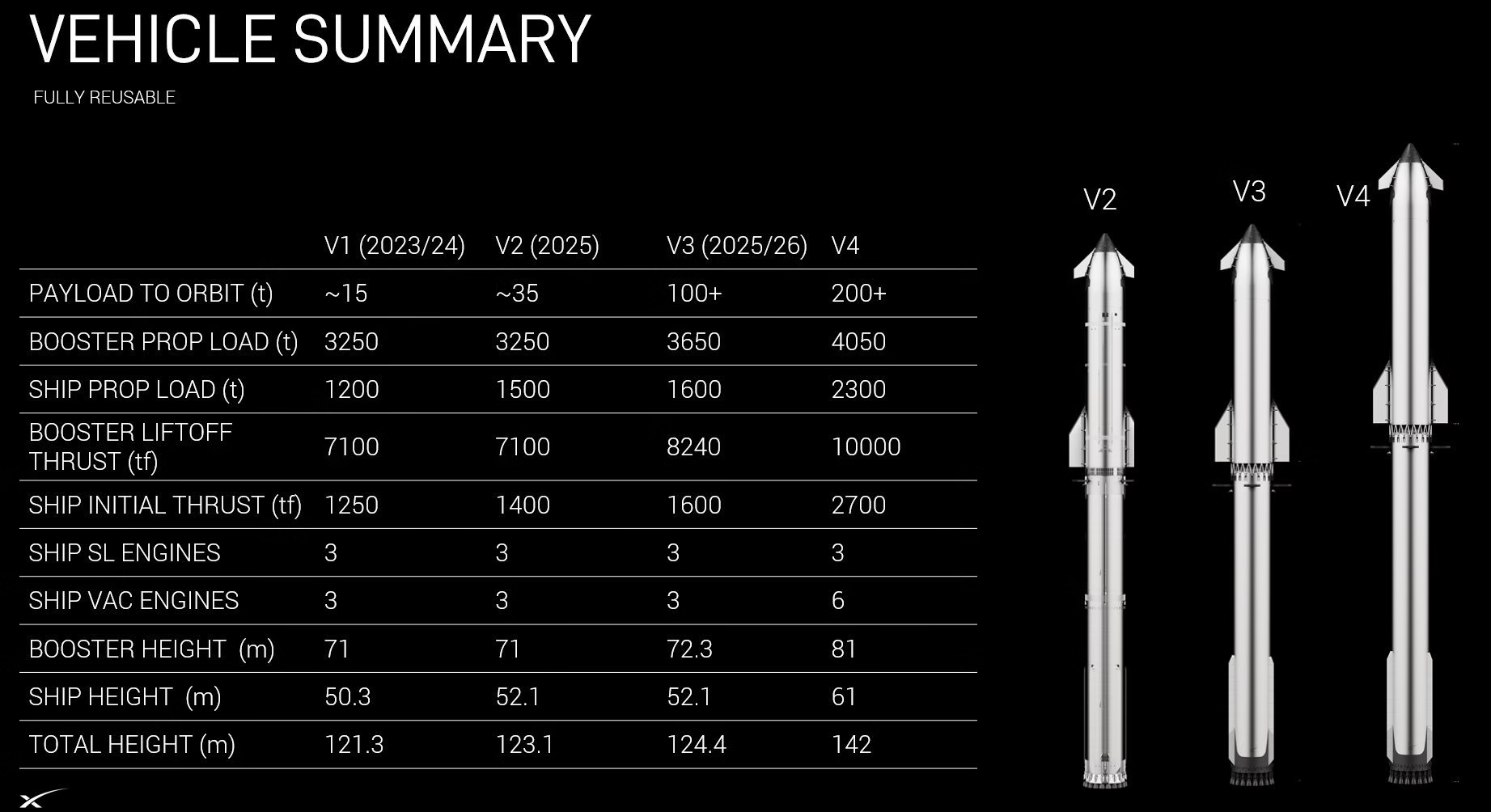
Hey there, space enthusiasts! Imagine a rocket so powerful it makes the legendary Saturn V look like a firecracker. That’s exactly what SpaceX Starship V4’s Ambitious Thrust Goal is gunning for with their Starship V4. The stretch goal? A whopping 300 tons of thrust from each engine, multiplied by 33 engines, equaling a mind-blowing 10,000 tons of total thrust.
Yeah, you read that right – that’s three times the muscle of the Saturn V, the beast that put humans on the Moon back in the Apollo days. If you’re like me, your inner sci-fi fan is already buzzing with excitement. In this article, we’re diving deep into what this means for the future of space exploration, why it’s a game-changer, and how it stacks up against history’s heavy hitters. Buckle up – we’re about to launch into the details.
SpaceX Starship V4’s Ambitious Thrust Goal Evolution: From Concept to Colossal Powerhouse
Let’s rewind a bit. SpaceX’s Starship isn’t just another rocket; it’s the cornerstone of Elon Musk’s vision for making humanity multi-planetary. First unveiled in 2018, Starship has gone through several iterations, each pushing the boundaries of what’s possible in reusable rocketry. The V1 and V2 versions focused on basic flight tests, proving the concept of a fully reusable super-heavy lift vehicle. V3 ramped things up with improved materials and engine configurations, but V4? That’s where things get really ambitious.
The key here is the Raptor engine – SpaceX’s homegrown marvel. Early Raptors delivered around 230 tons of thrust, which was already impressive. But for V4, they’re aiming for 300 tons per engine. Multiply that by 33 engines on the Super Heavy booster, and boom: 10,000 tons of thrust at liftoff. To put that in perspective, that’s enough power to hurl massive payloads into orbit, or even straight to Mars, with fuel to spare.
What makes this stretch goal so intriguing isn’t just the numbers; it’s the engineering wizardry behind it. SpaceX has been tweaking the Raptor’s design, incorporating advanced materials like high-strength alloys and improved turbopumps to handle higher pressures and temperatures. These upgrades aren’t just about raw power – they’re about efficiency, reliability, and cost. Reusability is the name of the game, and hitting 300 tons per engine means fewer engines needed for the same job, or more capability with the same setup. It’s like upgrading your car’s engine from a V6 to a turbocharged V8, but on a cosmic scale.
As someone who’s followed SpaceX since the Falcon 1 days, I can’t help but feel a thrill. Remember the early failures? Those grasshopper tests that looked like something out of a cartoon? Now, we’re talking about a rocket that could redefine space travel. But how does this compare to the icons of the past?
Starship V4 vs. Saturn V: A Thrust Showdown for the Ages
Ah, the Saturn V – the undisputed king of the Apollo era. Standing at 363 feet tall, it generated about 3,400 tons of thrust from its five F-1 engines. That was enough to send three astronauts to the Moon, along with all their gear, and bring them back safely. It was a engineering triumph of the 1960s, built with slide rules and sheer determination during the height of the Space Race.
Fast forward to today, and SpaceX Starship V4’s Ambitious Thrust Goal of 10,000 tons is triple that. Triple! That’s not just incremental improvement; it’s a quantum leap. The Saturn V could loft about 140 tons to low Earth orbit (LEO). Starship, even in its current form, aims for 100-150 tons, but with V4’s upgrades, we’re looking at potentially 250 tons or more to LEO in expendable mode, and still over 100 tons reusable. Factor in the thrust increases, and the possibilities explode.
Why does thrust matter so much? Thrust is what fights gravity, propels the rocket through the atmosphere, and sets the stage for orbital insertion. More thrust means quicker acceleration, which reduces gravity losses and allows for heavier payloads. For Starship, this translates to carrying more fuel for in-orbit refueling – a critical step for deep-space missions. Imagine refueling depots in orbit, turning Starship into a space ferry for Mars colonists.
But it’s not all about brute force. The Saturn V was a one-and-done deal; each launch cost billions in today’s dollars and required building a new rocket every time. Starship? Fully reusable, with rapid turnaround times. SpaceX envisions launching multiple times a day, driving costs down to as low as $10 per kilogram to orbit. Compare that to Saturn V’s estimated $1,000+ per kg, and you see why this is revolutionary.
I remember watching grainy footage of Apollo 11’s launch as a kid, feeling that raw power through the screen. Now, picturing SpaceX Starship V4’s Ambitious Thrust Goal roaring to life with three times that energy? It’s enough to give you goosebumps. But what does this mean practically?
The Implications: Mars, Moon, and Beyond the Stars
Reaching 10,000 tons of thrust isn’t just a bragging right; it’s a ticket to the solar system. First up: NASA’s Artemis program. Starship is slated to be the Human Landing System for returning astronauts to the Moon. With enhanced thrust, it could carry more crew, more science gear, or even set up semi-permanent bases. Think lunar habitats, resource extraction for water and fuel – turning the Moon into a stepping stone.
Then there’s Mars. Musk’s ultimate goal is a self-sustaining city on the Red Planet. Current Starship designs call for fleets of ships, refueled in orbit, to transport hundreds of tons of cargo and people. Upping the thrust to 300 tons per engine means each ship can carry more, reducing the number of launches needed. Efficiency skyrockets, timelines shorten. We could see the first uncrewed Mars missions in the late 2020s, with humans following in the 2030s.
Beyond that? Starship V4’s power opens doors to outer planets. Probes to Europa or Enceladus could be larger, more capable. Even crewed missions to asteroids for mining aren’t out of the question. And let’s not forget commercial space: satellite constellations, space tourism, orbital manufacturing. With this thrust level, SpaceX could dominate the market, making space accessible to more than just governments.
Of course, challenges remain. Reliability is key – those 33 engines have to fire in perfect sync. We’ve seen hiccups in early tests, like engine failures during ascent. But SpaceX’s iterative approach means they learn fast. Each flight test refines the design, inching closer to that 300-ton goal.
As an everyday space fan, this stuff keeps me up at night in the best way. What if we could vacation on the Moon? Or mine asteroids for rare metals? Starship V4’s thrust ambitions are the fuel for those dreams.
Technical Deep Dive: How They Plan to Achieve 300 Tons Per Engine
Alright, let’s geek out a bit. The Raptor engine uses full-flow staged combustion, burning methane and liquid oxygen for efficiency. To hit 300 tons, SpaceX is optimizing the combustion chamber pressure, nozzle design, and propellant flow. Higher chamber pressure means more thrust, but it demands beefier materials to withstand the heat – we’re talking temperatures over 3,000 Kelvin.
The Super Heavy booster’s 33-engine setup is a cluster of power. Engine-out capability ensures that even if one or two fail, the mission continues. That’s a huge advantage over Saturn V’s five engines, where a single failure could doom the launch.
Payload capacity scales with thrust. The Tsiolkovsky rocket equation tells us delta-v (change in velocity) depends on exhaust velocity and mass ratio. More thrust allows for better mass ratios, meaning more payload or farther destinations. In numbers: Saturn V’s first stage burned for about 2.5 minutes; Starship’s could do it in under 3, but with way more oomph.
Safety is paramount too. With great power comes great responsibility – higher thrust means more intense vibrations and stresses. SpaceX is using advanced simulations and real-world tests to mitigate risks.
If you’re into the nitty-gritty, check out SpaceX’s updates; they’re transparent about progress. It’s inspiring to see engineering evolve in real time.
The Broader Impact: Economy, Environment, and Ethics
This thrust milestone isn’t isolated. Economically, cheaper launches spur innovation. Startups could afford to send experiments to space, accelerating tech like biotech or materials science.
Environmentally, methane fuel is cleaner than kerosene, and reusability cuts waste. But mega-launches raise concerns about atmospheric impact – more research needed there.
Ethically, who gets to go to space? SpaceX aims for inclusivity, but we must ensure benefits trickle down to all humanity, not just the elite.
In the end, SpaceX Starship V4’s Ambitious Thrust Goal embodies human ambition. It’s about pushing limits, just like the Saturn V did.
Source: https://x.com/i/status/2014749076672184631
FAQs: SpaceX Starship V4’s Ambitious Thrust Goal
What is the SpaceX Starship V4’s Ambitious Thrust Goal?
The stretch goal is 300 tons of thrust per Raptor engine, with 33 engines on the Super Heavy booster, totaling 10,000 tons – three times the Saturn V’s 3,400 tons.
How does Starship compare to Saturn V in size and capability?
Starship is taller at about 400 feet and fully reusable, unlike the expendable Saturn V. It aims for 100+ tons to LEO reusable, versus Saturn V’s 140 tons expendable.
When might we see Starship V4 in action?
Flight tests could ramp up in the mid-2020s, with full capabilities by the end of the decade, depending on iterative successes.
What are the risks with such high thrust?
Engine synchronization, structural integrity, and safety during ascent are key challenges, but SpaceX’s rapid prototyping mitigates them.
How will this affect Mars colonization?
Higher thrust enables more efficient refueling and larger payloads, potentially accelerating timelines for crewed Mars missions to the 2030s.
Is Starship V4’s thrust the highest ever?
Yes, it would surpass all previous rockets, including the Soviet N1’s attempted 4,500 tons (which failed).
There you have it – a deep dive into SpaceX Starship V4’s Ambitious Thrust Goal and 10,000 tons powerhouse potential. What do you think? Will we hit that 10,000-ton mark? Drop your thoughts in the comments; I’d love to chat more about this stellar future.