
Dive into the heart-pounding details of Blue Origin’s NS-38 Replay Mission – from jaw-dropping apogee heights to precise launch timelines. Discover how this suborbital triumph is revolutionizing space tourism and what it means for the future of human spaceflight.
Have you ever dreamed of touching the edge of space? That weightless moment where Earth looks like a fragile blue marble against the black void? Well, Blue Origin just made that dream a little more real with their latest New Shepard mission, NS-38. Launched today from their West Texas facility, this flight wasn’t just another routine test – it was a testament to human ingenuity, pushing the boundaries of what’s possible in suborbital travel. If you’re like me, someone who’s always glued to space news, you’ll want to stick around as I break down everything from the nail-biting stats to what this means for you and me down here on the ground.
I’m not some distant expert spouting facts from a textbook; think of me as your enthusiastic friend who’s obsessed with rockets and stars. I’ve followed Blue Origin since Jeff Bezos first unveiled New Shepard, and missions like NS-38 remind me why space exploration gets my heart racing every time. Let’s dive in, shall we? We’ll cover the mission’s highlights, the tech behind it, and even peek into the future. By the end, you’ll feel like you were right there in mission control.
What is Blue Origin’s New Shepard Program? A Quick Refresher
Before we get into the nitty-gritty of NS-38, let’s set the stage for those who might be new to this. Blue Origin, founded by Amazon mogul Jeff Bezos in 2000, isn’t just about sending packages to your door – it’s about sending people to space. Their New Shepard rocket, named after Alan Shepard (the first American in space), is designed for suborbital flights. That means it goes up high enough to give you a taste of space – crossing the Kármán line at about 100 km altitude – but comes back down without orbiting Earth.
Unlike NASA’s massive Saturn V or SpaceX’s Falcon 9, New Shepard is a reusable, vertical-takeoff-and-landing vehicle. The booster and capsule separate mid-flight, with the capsule carrying passengers (or payloads) to the edge of space for a few minutes of zero gravity before parachuting back. The booster? It lands itself like a pro, using its engines to touch down softly. This reusability is key – it slashes costs and makes space more accessible.
Over the years, Blue Origin has racked up dozens of successful missions. From the first uncrewed tests in 2015 to crewed flights starting in 2021, they’ve carried celebrities, scientists, and everyday adventurers. NS-38 is the 38th in this series, building on a legacy of safety and innovation. What sets it apart? It’s not just about tourism; these flights often carry research payloads, testing everything from microgravity effects on plants to new materials for space habitats.
Imagine strapping in with a small crew, feeling the rumble as the engines ignite, and then – silence – as you float free. That’s the magic Blue Origin sells, and NS-38 delivered it flawlessly.
Blue Origin’s NS-38 Replay Mission Overview: From Liftoff to Touchdown
Today’s launch was picture-perfect, kicking off at exactly 10:25:35 AM CST (that’s 16:25:35 UTC for my international friends). The West Texas skies were clear, and the countdown went without a hitch. NS-38 followed the classic New Shepard profile: a quick ascent, separation, apogee, and controlled descent.
The Blue Origin’s NS-38 Replay Mission crew capsule, which can hold up to six passengers, rocketed upward, reaching an impressive apogee of 346,722 feet above ground level (AGL) or 350,369 feet mean sea level (MSL). In metric terms, that’s 106 km AGL and 107 km MSL – well above the internationally recognized boundary of space. The booster wasn’t far behind, hitting 346,327 feet AGL or 349,974 feet MSL (again, 106 km AGL and 107 km MSL).
What does apogee mean? It’s the highest point in the trajectory, where the vehicle is farthest from Earth. At that altitude, passengers experience about three to four minutes of weightlessness, staring out at the curvature of the planet and the thin blue atmosphere. It’s not just a thrill ride; it’s a profound perspective shift, as many astronauts describe it.
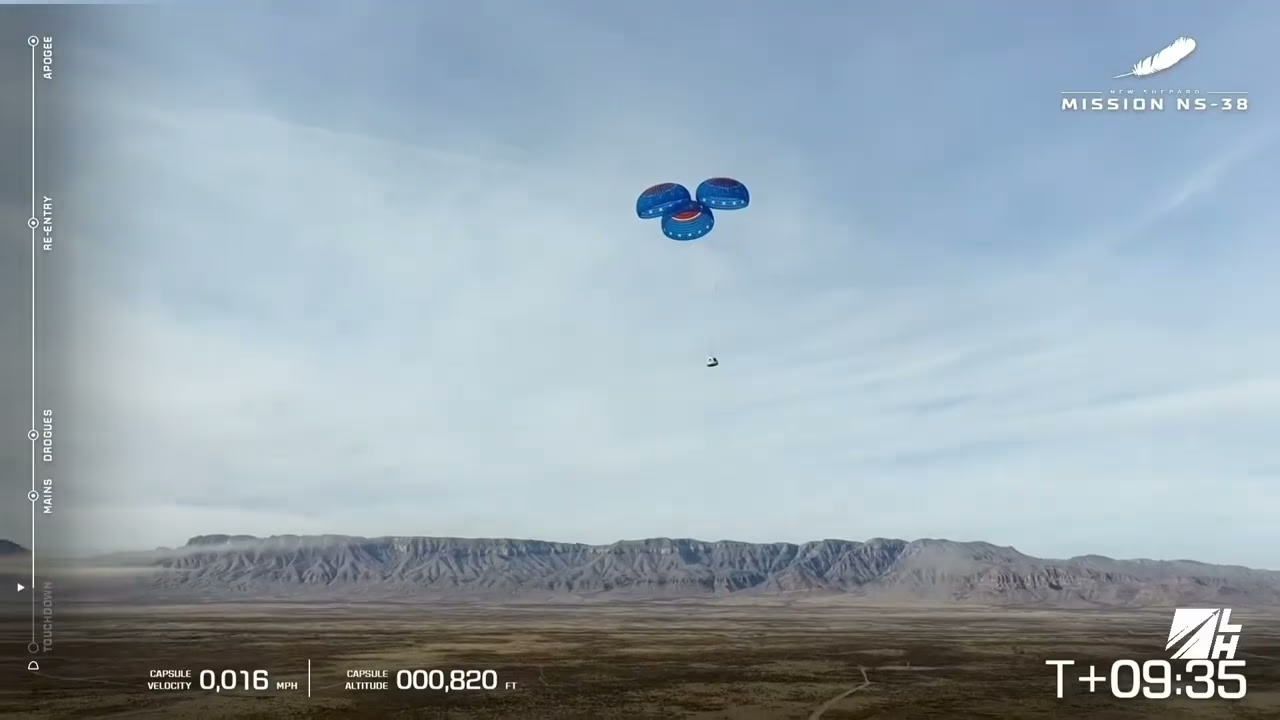
The entire Blue Origin’s NS-38 Replay Mission clocked in at just 10 minutes and 12 seconds – short but intense. The capsule touched down safely at 10:35:47 AM CST (16:35:47 UTC), likely with parachutes deploying in that signature Blue Origin style. No major anomalies reported, which is huge for a program emphasizing safety above all.
Who was on board? While specific crew details aren’t always publicized immediately, these missions often include a mix of paying customers, company employees, and sometimes even artists or educators through programs like “Postcards to Space.” If it was crewed, those folks just joined an elite club of suborbital spacefarers. If uncrewed, it might have been packed with scientific experiments – either way, it’s advancing the field.
Breaking Down the Key Stats: What Do These Numbers Really Mean?
Let’s geek out on the stats because they’re what make NS-38 stand out. First, the apogee heights: 346,722 feet for the capsule AGL. To put that in perspective, commercial airplanes cruise at around 35,000 feet. This is ten times higher! Converting to kilometers, 106 km AGL crosses the Kármán line, officially making anyone aboard an astronaut.
The slight difference between capsule and booster apogees is normal – the capsule gets a tiny extra boost after separation. MSL measurements account for the launch site’s elevation (West Texas is about 3,647 feet above sea level), so that’s why they’re a bit higher.
Launch time: 10:25:35 AM CST. Precision matters in rocketry; even seconds can affect trajectories due to Earth’s rotation. The landing at 10:35:47 AM CST gives us that 10-minute-12-second elapsed time – efficient, right? Compare this to early spaceflights like Mercury-Redstone, which were riskier and less reusable.
These numbers aren’t just bragging rights. They demonstrate New Shepard’s reliability. With over 30 prior missions, Blue Origin has a near-perfect success rate, minus a few uncrewed anomalies. NS-38 adds to that track record, proving the system can handle repeated flights without major overhauls.
From an engineering standpoint, the booster’s landing is a highlight. It uses a ring fin for stability and a single BE-3 engine for that pinpoint touchdown. Watching videos of these (though I won’t link any here), it’s like science fiction come to life.
The Bigger Picture: How NS-38 Advances Space Tourism and Beyond
Why should you care about Blue Origin’s NS-38 Replay Mission if you’re not booking a ticket? Because it’s part of a revolution. Space tourism is booming – Blue Origin, Virgin Galactic, and SpaceX are making what was once government-only accessible to civilians. Tickets aren’t cheap (think hundreds of thousands), but prices will drop as flights become routine.
This mission underscores Blue Origin’s motto: “Gradatim Ferociter” (Step by Step, Ferociously). Each flight gathers data for bigger goals, like their New Glenn orbital rocket or even lunar landers for NASA’s Artemis program. NS-38’s success boosts confidence in reusable tech, which could lower costs for satellite launches and scientific research.
Environmentally, New Shepard uses hydrogen-oxygen fuel, which burns clean (just water vapor). That’s a win over older kerosene-based rockets. And the payloads? They often include student experiments, fostering the next generation of STEM pros.
But let’s be real – challenges remain. Regulatory hurdles from the FAA, competition from rivals, and the inherent risks of spaceflight. Remember the NS-23 anomaly in 2022? Blue Origin paused crewed flights to investigate, showing their commitment to safety. NS-38’s smooth run is a rebound, proving they’ve learned and improved.
For the everyday dreamer, this means space is closer. Imagine honeymoons in orbit or research trips for scientists. Blue Origin’s NS-38 Replay Mission is a stepping stone, making those visions tangible.
Looking Ahead: What’s Next for Blue Origin and New Shepard?
With NS-38 in the books, eyes turn to NS-39 and beyond. Blue Origin aims for more frequent flights, potentially monthly. They’re expanding their Launch Site One in Texas and building facilities in Florida for New Glenn.
Jeff Bezos has big dreams: millions living and working in space. New Shepard is the appetizer; orbital and lunar missions are the main course. Partnerships with NASA (like the Blue Moon lander) position them as key players.
For space enthusiasts, watch for celebrity flights or record-breaking payloads. And if you’re thinking of going yourself? Start saving – or enter contests like their “Club for the Future.”
In a world facing climate woes and geopolitical tensions, space unites us. NS-38 reminds us of that shared human spirit to explore.
Wrapping It Up: Why Blue Origin’s NS-38 Replay Mission Matters to All of Us
There you have it – a deep dive into Blue Origin’s NS-38 Replay Mission. From the precise launch at 10:25:35 AM CST to the capsule’s safe landing 10 minutes later, it’s a story of triumph. Those apogee heights of over 106 km aren’t just numbers; they’re milestones in our journey to the stars.
If this got your pulse racing, share your thoughts – have you followed Blue Origin? Dreamed of space travel? Missions like this inspire, and that’s the real win. Stay tuned for more; space is just getting started.
Source: https://x.com/i/status/2014416929944174946
FAQs About Blue Origin’s NS-38 Replay Mission
What was the apogee height reached during NS-38?
The crew capsule hit 346,722 feet AGL (106 km) and 350,369 feet MSL (107 km). The booster reached 346,327 feet AGL (106 km) and 349,974 feet MSL (107 km).
When did the NS-38 mission launch and land?
Launch was at 10:25:35 AM CST (16:25:35 UTC), and the capsule landed at 10:35:47 AM CST (16:35:47 UTC). Total time: 10 minutes 12 seconds.
Was NS-38 a crewed mission?
Details on the crew aren’t specified in initial reports, but New Shepard missions often include passengers or payloads. It featured a crew capsule, suggesting possible human presence.
How does NS-38 compare to previous missions?
It aligns with New Shepard’s standard profile, achieving similar altitudes to prior flights while maintaining the program’s high success rate.
What makes New Shepard reusable?
The booster lands vertically using its engine, and the capsule uses parachutes. This design cuts costs and enables quick turnarounds.
Is space tourism safe with Blue Origin?
Blue Origin prioritizes safety, with extensive testing. While risks exist, their track record is strong, with only minor setbacks in uncrewed tests.
How can I follow future Blue Origin missions?
Check their official website, social media, or space news outlets for live streams and updates.