

A mysterious green fireball lit up Australia as Varda Space W-5 Mission capsule reentered Earth. Inside: a next-generation orbital factory changing the future of pharmaceuticals.

An Introduction: Varda Space W-5 Mission
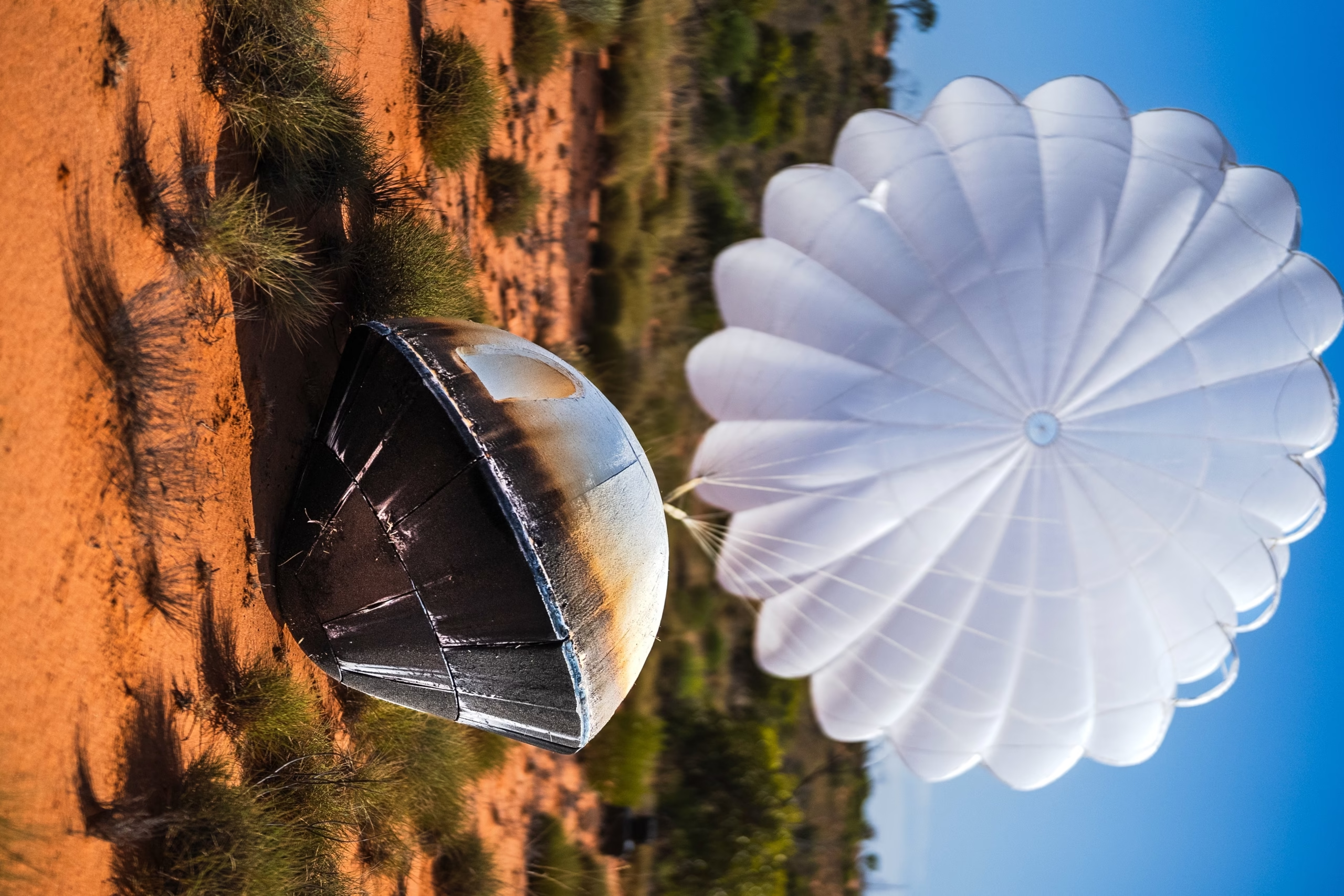
Imagine looking up at the night sky and witnessing a streak of green light blazing across the horizon, like a shooting star on steroids. That’s exactly what happened over Adelaide, Australia, on January 29, 2026, when Varda Space Industries’ W-5 capsule made its dramatic return to Earth. This wasn’t just any space junk falling from the heavens—it was a meticulously engineered satellite bus completing its mission, landing safely at the remote Koonibba Test Range. Operated by Southern Launch, this site has become a hotspot for cutting-edge space operations Down Under.
For space enthusiasts, tech geeks, and anyone fascinated by the future of manufacturing, this event is a game-changer. It marks the first reentry of Varda’s next-generation satellite bus, designed from the ground up for long-duration orbital tasks, particularly in pharmaceutical processing. Let’s dive into what this means, why it’s exciting, and how it’s paving the way for innovations that could revolutionize medicine and beyond.
As someone who’s followed the space industry for years, I can’t help but get pumped about stories like this. It’s not just about rockets and satellites anymore; it’s about bringing real-world benefits back to Earth. Varda’s achievement isn’t a one-off stunt—it’s part of a broader push to make space accessible for commercial purposes. In this article, we’ll break down the mission, the tech behind it, the partnerships involved, and what it all means for the future. Stick around, because by the end, you’ll see why this landing is more than a footnote in space history—it’s a launchpad for tomorrow’s breakthroughs.
Who Is Varda Space Industries and What Do They Do?
Varda Space Industries, based in El Segundo, California, is a trailblazer in the emerging field of in-space manufacturing. Founded with the vision of harnessing microgravity—the near-weightless environment of orbit—to produce materials and products that are impossible or inefficient to make on Earth. Think about it: gravity affects everything from crystal growth to fluid mixing. In space, pharmaceuticals can form purer crystals, leading to more effective drugs. Varda’s focus is on orbital pharmaceutical processing, but their tech extends to hypersonic reentry systems that ensure these space-made goodies get back safely.
The company has been ramping up operations since their first missions. Their W-series capsules are essentially mini-factories in space, equipped to handle extended stays in orbit while conducting experiments or production runs. The W-5 mission, in particular, showcases their evolution. Launched in November 2025 as part of a SpaceX rideshare, it spent about nine weeks in low Earth orbit before its controlled descent. This isn’t Varda’s first rodeo—they’ve had successful reentries with W-2 and W-3 in 2025, but W-5 introduces their next-gen satellite bus, optimized for both processing and reentry demands.
What sets Varda apart is their end-to-end control. They design, build, and operate everything in-house, from the spacecraft to the heat shields. This vertical integration allows for quicker iterations and more reliable missions. As Varda puts it, owning the whole system means they can “iterate faster, fly more often, and reliably bring complex manufacturing processes back to Earth.” It’s a smart strategy in an industry where delays and failures can cost millions.
The Varda Space W-5 Mission Breakdown: From Launch to Landing
Let’s get into the nitty-gritty of Varda Space W-5 Mission. This mission wasn’t just about testing hardware; it carried a real payload for the U.S. Navy, in collaboration with the Air Force Research Laboratory (AFRL). 0 The goal? To collect data during hypersonic reentry, which is crucial for advancing military and civilian tech. Hypersonic speeds—over Mach 5—are tough to simulate on the ground, so real flights like this provide invaluable insights.
The capsule was equipped with a heat shield made from C-PICA (Carbon-Phenolic Impregnated Carbon Ablator), a material originally developed at NASA’s Ames Research Center but produced in-house by Varda. This ablative shield protects the craft as it plunges through the atmosphere at blistering speeds, shedding heat by vaporizing layers of material. The reentry was autonomous, with the satellite bus handling orbital maneuvers and a precise deorbit burn to ensure it hit the target zone.
Touchdown happened at the Koonibba Test Range, a vast 15,830 square-mile area in South Australia, around 2:00 PM UTC on January 29. Witnesses described a “green fireball” streaking across the sky, visible from Adelaide to Coober Pedy. It wasn’t a meteor—it was W-5, decelerating under parachute after surviving atmospheric entry at Mach 25. Southern Launch’s team recovered it swiftly by helicopter, allowing for immediate analysis of the payload. This quick turnaround is a big deal for customers who need data fast to iterate on their designs.
The mission’s success highlights three key areas: end-to-end autonomy, high-fidelity recovery, and hypersonic science and technology (S&T). Autonomy means less human intervention, reducing costs and risks. Rapid recovery ensures payloads aren’t damaged or delayed. And the hypersonic data? That’s gold for understanding reentry chemistry, which ground tests can’t fully replicate.
Southern Launch: The Unsung Heroes of Down Under Space Ops
No discussion of Varda Space W-5 Mission would be complete without shouting out Southern Launch. This Australian company operates the Koonibba Test Range in partnership with the Koonibba Community Aboriginal Corporation. It’s not just a landing pad—it’s a full-fledged spaceport for suborbital launches and reentries. Located on the west coast of South Australia, the range’s isolation makes it ideal for high-risk operations like hypersonic reentries.
Varda and Southern Launch have built a strong partnership. Since W-2 in February 2025, they’ve handled multiple returns, proving the site’s capabilities. In September 2025, they inked a deal for up to 20 reentries through 2028, solidifying South Australia’s role in the global space economy. Lloyd Damp, Southern Launch’s CEO, called it a “vote of confidence” in their facilities. For Australia, this means jobs, tech transfer, and positioning as a leader in commercial space activities.
The collaboration is a prime example of “new space” companies teaming up. Varda handles the orbital side, while Southern Launch manages the ground ops. Together, they’re enabling routine reentries—something that was science fiction a decade ago.
Why Orbital Pharmaceutical Processing Matters
At its core, W-5 advances Varda’s mission in space pharma. Microgravity allows for better crystal formation in drugs, potentially leading to more stable, effective medications. For instance, proteins and crystals grow without sedimentation, resulting in higher purity. Varda’s capsules are built for long-duration processing, meaning they can run experiments or production for weeks or months.
While W-5 focused on Navy payloads and hypersonic testing, the satellite bus is tailored for pharma needs. Future missions could produce drugs for rare diseases or even vaccines. The reentry tech ensures these delicate products survive the trip home intact. It’s not hype—NASA and others have experimented with space manufacturing for years, but Varda is commercializing it at scale.
This could disrupt the pharma industry, reducing costs and speeding up development. Imagine treatments for cancer or Alzheimer’s refined in orbit. As space access gets cheaper, thanks to companies like SpaceX, orbital factories become viable. W-5’s success proves the hardware works, opening doors for more clients.
Future Implications and Upcoming Missions
Looking ahead, Varda has big plans. W-4 is already in orbit, set to land at Koonibba soon, with more W-series missions lined up. The 20-reentry agreement with Southern Launch ensures a steady cadence. This routine operation is key—space needs to be predictable for businesses to invest.
Broader impacts? Advances in hypersonic tech from missions like Varda Space W-5 Mission could improve missiles, aircraft, or even passenger travel. For Australia, it’s economic growth: more missions mean more jobs in STEM and infrastructure. Globally, it democratizes space, letting startups like Varda compete with giants.
But challenges remain: regulatory hurdles, environmental concerns, and scaling production. Varda’s in-house approach helps, but the industry must address space debris and sustainability.
The Spectacle of Reentry: What Witnesses Saw
Back to that green fireball. Reports flooded in from across South Australia—people described it as “absolutely beautiful” with green and rainbow hues. The capsule streaked over at hypersonic speeds before parachuting down. It landed in the designated zone, far from populated areas, ensuring safety.
This visibility reminds us space is tangible. It’s not abstract—it’s fireballs in the sky, tech landing in the outback. Events like this inspire the next generation of engineers and scientists.
In wrapping up, Varda Space W-5 Mission isn’t just a successful landing; it’s a milestone in making space work for us. From pharma breakthroughs to hypersonic insights, the ripple effects will be felt for years. If you’re as excited as I am, keep an eye on Varda and Southern Launch—they’re just getting started.
Reference: https://x.com/i/status/2017059849306255783
FAQs About Varda Space W-5 Mission and Reentry
- What is the Varda Space W-5 Mission?
The W-5 is Varda Space Industries’ satellite mission launched in November 2025, focusing on hypersonic reentry testing with a U.S. Navy payload. It successfully reentered on January 29, 2026. - Where did the W-5 capsule land?
It landed at the Koonibba Test Range in South Australia, operated by Southern Launch. - Why is this reentry significant?
It’s the first use of Varda’s next-gen satellite bus, designed for orbital pharmaceutical processing and reliable reentry, advancing in-space manufacturing. - What payload did W-5 carry?
It carried a payload for the U.S. Navy, in partnership with the Air Force Research Laboratory, to collect reentry data. - What was the green fireball seen over Adelaide?
It was the W-5 capsule reentering the atmosphere, creating a visible streak due to hypersonic speeds. - How does Varda’s tech benefit pharmaceuticals?
Microgravity in orbit allows for purer drug crystals, potentially leading to more effective medications. - What are Varda’s future plans?
They have an agreement for 20 reentries through 2028 at Koonibba, with W-4 and more missions upcoming. - Is the Koonibba Test Range safe for reentries?
Yes, its vast, isolated area minimizes risks, and operations are coordinated with local authorities. - How does this impact Australia?
It boosts the local space economy, creating jobs and positioning South Australia as a reentry hub. - Can anyone witness these reentries?
While visible from afar, like the green fireball, access to the range is restricted for safety. Follow updates from Varda or Southern Launch for details.